Artificial Intelligence in Hypertrophic Cardiomyopathy: Advances, Challenges, and Future Directions for Personalized Risk Prediction and Management
Moiud Mohyeldin, Feras O Mohamed, Marcos Molina, Muhanned Faisal Towfig, Ahmed M.G. Mustafa, Ahmed H Elhussein, Faris Alamin, Misbahuddin Khaja, Preeti Jadhav

TL;DR
This paper reviews how AI is improving risk prediction and management in hypertrophic cardiomyopathy, highlighting successes and challenges in clinical implementation.
Contribution
The paper provides a comprehensive review of validated AI applications in HCM, emphasizing novel predictive accuracy and implementation barriers.
Findings
Deep learning ECG analysis outperforms traditional risk scores in predicting sudden cardiac death (AUC: 0.87 vs. 0.62).
AI-enhanced genetic testing achieves 96% accuracy in reclassifying variants of uncertain significance.
Automated ECG screening tools and decision support systems show high accuracy in real-time clinical applications.
Abstract
Hypertrophic cardiomyopathy (HCM) is a complex genetic cardiovascular disease, with current risk stratification strategies showing limited accuracy in predicting sudden cardiac death and clinical outcomes. This review examines how artificial intelligence (AI) is transforming personalized risk prediction and management in HCM, with particular focus on validated clinical applications. We conducted a comprehensive literature search across PubMed, IEEE Xplore, Web of Science, and Scopus databases from January 2015 to January 2025. Search terms included "artificial intelligence", "machine learning", "deep learning", "hypertrophic cardiomyopathy", and "risk prediction". Inclusion criteria comprised peer-reviewed studies reporting AI applications in HCM with validated performance metrics. We excluded case reports, editorials, and studies without clinical validation. Of 487 identified…
Genes, proteins, chemicals, diseases, species, mutations and cell lines named across the full text — each resolved to its canonical identifier and authoritative record.
Click any figure to enlarge with its caption.
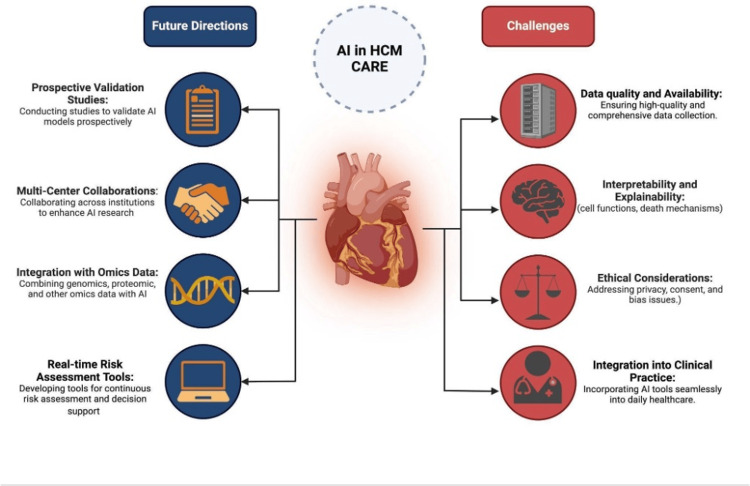 Figure 1
Peer Reviews
No public reviews on file for this paper yet. If you reviewed it on a platform where reviews are public (OpenReview, ICLR, NeurIPS, ICML), you can paste yours below so the community can read it here.
Videos
No videos yet. Explain this paper in a talk, walkthrough, or lecture? Add one.
Taxonomy
TopicsCardiomyopathy and Myosin Studies · Congenital Heart Disease Studies · Cardiovascular Function and Risk Factors