Influence of Plant-Based Substrate Composition and Extraction Method on Accumulation of Bioactive Compounds in Hericium erinaceus (Bull.) Pers. Fruiting Bodies
Katarzyna Kała, Małgorzata Cicha-Jeleń, Katarzyna Sułkowska-Ziaja, Beata Ostachowicz, Ewa Węgrzynowicz, Jan Lazur, Agnieszka Szewczyk, Bożena Muszyńska

TL;DR
This study shows how different plant substrates and extraction methods affect the levels of health-promoting compounds in Hericium erinaceus mushrooms.
Contribution
The study introduces an innovative approach to comparing waste-based substrates and extraction methods for maximizing bioactive compound accumulation in Hericium erinaceus.
Findings
Beech sawdust substrates produced higher levels of bioactive compounds compared to hemp straw.
Dual extraction with moderate ethanol concentrations was most effective for isolating key metabolites like ergothioneine and lovastatin.
Whole fruiting bodies retained higher levels of bioelements than extracts, despite enhanced antioxidant activity in extracts.
Abstract
The selection of plant-based substrates for mushroom cultivation is a key factor influencing their growth and metabolism. The aim of this study was to demonstrate, in an innovative approach, differences in the content of biologically active compounds, bioelements, and antioxidant properties of Hericium erinaceus (Bull.) Pers. cultivated on various plant-based substrates derived from waste materials, specifically hemp straw and beech sawdust. Another objective was to compare various extraction methods in terms of their impact on the concentration of these compounds. Elemental analysis was performed using the TXRF method, while bioactive constituents were determined using the DAD/UV RP-HPLC technique. The plant-based substrate and extraction method influenced the levels of obtained metabolites. Dual extraction with moderate ethanol concentrations was most effective for isolating key…
Genes, proteins, chemicals, diseases, species, mutations and cell lines named across the full text — each resolved to its canonical identifier and authoritative record.
Click any figure to enlarge with its caption.
 Figure 1
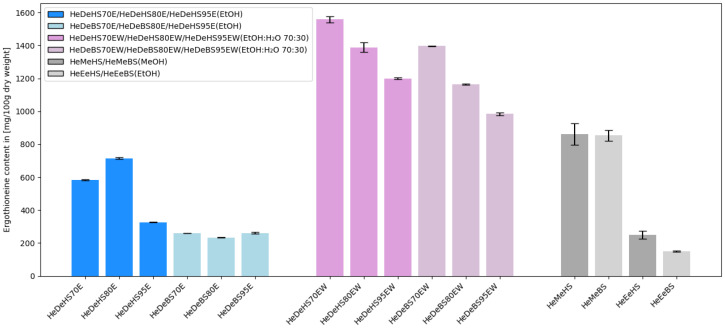 Figure 2
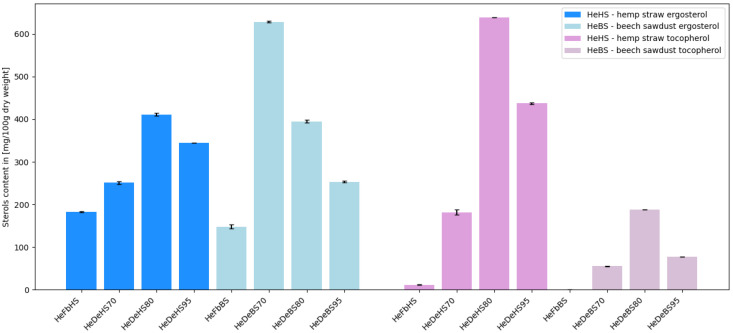 Figure 3
Peer Reviews
No public reviews on file for this paper yet. If you reviewed it on a platform where reviews are public (OpenReview, ICLR, NeurIPS, ICML), you can paste yours below so the community can read it here.
Videos
No videos yet. Explain this paper in a talk, walkthrough, or lecture? Add one.
Taxonomy
TopicsFungal Biology and Applications · Phytochemistry and Bioactivity Studies · Silymarin and Mushroom Poisoning