The Epidemiology of Urinary Tract Trauma: Results from the GRAND Study
Nikolaos Pyrgidis, Julian Marcon, Gerald Bastian Schulz, Patrick Keller, Yannic Volz, Lennert Eismann, Robert Bischoff, Paulo L. Pfitzinger, Michael Chaloupka, Christian Stief, Philipp Weinhold

TL;DR
This study analyzed urinary tract trauma in Germany from 2005 to 2023, showing increasing rates of ureteral, bladder, and urethral injuries and highlighting differences in patient demographics and treatment outcomes.
Contribution
The study provides the first nationwide epidemiological analysis of urinary tract trauma in Germany, revealing trends and clinical outcomes over an 18-year period.
Findings
Kidney trauma was the most common, affecting younger males with a 2.4% in-hospital mortality rate.
Ureteral, bladder, and urethral trauma increased over time and affected older, multimorbid patients with higher mortality and transfusion rates.
Surgical interventions like ureteral anastomosis and bladder repair were frequently required for these injuries.
Abstract
Background: Urinary tract trauma encompasses injuries to the kidneys, ureters, urinary bladder, and urethra and can result from both external and iatrogenic causes. We aimed to evaluate the epidemiology, clinical characteristics, and in-hospital outcomes of urinary tract trauma in Germany. Methods: We analyzed data from the GeRmAn Nationwide inpatient Data (GRAND) registry, provided by the Research Data Center of the Federal Bureau of Statistics, from 2005 to 2023. We included patients admitted to the hospital with kidney, ureteral, urinary bladder, or urethral trauma. We assessed baseline characteristics, perioperative outcomes, surgical interventions, in-hospital all-cause mortality, and trends. Results: We identified 239,657 patients with urinary tract trauma: 109,376 with kidney, 34,330 with ureteral, 57,886 with bladder, and 38,065 with urethral trauma. While the incidence of…
Genes, proteins, chemicals, diseases, species, mutations and cell lines named across the full text — each resolved to its canonical identifier and authoritative record.
Click any figure to enlarge with its caption.
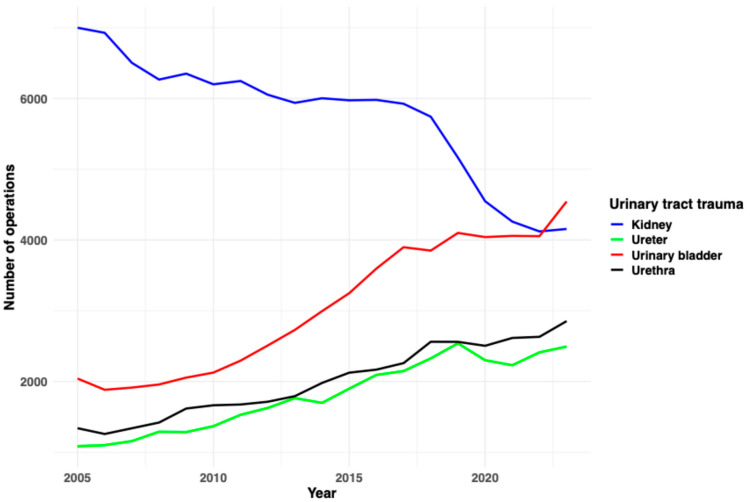 Figure 1
Peer Reviews
No public reviews on file for this paper yet. If you reviewed it on a platform where reviews are public (OpenReview, ICLR, NeurIPS, ICML), you can paste yours below so the community can read it here.
Videos
No videos yet. Explain this paper in a talk, walkthrough, or lecture? Add one.
Taxonomy
TopicsUrological Disorders and Treatments · Ureteral procedures and complications · Pediatric Urology and Nephrology Studies