Impact of Bilateral GPi Deep Brain Stimulation on Dystonia, Functional Outcomes, and Caregiver Burden in Patients with Dystonic Cerebral Palsy
Hatice Ömercikoğlu Özden, Nazlı Durmaz Çelik, Fatih Bayraklı, Serhat Özkan, Murat Vural, Özge Gönül Öner, Dilek İnce Günal

TL;DR
This study shows that deep brain stimulation of the GPi helps reduce dystonia severity and improves function and caregiver burden in adults with dystonic cerebral palsy.
Contribution
The study provides new evidence on the effectiveness of GPi DBS for adults with medically refractory dystonic cerebral palsy.
Findings
Bilateral GPi DBS significantly reduced dystonia severity as measured by BFMDRS scores.
Functional independence improved significantly as shown by increased FIM scores.
Caregiver burden decreased significantly with no surgical complications reported.
Abstract
Background: Dystonic cerebral palsy (DCP) is a complex, disabling manifestation of secondary dystonia, which significantly impacts motor function, quality of life, and well-being. Conventional pharmacologic therapies frequently do not relieve symptoms sufficiently. Deep brain stimulation (DBS) of the globus pallidus internal segment (GPi) has gained increasing attention as a neuromodulatory therapy for refractory dystonia. Still, the experience of the effect of GPi DBS treatment in adults with DCP has, until recently, been limited. Methods: We performed a retrospective, two-center case series of 11 adult patients with medically refractory DCP who underwent bilateral GPi-DBS. The clinical outcomes were evaluated based on the Burke–Fahn–Marsden Dystonia Rating Scale (BFMDRS), the Functional Independence Measure (FIM), the Gross Motor Function Classification System (GMFCS), and the…
Genes, proteins, chemicals, diseases, species, mutations and cell lines named across the full text — each resolved to its canonical identifier and authoritative record.
Click any figure to enlarge with its caption.
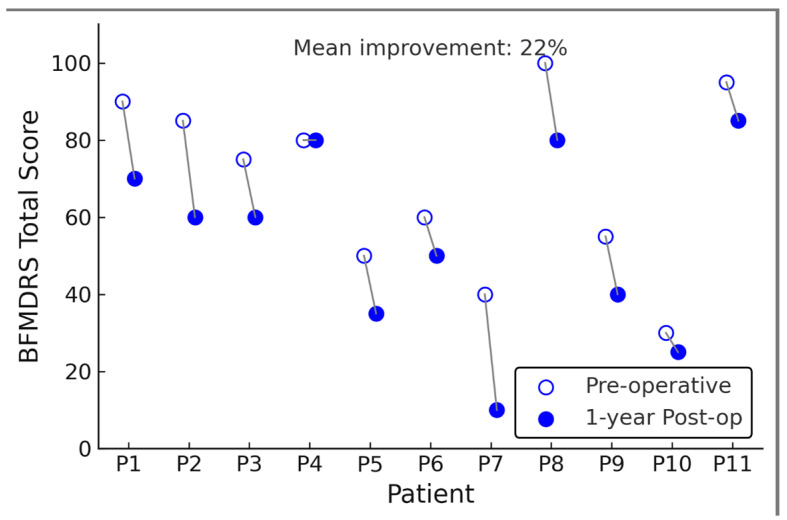 Figure 1
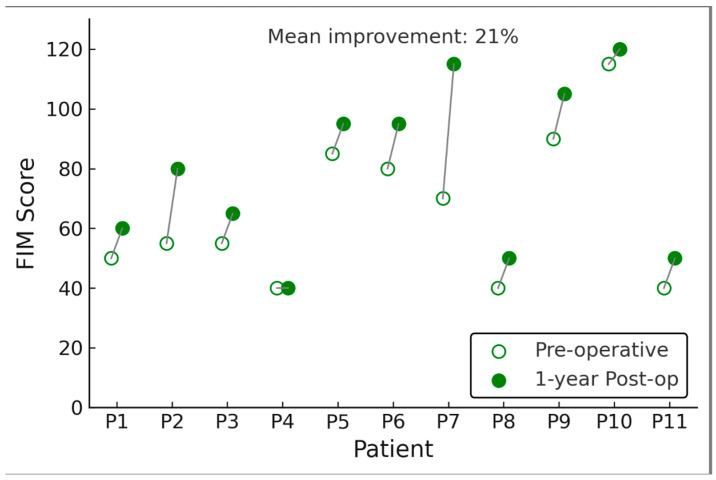 Figure 2
Peer Reviews
No public reviews on file for this paper yet. If you reviewed it on a platform where reviews are public (OpenReview, ICLR, NeurIPS, ICML), you can paste yours below so the community can read it here.
Videos
No videos yet. Explain this paper in a talk, walkthrough, or lecture? Add one.
Taxonomy
TopicsNeurological disorders and treatments · Botulinum Toxin and Related Neurological Disorders · Parkinson's Disease Mechanisms and Treatments