GnomAD Missense Variants of Uncertain Significance: Implications for p53 Stability and Phosphorylation
Fernando Daniel García-Ayala, María de la Luz Ayala-Madrigal, Jorge Peregrina-Sandoval, José Miguel Moreno-Ortiz, Anahí González-Mercado, Melva Gutiérrez-Angulo

TL;DR
This paper studies TP53 gene variants to understand how they affect p53 protein stability and phosphorylation, which are important in cancer.
Contribution
The study identifies specific TP53 missense variants that may disrupt p53 function through destabilization or altered phosphorylation.
Findings
Five TP53 variants disrupted known phosphorylation sites.
Twenty variants moderately destabilized the p53 protein structure.
Three variants were identified as potentially affecting p53 function and contributing to cancer.
Abstract
The TP53 gene, frequently mutated across multiple cancer types, plays a pivotal role in regulating the cell cycle and apoptosis through its protein, p53. Missense variants of uncertain significance (VUSs) in TP53 present challenges in understanding their impact on protein function and complicate clinical interpretation. This study aims to analyze the effects of missense VUSs in p53, as reported in the gnomAD database, with a specific focus on their impact on protein stability and phosphorylation. In this study, 33 missense VUSs in TP53 reported in the gnomAD database were analyzed using in silico tools, including PhosphositePlus v6.7.4, the Kinase Library v0.0.11, and Dynamut2. Of these analyzed variants, five disrupted known phosphorylation sites, while another five created new consensus sequences for phosphorylation. Moreover, 20 variants exhibited a moderate destabilizing effect on…
Genes, proteins, chemicals, diseases, species, mutations and cell lines named across the full text — each resolved to its canonical identifier and authoritative record.
Click any figure to enlarge with its caption.
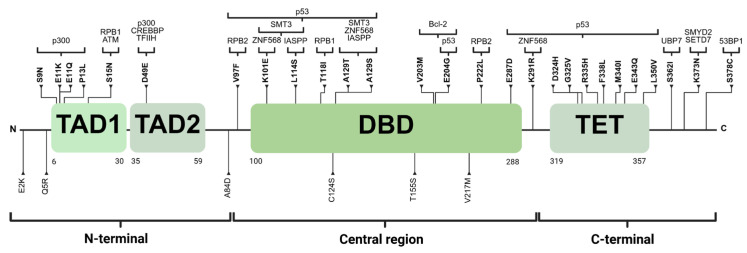 Figure 1
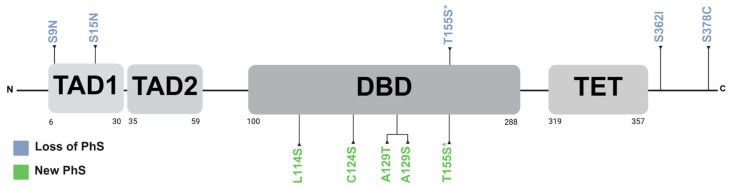 Figure 2
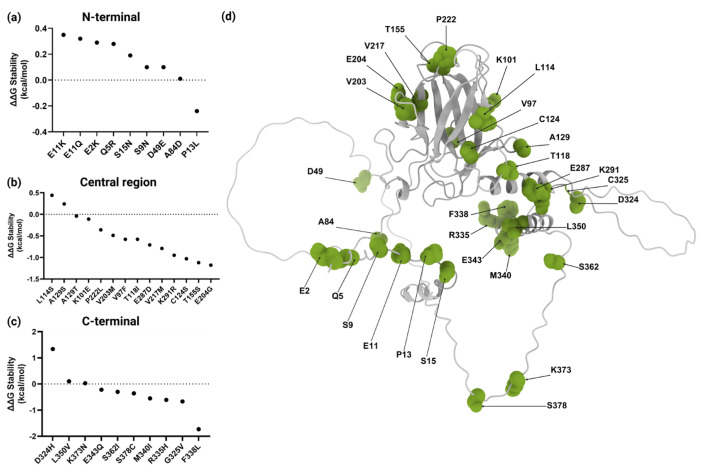 Figure 3
Peer Reviews
No public reviews on file for this paper yet. If you reviewed it on a platform where reviews are public (OpenReview, ICLR, NeurIPS, ICML), you can paste yours below so the community can read it here.
Videos
No videos yet. Explain this paper in a talk, walkthrough, or lecture? Add one.
Taxonomy
TopicsGenomics and Rare Diseases · Cancer Genomics and Diagnostics · Cancer-related Molecular Pathways