Fatty Acid Profile in the Liver of Mice with Early- and Late-Onset Forms of Huntington’s Disease
Magdalena Gregorczyk, Adriana Mika, Tomasz Śledziński, Marta Tomczyk, Iwona Rybakowska

TL;DR
This study compares liver fatty acid profiles in mice with early- and late-onset Huntington’s disease, finding more severe metabolic changes in early-onset models.
Contribution
The study reveals distinct hepatic fatty acid alterations in early-onset Huntington’s disease compared to late-onset forms.
Findings
R6/2 mice showed increased levels of iso-branched, monounsaturated, and n-6 polyunsaturated fatty acids compared to wild-type controls.
Hdh mice exhibited fewer and less pronounced fatty acid changes compared to R6/2 mice.
Early-onset HD is associated with more severe hepatic metabolic dysregulation than late-onset HD.
Abstract
Huntington’s disease (HD) is characterized by progressive neurodegeneration, but increasing evidence points to multisystemic involvement, including early hepatic steatosis in pediatric HD. Therefore, it is important to consider systemic alterations, particularly in liver lipid metabolism. In this study, we analyzed fatty acid (FA) profiles in two symptomatic HD mouse models: 2-month-old R6/2 mice representing early-onset HD and 22-month-old HdhQ150/Q150 (Hdh) mice representing late-onset HD, along with age-matched wild-type (WT) controls. FA composition in liver tissue was assessed by gas chromatography–mass spectrometry (GC–MS). In R6/2 mice, we observed increased levels of total iso-branched chain, monounsaturated, and n-6 polyunsaturated FAs compared to WT. In contrast, only a few FA species showed reduced concentrations in Hdh mice. Overall, our results indicate that R6/2 mice…
Genes, proteins, chemicals, diseases, species, mutations and cell lines named across the full text — each resolved to its canonical identifier and authoritative record.
Click any figure to enlarge with its caption.
 Figure 1
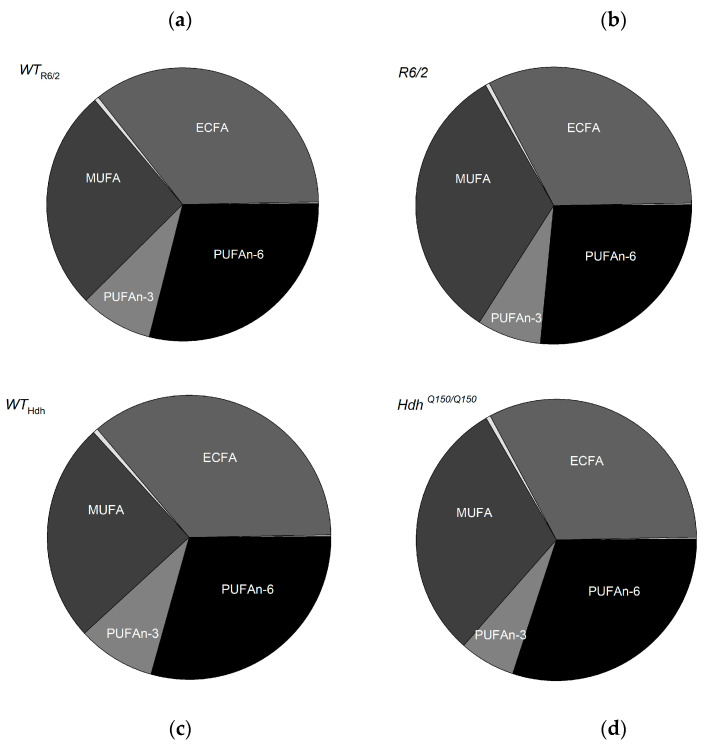 Figure 2
 Figure 3
 Figure 4
Peer Reviews
No public reviews on file for this paper yet. If you reviewed it on a platform where reviews are public (OpenReview, ICLR, NeurIPS, ICML), you can paste yours below so the community can read it here.
Videos
No videos yet. Explain this paper in a talk, walkthrough, or lecture? Add one.
Taxonomy
TopicsGenetic Neurodegenerative Diseases · Mitochondrial Function and Pathology · Endoplasmic Reticulum Stress and Disease