Simultaneous Determination of Reducing Sugars in Honey by Capillary Zone Electrophoresis with LIF Detection Using Low-Toxicity 2-Picoline Borane and APTS for Pre-Capillary Derivatization
Joanna Bulesowska, Michał Pieckowski, Piotr Kowalski, Tomasz Bączek, Ilona Olędzka

TL;DR
This paper presents a new method to accurately measure reducing sugars in honey using a safer and more sensitive technique.
Contribution
A safer, low-toxicity pre-capillary derivatization method for CZE-LIF analysis of reducing sugars in honey is developed.
Findings
Optimal derivatization conditions for glucose, mannose, and maltose were identified at 50 °C in 0.5 M citric acid.
Fructose showed low reactivity due to its ketose structure.
Liquid–liquid extraction with ethyl acetate was the most effective cleanup strategy for reducing background signals.
Abstract
This study aimed to develop a reliable method for profiling reducing sugars in honey using capillary zone electrophoresis with laser-induced fluorescence detection (CZE-LIF). Reducing sugars were derivatized with 8-aminopyrene-1,3,6-trisulfonic acid (APTS) in the presence of 2-picoline borane, a safer alternative to sodium cyanoborohydride. Key parameters influencing the derivatization efficiency—temperature, pH, incubation time, and reagent concentrations—were systematically optimized. The highest labeling efficiency for glucose, mannose, and maltose was achieved at 50 °C in 0.5 M citric acid with 0.1 M APTS, while fructose showed low reactivity due to its ketose structure. To reduce the background signal from excess reagents, three cleanup strategies were evaluated. Liquid–liquid extraction with ethyl acetate effectively removed unreacted APTS without significant analyte loss, whereas…
Genes, proteins, chemicals, diseases, species, mutations and cell lines named across the full text — each resolved to its canonical identifier and authoritative record.
Click any figure to enlarge with its caption.
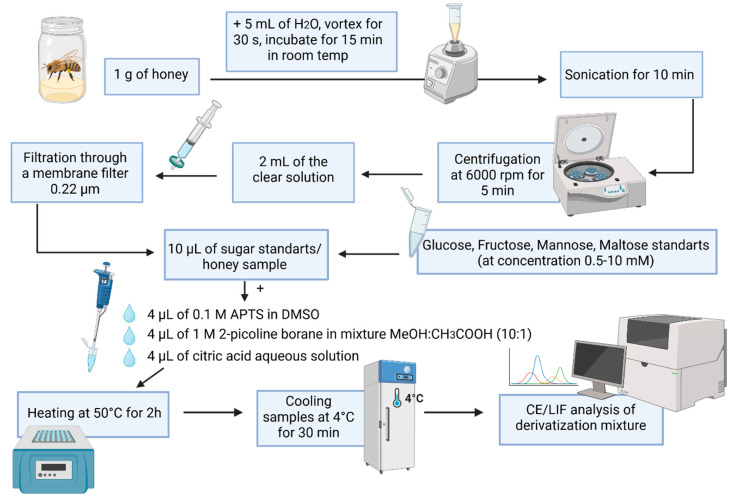 Figure 1
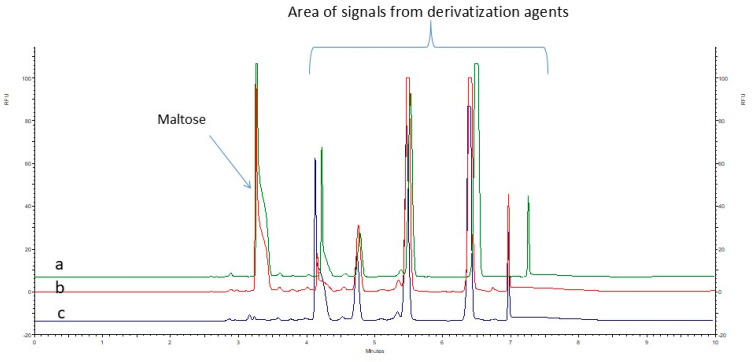 Figure 2
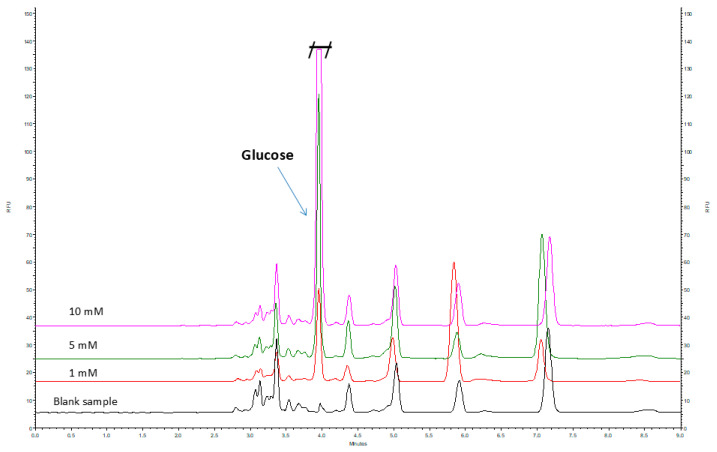 Figure 3
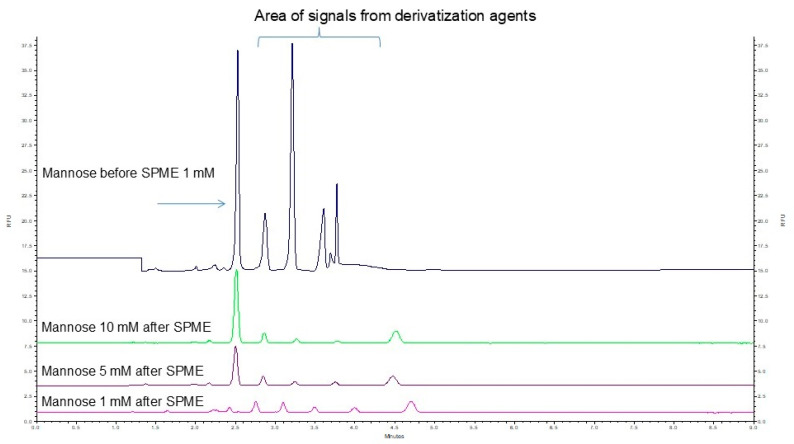 Figure 4
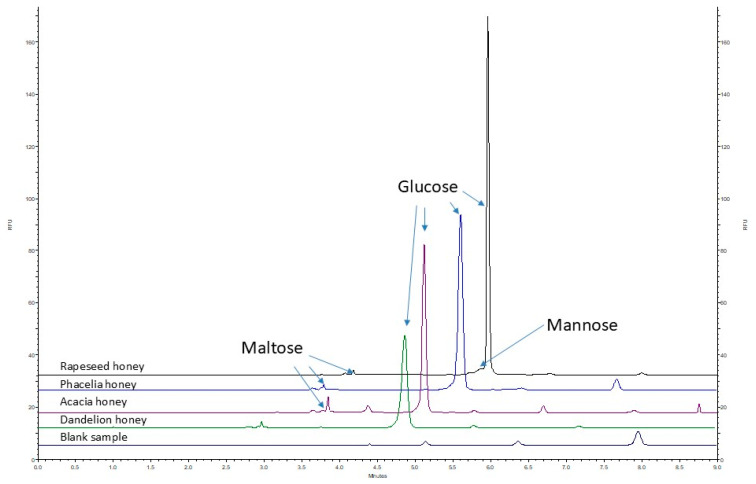 Figure 5
Peer Reviews
No public reviews on file for this paper yet. If you reviewed it on a platform where reviews are public (OpenReview, ICLR, NeurIPS, ICML), you can paste yours below so the community can read it here.
Videos
No videos yet. Explain this paper in a talk, walkthrough, or lecture? Add one.
Taxonomy
TopicsAdvanced Chemical Sensor Technologies · Meat and Animal Product Quality · Microfluidic and Capillary Electrophoresis Applications