The Role of Landiolol in Coronary Artery Disease: Insights into Acute Coronary Syndromes, Stable Coronary Artery Disease and Computed Tomography Coronary Angiography
Athina Nasoufidou, Marios G. Bantidos, Panagiotis Stachteas, Dimitrios V. Moysidis, Andreas Mitsis, Barbara Fyntanidou, Konstantinos Kouskouras, Efstratios Karagiannidis, Theodoros Karamitsos, George Kassimis, Nikolaos Fragakis

TL;DR
This paper reviews the role of landiolol, a fast-acting beta blocker, in improving diagnostic imaging and treatment outcomes for coronary artery disease.
Contribution
The paper provides a comprehensive review of landiolol's pharmacological properties and its potential in acute and chronic coronary artery disease settings.
Findings
Landiolol has ultra-short duration of action and high β1-receptor specificity, making it suitable for clinical use.
Landiolol improves diagnostic imaging quality by maintaining low heart rates in coronary computed tomography angiography.
It shows promise in both acute and chronic coronary artery disease settings, though more research is needed.
Abstract
Coronary artery disease (CAD) constitutes a major contributor to morbidity, mortality and healthcare burden worldwide. Recent innovations in imaging modalities, pharmaceuticals and interventional techniques have revolutionized diagnostic and treatment options, necessitating the reevaluation of established drug protocols or the consideration of newer alternatives. The utilization of beta blockers (BBs) in the setting of acute myocardial infarction (AMI), shifting from the pre-reperfusion to the thrombolytic and finally the primary percutaneous coronary intervention (pPCI) era, has become increasingly more selective and contentious. Nonetheless, the extent of myocardial necrosis remains a key predictor of outcomes in this patient population, with large trials establishing the beneficial use of beta blockers. Computed tomography coronary angiography (CTCA) has emerged as a highly effective…
Genes, proteins, chemicals, diseases, species, mutations and cell lines named across the full text — each resolved to its canonical identifier and authoritative record.
Click any figure to enlarge with its caption.
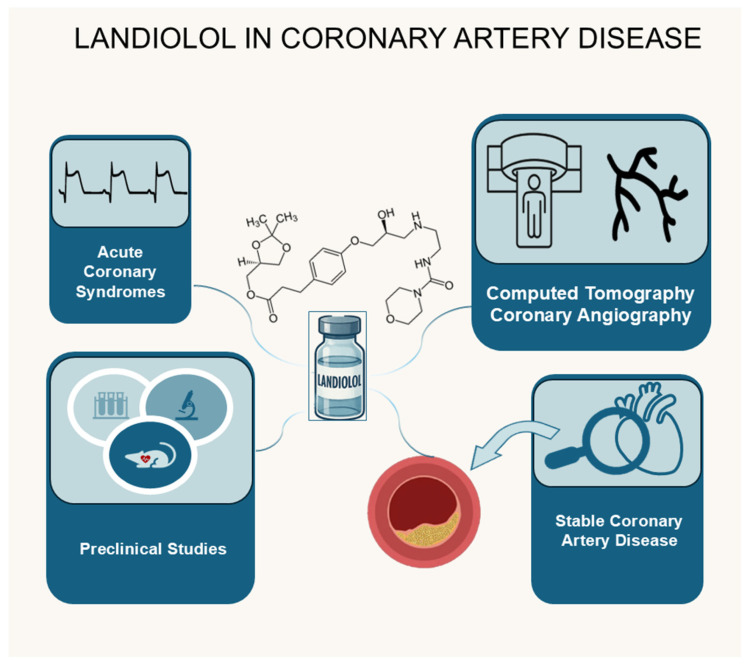 Figure 1
Peer Reviews
No public reviews on file for this paper yet. If you reviewed it on a platform where reviews are public (OpenReview, ICLR, NeurIPS, ICML), you can paste yours below so the community can read it here.
Videos
No videos yet. Explain this paper in a talk, walkthrough, or lecture? Add one.
Taxonomy
TopicsCardiac Imaging and Diagnostics · Cardiac electrophysiology and arrhythmias · Acute Myocardial Infarction Research