The generic Markov cohomological Hall algebra is not spherically generated
Ben Davison

TL;DR
This paper challenges a conjecture about cohomological Hall algebras by showing they depend on the choice of potential and are not always spherically generated.
Contribution
The paper provides a counterexample to a conjecture and proposes a modification by excluding non-spherical parts.
Findings
Low-degree BPS invariants show the cohomological Hall algebra is not spherically generated.
The algebra depends on the choice of infinitely mutable potential.
A modification to the conjecture is suggested using character decomposition.
Abstract
Let Q be the Markov quiver, and let W be an infinitely mutable potential for Q. We calculate some low-degree refined Bogomol'nyi-Prasad-Sommerfield (BPS) invariants for the resulting Jacobi algebra and use them to show that the critical cohomological Hall algebra HQ,W is not necessarily spherically generated and is not independent of the choice of infinitely mutable potential W. This leads to a counterexample to a conjecture of Gaiotto et al. (Gaiotto et al. 2024 Categories of line defects and cohomological Hall algebras. arXiv. §2.1), but also suggestions for how to modify it. In the case of generic cubic W, we discuss a way to modify the conjecture by excluding the non-spherical part via the decomposition of HQ,W according to the characters of a discrete symmetry group.
Genes, proteins, chemicals, diseases, species, mutations and cell lines named across the full text — each resolved to its canonical identifier and authoritative record.
Click any figure to enlarge with its caption.
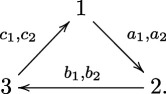 Figure 1
- —Royal Societyhttp://dx.doi.org/10.13039/501100000288
Peer Reviews
No public reviews on file for this paper yet. If you reviewed it on a platform where reviews are public (OpenReview, ICLR, NeurIPS, ICML), you can paste yours below so the community can read it here.
Videos
No videos yet. Explain this paper in a talk, walkthrough, or lecture? Add one.
Taxonomy
TopicsAlgebraic structures and combinatorial models · Advanced Topics in Algebra · Black Holes and Theoretical Physics
Preliminaries
Given a quiver with potential , the Kontsevich–Soibelman cohomological Hall algebra (CoHA) is an associative algebra that provides a beautiful link between two worlds (see [1] for details). On the one hand, taking partition functions encoding the dimensions of the graded pieces of and factorizing them according to the slopes determined by a given stability condition, we may extract the refined BPS invariants of the category of representations for the Jacobi algebra associated to and . These invariants have their origins in physics and should be thought of as counting BPS states on the noncommutative Calabi–Yau threefold associated to .
On the other hand, is an algebra, and for suitable choices of and , this algebra can be shown to recover and extend various quantum groups and may be used to prove new results regarding Yangian-type algebras [2].
On the algebraic side, the quivers with potential for which the algebra has been most intensively studied are symmetric, meaning that for every pair of vertices and in , there are as many arrows from to as there are from to . From the point of view of studying BPS invariants, this is quite a restrictive set of quivers: it is the set of quivers for which the BPS invariants are independent of stability conditions, and all wall-crossing phenomena disappear. Also, from the point of view of cluster algebras, the class of symmetric quivers is an unnatural choice, since in that subject (see [3] for background) the usual restriction on quivers is that they contain no loops or two-cycles. A symmetric quiver satisfying these restrictions has no arrows at all!
This short paper is inspired by a pair of related conjectures in [4, §2.1]. The first states that if is an infinitely mutable1 potential for a quiver containing no loops or two-cycles, then , where is the spherical subalgebra of the shuffle algebra (see §3 for partial definitions). Note that, while calculations inside are made rather difficult by the necessity of working with vanishing cycle cohomology, the algebra has a very down-to-earth presentation, and it may be studied and understood, along with its subalgebra , using elementary calculations and computer algebra packages. So it would be excellent news to discover that the algebra , for which it is hard to calculate products and for which the graded dimensions recover refined BPS invariants, is in fact isomorphic to . The weaker version of this conjecture, also stated in [4, §2.1], states that is independent of , as long as is chosen to be infinitely mutable.
The Markov quiver, for which the definition is recalled in §2, has a well-established reputation as a source of interesting properties, examples and counterexamples in the theory of cluster algebras (see [3,5] and references therein). The study of the cluster algebra built from this quiver is closely connected to the study of solutions to Markov’s equation; we refer to [6] for recent work in this direction, along with further references. True to its reputation, in this short paper, we present counterexamples to the above conjectures (propositions 3.2 and 3.4), built from the Markov quiver with infinitely mutable potentials. More positively, we will see that the Markov quiver provides example calculations that suggest how the spherical generation conjecture might be modified.
Set-up
1.1.
By a quiver we mean a finite directed graph. We set to be the set of vertices of , to be the set of arrows and to be the two morphisms sending an arrow to its source and target, respectively. Let be a dimension vector. We denote by the stack of -dimensional -modules. It has dimension , where is the Euler form defined by
We can present the stack as a global quotient stack, as we briefly recall. We define , a vector space parameterizing -dimensional -modules, which we may consider as an affine variety in the obvious way. This is acted on by the gauge group by a simultaneous change of basis. Then .
Let be a linear combination of (finitely many) cyclic paths. Taking the trace of , considered as an endomorphism of the underlying vector spaces of -modules, provides a function on . It is often desirable, in the study of mutation of quivers with potentials, to consider formal potentials (infinite linear combinations of cyclic paths). In order to define the CoHA, we will not do so, so that the function is well defined.
The Kontsevich–Soibelman critical CoHA is a -graded associative algebra, for which the underlying vector space of the th graded piece is the vanishing cycle cohomology
and the square brackets denote the cohomological shift. In words, the th graded piece of is the hypercohomology of the perverse sheaf of vanishing cycles for the function on the stack of -dimensional -representations.
The associative product is defined in [1, §7]. We remark that the product respects the cohomological grading on if and only if is symmetric. In general, the failure of the CoHA multiplication to preserve the cohomological grading is captured by the following formula relating cohomological degrees, where we assume and , and we use to denote the CoHA multiplication
Fix a quiver . We define the ring as follows. It is a -module, and as a -module, it is equal to the set of formal linear combinations with each . The multiplication is given by extending the rule to formal linear combinations.
We consider the partition function in
where for a -graded vector space we set
Remark 1.1. Conceptually, it often makes more sense to replace the above Poincaré series with a ‘weight’ Poincaré series that is sensitive to the mixed Hodge structure on and, in particular, the weight filtration. See [1, §7] for definitions and details of this approach. Since in this paper we will only be interested in calculating graded dimensions of certain vector spaces, we ignore this alternative and instead take naive Poincaré series throughout.
Let be a stability condition. We define the slope of a dimension vector by setting
We assume that is generic, meaning that if have the same slope, then . Given a slope , we define
We define to be the subring of spanned by formal -linear combinations of symbols , where . By the genericity of , for every , the ring is commutative. There is a unique factorization
where . By the cohomological wall-crossing isomorphism [7, Thm. B], there are equalities
where is the substack of -semistable -representations.
We may repackage the functions in terms of refined BPS invariants, which are Laurent polynomials defined via the equality
Here is the plethystic exponential, defined by setting
whenever the right-hand side makes sense. The fact that the formal power series defined by (1.4) are actually Laurent polynomials is a consequence of the cohomological integrality theorem [7, Thm. A].
Remark 1.2.** The polynomials can be realized by taking the Poincaré polynomials of BPS cohomology, introduced in [7]. If we had defined the partition functions using weight series instead, we would take the weight polynomials of BPS cohomology to recover the corresponding refined BPS invariants. Since in this paper we are principally interested in the dimensions of vector spaces, it is most natural to consider naive Poincaré series.
The conjectures
1.2.
Fixing a quiver , it is very interesting to study the dependence of on . It is conjectured in [4, §2.1] that as long as the quiver with potential is infinitely mutable, the partition function does not depend on the choice of . This is equivalent to the statement that after fixing a stability condition , the BPS invariants do not depend on . Being infinitely mutable is a certain non-degeneracy condition on quivers with potentials that is important in the categorification of cluster algebras via Ginzburg’s differential graded algebras (see [3,8,9] for definitions, motivation and background). It is, first of all, assumed that does not contain loops and two-cycles. Then the mutation at a given vertex produces a new quiver with potential2 . Infinite mutability is the condition that the underlying quiver of this mutated quiver with potential also does not contain two cycles, and that this remains the case after iterated mutation at any sequence of vertices.
The Markov quiver
Potentials for the Markov quiver
2.1.
For the rest of the paper, we fix to be the Markov quiver. Precisely, we set and , with the orientations of the arrows as in the following diagram:
Let be a potential. We grade by path length.
Lemma 2.1. [10, chapter 14, example 4.5] After applying a graded linear isomorphism , i.e. an isomorphism taking arrows to linear combinations of arrows, we may write in one of the following five forms:
(1) (2) (3) (4) (5) ,
where is the sum of all of the homogeneous pieces of of degree at least , i.e. a linear combination of cyclic paths of length at least .
Moreover, case (5) is generic, in the following sense: the type of a potential under graded linear isomorphisms is determined by the cubic part of , and a generic homogeneous cubic potential can be transformed to the form .
Proposition 2.2. is infinitely mutable if and only if it is of one of the forms given in cases (4) and (5) above.
Proof. In the first three cases, a single mutation at vertex produces a quiver with potential that contains at least one two-cycle (see [3] for the definition of mutation for quivers with potentials). So we just need to show that in the remaining two cases, the quiver with potential is infinitely mutable. For case (5), this is [3, example 8.6]. The argument for case (4) is the same as the argument for (5); we write it for completeness.
As in [3], we consider as an element in the completed path algebra , where is the vector space spanned by paths of length . We describe the mutation of at vertex and show that the mutated quiver has no two-cycles; this will suffice, since the quiver with potential is invariant under rotational symmetry by the group . The new quiver has arrows from to , arrows from to , arrows from to and four arrows from to , with . The new potential, before cancelling off quadratic terms, is of the form
Writing and we find
As in [3, definition 2.5], we define a unitriangular automorphism of the (completed) path algebra to be one for which, for every arrow , , where is a formal linear combination of paths of length at least two. By [3, lemma 4.7], there is a unitriangular automorphism sending and , such that after rescaling and , the potential transforms to
where does not contain the arrows . Removing the quadratic terms and the two-cycles and , we find that the mutated quiver with potential contains no two-cycles, is isomorphic to the Markov quiver and the new potential is again of the form (4).∎
BPS invariants for generic W and small dimension vectors
2.2.
In order to use the formulas (1.2) and (1.3), we need to make a choice of stability condition. For the rest of the paper, we fix a stability condition by setting , with irrational and , although the calculation of the refined BPS invariants for small dimensions and other choices of generic stability conditions is performed in the same way.
Next, we calculate some low-degree refined BPS invariants for potentials of generic form ((5) above). Setting to be the dimension vector that is zero everywhere apart from and for which the entry at is , we find and the function is zero on this stack. So if , we have the standard calculation
In particular,
for .
Now let . A -stable -dimensional -representation is given by two linear maps and , satisfying the condition that neither of them is the zero map. We thus see that . Again, the function is zero on this stack, and we have the isomorphism of sheaves . Comparing (1.3) and (1.4), we deduce
which is the normalized Poincaré polynomial of . By the same argument, we calculate
On the other hand, there are no -semistable -representations of dimension vector ; such a module would have a destabilizing submodule of dimension vector . So it follows, again from (1.3), that
Note that, so far, our choice of has played essentially no role. More generally, it follows from the discussion in [11, §8.4] that, for infinitely mutable potentials for the Markov quiver , the BPS invariants for are entirely determined by the rules governing the behaviour of under cluster mutation and do not depend on the potential . Our choice of potential can only start to be relevant for the dimension vector .
Proposition 2.3. Continue to assume that is generic, i.e. that we can write . Then
— , where is a Laurent polynomial in , with the coefficient of positive or negative depending on whether is even or odd.—If we set , then .
Proof. Let be a -semistable -dimensional -representation. Fixing identifications between the vector spaces that assigns to the three vertices and the one-dimensional vector space , is determined by six linear maps , which we may identify with numbers in . We abuse notation by denoting these numbers . Then stability for is equivalent to the two conditions
—At least one of is non-zero.—At least one of is non-zero.
Let be the coarse moduli space; since is indivisible, this is a fine moduli space, and moreover, we have , the quotient by the trivial -action.
We cover by the four charts , for , where is defined to be the subvariety corresponding to -representations for which and . Then each of is isomorphic to ; up to gauge equivalence , and then the remaining four arrows provide the four coordinates of affine four-space. We prove the final part of the proposition first, so for now we set . I claim that
The first case ( ) is easy: in local coordinates, we write
with . In particular, the critical locus of this function is empty, and since is supported on this locus, the first part of the claim follows.
For the second case ( ), we have instead
By the Thom–Sebastiani isomorphism [12], we find
We have used here the standard calculation , where is the constant sheaf supported on the origin .
Let be the point corresponding to the module for which and act via isomorphisms and all other arrows act via the zero map. Let be the point corresponding to the module for which and act via isomorphisms and all other arrows act via the zero map. We depict them as follows:
The claim tells us that .
Then we have
and so
Now we consider the case of general . In this case, we find that the scheme-theoretic critical locus of contains the points and as reduced connected components, since after a formal change of coordinates, we may transform back into the form (5). It follows that the restriction of to a small analytic neighbourhood of is , and its restriction to a small analytic neighbourhood of is . Set . Passing to derived global sections, we find that there is a direct sum decomposition
Then we set .∎
Counterexamples
Spherical (non) generation
3.1.
We refer to [1, §2.4] for the definition of the shuffle algebra associated to an arbitrary quiver. It is shown there that this shuffle algebra is isomorphic to the CoHA with . Let be a dimension vector for . At the level of underlying vector spaces, we have
where the symmetric group acts by permuting all variables while preserving the first of their two subscripts. The cohomological degree of a homogeneous polynomial is given by setting
We continue to denote by the Markov quiver from §2. We define the spherical subalgebra to be the subalgebra generated by all the subspaces for . The algebra inherits a -grading from , and for , we define to be the th graded piece. More generally, we define the spherical subalgebra to be the subalgebra generated by the subspaces for , and we denote by the th graded piece. We say that is spherically generated if it is equal to its spherical subalgebra.
The vector space is spanned by shuffle products of polynomials , and , in any order, where we have abbreviated for . By the formula for the shuffle product in [1, §2.4], we find
and the same formulas hold under cyclic permutation of the subscripts. We thus find that is spanned as a vector space by elements
where . In particular, we find that
Taking dimensions
If instead we allow non-zero potential , we find that we still have isomorphisms , and via the cohomological degree calculation of (1.1), the following lemma:
Lemma 3.1. For the Markov quiver and arbitrary, we have
Now we reinstate the assumption that is generic. From the calculations of BPS invariants in §2.2, we calculate the dimensions of for low values of
where the higher-order terms are linear combinations of monomials with at least one of , and is the Laurent polynomial introduced in proposition 2.3. Write for the term of . Then the above-mentioned factorization of yields
and so
Observing that the coefficients of even powers of in are positive, we deduce that the modulus of the coefficient of is at least , and so, comparing with lemma 3.1, we deduce the following:
Proposition 3.2. Let be the Markov quiver from §2. Let be a generic potential. Then is not spherically generated. Moreover, .
In particular, there is no (graded) isomorphism .
Excluding non-spherical generators
3.2.
Let . Fix the potential . We consider the -action on that swaps with , with and with . This action fixes . As such, acts on the critical cohomology , and it is easy to see that the CoHA multiplication is -equivariant. Furthermore, acts trivially on for , and so acts trivially on the entire spherical subalgebra. Therefore, letting be the summand carrying the sign representation for , elements of this summand are not spherically generated. The idea of isolating and excluding the BPS contributions that are not -invariant has been explored already in the physics literature, for example, in [13, §4.4.5] and [14, §4.2].
With and the -dimensional representations introduced in (2.2), the vector space , which is the BPS cohomology giving rise to the BPS invariant , carries the regular -representation. The Poincaré series of the -invariant part of the BPS cohomology is thus , and so repeating the calculation of (3.2), we find the generating function for the -invariant part of the CoHA
From (3.1), under the change of variables , the ideal is identified with the ideal containing elements of degree at least in . So we have , and
Put differently, the non-spherically generated part of is given by elements , where acts via multiplication by the first Chern class of the determinant line bundle. It is possible to show that the algebra generated by these elements surjects onto the free exterior algebra generated by the same symbols. A physically motivated possible modification of the spherical generation conjecture, suggested by Davide Gaiotto, is that splits as the product of and . Via dimensional reduction [15, appendix A] and proposition 3.5, it should be possible to test this prediction for low-dimension vectors.
Dependence on W
3.3.
The second part of proposition 3.2 provides a counterexample to the conjecture regarding spherical subalgebras in [4, §2.1]. A weaker conjecture, also stated in [4, §2.1], is that for infinitely mutable , is independent of . Comparing the two parts of proposition 2.3, this would imply the equality for all . To exclude the ‘error term’ one could instead conjecture that is independent of , where we define to be the inclusion of the reduced substack containing the nilpotent representations, and
Defining and starting from as in (1.2) and (1.4), respectively, we may instead conjecture that the nilpotent BPS invariants are independent of . The multiplication is again as defined in [1, §7]. Alternatively, one could conjecture that for quasi-homogeneous infinitely mutable potentials , the CoHA is independent of . In this final section, on the one hand, we show that the Markov quiver provides counterexamples to these forms of the independence conjecture, but on the other hand, our results will indicate a way forward with a weakened version of the spherical generation conjecture.
We consider the ‘marginal’ potential —the homogeneous potential of type (4). Recall from proposition 2.2 that this potential is infinitely mutable.
Lemma 3.3. There is an equality of generating series
Proof. By Verdier self-duality of the vanishing cycle sheaf, we have the isomorphism
where the right-hand side is the graded vector dual of the compactly supported hypercohomology. Let be the quiver obtained from by removing the arrows and . Define
We denote by the stack of -dimensional -modules. By the dimensional reduction isomorphism [[15], appendix A], there is an isomorphism
The stack is isomorphic to the global quotient stack , where is cut out by the equations and , , and the first copy of scales the coordinates, the second scales the coordinates and the third acts trivially. We define
Then
These three stacks stratify . All of the above-mentioned stacks have pure mixed Hodge structures on their compactly supported cohomology, so that their weight Poincaré series agree with their naive Poincaré series, and the above-mentioned stratification gives the identity
as required.∎
Comparing with the analogous calculation for the generic infinitely mutable potential yields the following.
Proposition 3.4. The CoHA is not independent of the choice of infinitely mutable potential . There are equalities of refined BPS invariants and . Moreover, there is an equality .
Proof. Comparing lemma 3.3 with (3.2), we find that the coefficient of is given by
Since this difference is non-zero, the graded dimensions of and are not the same.
The equality is proposition 2.3. Since for dimension vectors strictly less than in the natural partial order, we have , it follows from (1.2) and (1.4) that (3.3) is equal to .
Finally, we show that . We define for as in the proof of proposition 2.3. It is easily verified that for , we have . On , we have the affine coordinates , in which becomes , which has critical locus (forgetting the scheme structure) given by . Now we claim that there is an isomorphism
where is the locus cut out by the equations and is the inclusion. Since on the right-hand side we have taken the graded dual, the claimed isomorphism implies that there is an equality
as required. We have isomorphisms
where denotes the Verdier duality functor. The second isomorphism exists since the vanishing cycle sheaf is Verdier self-dual [16], while the third follows from the fact that has compact support.
Let act on by scaling with weight 1 and with weight . We extend this to an action on by letting act on with weight . Then is a -invariant function, and is a -equivariant perverse sheaf. Let be the inclusion of the critical locus of , let be the inclusion of the origin and let . Since is supported on the image of , we have isomorphisms
by base change. Since is -equivariant, it follows from [17], proposition 3.7.5] that the adjunction map is an isomorphism. Putting all of these isomorphisms together, we obtain (3.4).∎
By proposition 3.4 and proposition 3.5 below, is spherically generated in degree . We note, following lemma 2.1, that this is a non-generic infinitely mutable potential. Whether spherical generation continues for the marginal potential, for higher-dimension vectors, is an interesting problem, which (via dimensional reduction) may again be tested numerically. More generally, an interesting modification of the conjecture in [4, §2.1] would be that for every quiver, there exists at least one infinitely mutable potential for which the CoHA is spherically generated.
We finish with a proposition that should be useful for studying this conjecture. Before stating it, we recall that a potential is called quasi-homogeneous if there is a grading such that all the cycles appearing in are of the same total degree with respect to the grading and .
Proposition 3.5. Let be a quiver without loops, and let be a quasi-homogeneous potential. Then as graded algebras if and only if . In this case, is spherically generated.
Proof. One implication is trivial: if two graded algebras are isomorphic, they certainly have the same graded dimensions. So we need to show the reverse implication. For this, we consider the morphism of CoHAs constructed in [2, prop 4.4] (this uses that is quasi-homogeneous). Since has no loops, it follows that when restricted to each of the stacks for . It follows that induces an isomorphism when we restrict to the graded piece. In particular, the image of contains . By the equality of graded dimensions, the image of is precisely , and induces an isomorphism . The final statement follows, since is spherically generated by definition.∎
Via proposition 3.5, the kinds of calculations of BPS invariants performed in this paper may be used not just to test the variants of the spherical generation conjecture discussed above, but try to prove them.
The reference list from the paper itself. Each links out to its DOI / PubMed record.
- 1Kontsevich M, Soibelman Y. 2011 Cohomological hall algebra, exponential Hodge structures and motivic Donaldson–Thomas invariants. Commun. Number Theory Phys. 5, 231–352. (10.4310/cntp.2011.v 5.n 2.a 1) · doi ↗
- 2Botta TM, Davison B. 2023 Okounkov’s conjecture via BPS Lie algebras. ar Xiv. (10.48550/ar Xiv.2312.14008) · doi ↗
- 3Derksen H, Weyman J, Zelevinsky A. 2008 Quivers with potentials and their representations I: mutations. Sel. Math. 14, 59–119. (10.1007/s 00029-008-0057-9) · doi ↗
- 4Gaiotto D, Grygoryev N, Li W. 2024 Categories of line defects and cohomological Hall algebras. ar Xiv. (10.48550/ar Xiv.2406.07134) · doi ↗
- 5Chávez AN. 2012 On the c-vectors and g-vectors of the Markov cluster algebra. Sem. Lothar. Combin. 69, 12. (10.1029/JZ 069i 001p 00001) · doi ↗
- 6Lee K, Li L, Rabideau M, Schiffler R. 2023 On the ordering of the Markov numbers. Adv. Appl. Math. 143, 102453. (10.1016/j.aam.2022.102453) · doi ↗
- 7Davison B, Meinhardt S. 2020 Cohomological Donaldson–Thomas theory of a quiver with potential and quantum enveloping algebras. Invent. Math. 221, 777–871. (10.1007/s 00222-020-00961-y) · doi ↗
- 8Ginzburg V. 2006 Calabi--Yau algebras. ar Xiv.