Sulbactam-durlobactam in combination with aztreonam and carbapenems against carbapenem-resistant Acinetobacter baumannii: an assessment using the MIC-based broth disk elution
C. Koenig, D. P. Nicolau, T.E. Asempa

Abstract
Genes, proteins, chemicals, diseases, species, mutations and cell lines named across the full text — each resolved to its canonical identifier and authoritative record.
Click any figure to enlarge with its caption.
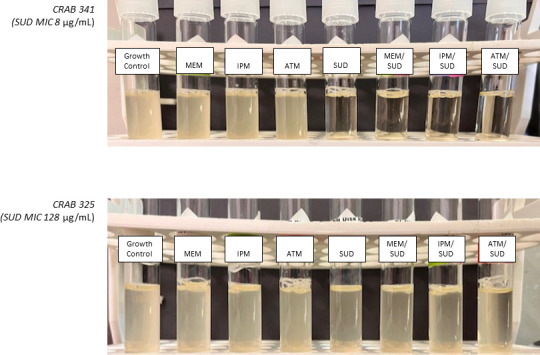 Fig 1
Fig 1| Isolate ID | SUD MIC (µg/mL) | SUD | ATM | ATM/SUD | IPM | IPM/SUD | MEM | MEM/SUD | MIC (µg/mL) | ||
|---|---|---|---|---|---|---|---|---|---|---|---|
| ATM | IPM | MEM | |||||||||
| 0.5 | − | + | − | + | − | + | − | 64 | 32 | 64 | |
| ≤0.12 | − | − | − | − | − | − | − | 0.25 | 0.12 | 0.12 | |
| 128 | + | + | + | + | + | + | + | >64 | >32 | 32 | |
| CRAB 315 | 0.5 | − | + | − | + | − | + | − | >64 | >32 | 64 |
| ACNB 1111 | 0.5 | − | + | − | − | − | − | − | 64 | 0.25 | 0.25 |
| ACNB 1732 | 0.5 | − | + | − | − | − | − | − | 32 | 0.25 | 0.25 |
| CRAB 320 | 1 | − | + | − | + | − | + | − | 64 | 32 | 32 |
| CRAB 117 | 1 | − | + | − | + | − | + | − | 64 | >32 | 64 |
| ACNB 1360 | 1 | − | + | − | − | − | − | − | 16 | 0.25 | 0.5 |
| CRAB 1716 | 8 | − | + | − | + | − | + | − | >64 | >32 | >64 |
| CRAB 326 | 8 | − | + | − | + | − | + | − | >64 | 32 | 64 |
| CRAB 341 | 8 | − | + | − | + | − | + | − | >64 | >32 | 64 |
| CRAB 513 | 8 | + | + | + | + | − | + | + | 64 | 8 | 16 |
| CRAB 133 | 8 | − | + | − | + | − | + | − | >64 | >32 | >64 |
| CRAB 1336 | 8 | − | + | − | + | − | + | − | >64 | >32 | >64 |
| CRAB 1433 | 8 | − | + | − | + | − | + | − | >64 | 32 | 64 |
| ACNB 211 | 8 | − | − | − | − | − | − | − | 0.12 | 2 | 0.06 |
| CRAB 2114 | 8 | − | + | − | + | − | + | − | >64 | >32 | >64 |
| CRAB 2119 | 8 | − | + | − | + | − | + | − | 64 | >32 | >64 |
| CRAB 2122 | 8 | − | + | − | + | − | + | − | 64 | >32 | >64 |
| CRAB 124 | 16 | − | + | − | + | − | + | − | >64 | >32 | >64 |
| CRAB 134 | 16 | − | + | − | + | − | + | − | >64 | 32 | 64 |
| CRAB 622 | 32 | + | + | + | + | + | + | + | 64 | >32 | >64 |
| CRAB 621 | 64 | + | + | + | + | + | + | + | >64 | >32 | >64 |
| CRAB 167 | 64 | + | + | + | + | + | + | + | >64 | >32 | >64 |
| CRAB 325 | 128 | + | + | + | + | + | + | + | 64 | >32 | >64 |
| CRAB 332 | 128 | + | + | + | + | + | + | + | 64 | >32 | >64 |
- —innoviva
Peer Reviews
No public reviews on file for this paper yet. If you reviewed it on a platform where reviews are public (OpenReview, ICLR, NeurIPS, ICML), you can paste yours below so the community can read it here.
Videos
No videos yet. Explain this paper in a talk, walkthrough, or lecture? Add one.
Taxonomy
TopicsAntibiotic Resistance in Bacteria · Antibiotics Pharmacokinetics and Efficacy · Bacterial Identification and Susceptibility Testing
LETTER
Sulbactam-durlobactam (SUD) resistance among Acinetobacter baumannii-calcoaceticus complex (ABC) is rare (2%–3%) and likely due to the interplay of metallo-β-lactamase (MBL) production, mutations in PBP3, and increased efflux activity (1–5). The combination of SUD plus aztreonam (MBL-stable β-lactam) or SUD plus carbapenem could potentially overcome the aforementioned resistance mechanisms and be considered an additional option in these scenarios (6–8). Recently, a broth disk elution (BDE) test was CLSI-approved to determine susceptibility to the ceftazidime-avibactam-aztreonam combination (9, 10). Therefore, we aimed to evaluate the activity of SUD plus aztreonam (ATM), imipenem (IPM), or meropenem (MEM) using the BDE method against ABC.
Twenty-four clinical ABC isolates were utilized and included 20 carbapenem-resistant isolates. Of these isolates, 6 were SUD-susceptible (MIC ≤ 4 µg/mL), 11 were SUD-intermediate (MIC 8 µg/mL), and 7 were SUD-resistant (MIC ≥ 16 µg/mL) by broth microdilution testing (Table 1) (10). Isolates with a SUD MIC ≥ 8 µg/mL underwent whole-genome sequencing as previously described and revealed New Delhi MBL genes (blaNDM) in seven isolates (4).
Briefly, SUD 10/10 µg, ATM 30 µg, IPM 10 µg, and MEM 10 µg disks (Hardy Diagnostics, CA) were added to separate 5 mL cation-adjusted Mueller-Hinton broth (Becton Dickinson, NJ) tubes in the following combinations: no disk (growth control), 2× SUD (two disks), ATM, ATM/2× SUD, IPM, IPM/2× SUD, MEM, MEM/2× SUD, and incubated for 30–60 min to allow for drug diffusion from the disk(s). Disk-content/broth ratio allowed for final SUD, ATM, IPM, and MEM concentrations of 4/4, 6, 2, and 2 µg/mL, respectively. Aliquots (25 µL) of the 0.5 McFarland culture were added to each tube, vortexed, incubated at 35^o^C ± 2^o^C for 20 h, and visibly assessed for growth (haziness/turbidity: not susceptible) or no growth (susceptible). Quality control strains were tested with each run (Table 1, Fig. S1), and BDE testing was repeated for confirmation if discordance between MIC susceptibility category and BDE result was observed.
SUD-susceptible ABC (n=6). The BDE method was concordant with MIC across all single-agent tubes. As expected, SUD-combination tubes exhibited no growth given SUD susceptibility.
SUD-intermediate ABC (n=11). No growth was observed in 10/11 tubes despite SUD MIC of 8 µg/mL, including 2 NDM-positive isolates (Fig. 1). Of note, one isolate (CRAB 513, negative for blaNDM) demonstrated bacterial growth in the SUD monotherapy tube, but no growth when combined with IPM (MIC 8 µg/mL), likely reflecting potential for synergy against isolates with low-level resistance to both agents.
Representative BDE results for two isolates: CRAB 341 (SUD MIC of 8 µg/mL; intermediate) and CRAB 325 (SUD MIC of 128 µg/mL; resistant).
SUD-resistant ABC (n=7). Among the two isolates with SUD MIC 16 µg/mL, no growth was observed in both SUD-monotherapy tubes and SUD-combination tubes. Among the five isolates with MIC ≥32 µg/mL, including five NDM-positive strains, we observed bacterial growth in all SUD-monotherapy and SUD-combination tubes (Fig. 1).
ABC resistance to SUD is rare (2%–3%); thus, the study size of this SUD non-susceptible data set is a strength. No antagonism was observed. Replicate testing and CLSI quality control tests, including the addition of an A. baumannii-specific QC (A. baumannii NCTC 13304), were performed (Table S1). A limitation of the present study is that broth microdilution MICs of the antimicrobial combinations were not performed to compare with BDE combination tube results. A larger multicenter study utilizing different broth and disk manufacturers is required to confirm the accuracy and reproducibility of these BDE results, given test performance variability, especially against clinical isolates with antimicrobial MICs that shoulder the breakpoint (9–11). Lastly, the concentration of antimicrobials eluted from the disks in broth was assumed and not confirmed. Notably, these FDA-approved antimicrobial disks are optimized for drug elution on agar, while disk elution in broth is experimental and thus needs confirmation, including the extent of drug elution from the 2 SUD disks/tube necessary for this study.
In summary, SUD susceptibility in the monotherapy tubes was observed with the BDE method for isolates with SUD MICs of ≤16 µg/mL. This drove susceptibility in the corresponding SUD-combination tubes. Bacterial growth was observed in SUD-monotherapy and combination tubes against all isolates with SUD MICs of ≥32 µg/mL (all NDM+).
The reference list from the paper itself. Each links out to its DOI / PubMed record.
- 1Castanheira M, Mendes RE, Gales AC. 2023. Global epidemiology and mechanisms of resistance of Acinetobacter baumannii-calcoaceticus complex. Clin Infect Dis 76:S 166–S 178. doi:10.1093/cid/ciad 10937125466 PMC 10150277 · doi ↗ · pubmed ↗
- 2Penwell WF, Shapiro AB, Giacobbe RA, Gu R-F, Gao N, Thresher J, Mc Laughlin RE, Huband MD, De Jonge BLM, Ehmann DE, Miller AA. 2015. Molecular mechanisms of sulbactam antibacterial activity and resistance determinants in Acinetobacter baumannii. Antimicrob Agents Chemother 59:1680–1689. doi:10.1128/AAC.04808-1425561334 PMC 4325763 · doi ↗ · pubmed ↗
- 3Principe L, Di Bella S, Conti J, Perilli M, Piccirilli A, Mussini C, Decorti G. 2022. Acinetobacter baumannii resistance to sulbactam/durlobactam: a systematic review. Antibiotics (Basel) 11:1793. doi:10.3390/antibiotics 1112179336551450 PMC 9774100 · doi ↗ · pubmed ↗
- 4Buyukyanbolu E, Argotsinger J, Beck ET, Chamberland RR, Clark AE, Daniels AR, Liesman R, Fisher M, Gialanella P, Hand J, et al.. 2025. Activity of ampicillin-sulbactam, sulbactam-durlobactam, and comparators against Acinetobacter baumannii-calcoaceticus complex strains isolated from respiratory and bloodstream sources: results from ACN Bio study. Antimicrob Agents Chemother 0:e 0037925. doi:10.1128/aac.00379-25PMC 1232696140673757 · doi ↗ · pubmed ↗
- 5Moussa SH, Shapiro AB, Mc Leod SM, Iyer R, Carter NM, Tsai Y-K, Siu LK, Miller AA. 2023. Molecular drivers of resistance to sulbactam-durlobactam in contemporary clinical isolates of Acinetobacter baumannii Antimicrob Agents Chemother 67:e 0066523. doi:10.1128/aac.00665-2337843305 PMC 10648852 · doi ↗ · pubmed ↗
- 6Fu Y, Asempa TE, Kuti JL. 2025. Unraveling sulbactam-durlobactam: insights into its role in combating infections caused by Acinetobacter baumannii. Expert Rev Anti Infect Ther 23:67–78. doi:10.1080/14787210.2024.244001839644103 · doi ↗ · pubmed ↗
- 7Shapiro AB, Gao N, Jahić H, Carter NM, Chen A, Miller AA. 2017. Reversibility of covalent, broad-spectrum serine β-lactamase inhibition by the diazabicyclooctenone ETX 2514. ACS Infect Dis 3:833–844. doi:10.1021/acsinfecdis.7b 0011328835096 · doi ↗ · pubmed ↗
- 8O’Donnell J, Tanudra A, Chen A, Miller AA, Mc Leod SM, Tommasi R. 2024. In vitro pharmacokinetics/pharmacodynamics of the β-lactamase inhibitor, durlobactam, in combination with sulbactam against Acinetobacter baumannii-calcoaceticus complex. Antimicrob Agents Chemother:e 0031223. doi:10.1128/aac.00312-2338092676 PMC 10869334 · doi ↗ · pubmed ↗