A qualitative process evaluation of group problem management plus for distressed Syrian refugees in Türkiye
Ayşenur Coşkun-Toker, Zeynep İlkkurşun, Daniela Fuhr, Bayard Roberts, Pim Cuijpers, Marit Sijbrandij, Ceren Acarturk, Phiona Koyiet

TL;DR
This study evaluates a mental health intervention for Syrian refugees in Türkiye, finding it acceptable and feasible but highlighting barriers like poverty and the need for long-term support.
Contribution
The study provides insights into adapting low-intensity mental health interventions for refugee populations while addressing social and practical barriers.
Findings
Group Problem Management Plus (gPM+) was well-received for fostering social support and improving coping skills.
Barriers to engagement included economic struggles, childcare issues, and low mental health literacy.
Training nonprofessional facilitators and governmental support are crucial for scaling up gPM+.
Abstract
Syrian refugees in Türkiye show a high prevalence of mental health problems but encounter barriers to accessing mental health services. Group Problem Management Plus (gPM+), developed by the World Health Organization, is a low-intensity psychological intervention delivered by nonspecialist facilitators. This qualitative process evaluation explores the acceptability, feasibility and perceived effectiveness of gPM+ for Syrian refugees resettled in Türkiye, as well as facilitating factors and barriers to its implementation. Twenty-three semi-structured interviews were conducted with gPM+ participants, facilitators, drop-outs, relatives of participants and key informants. Findings showed that gPM+ was well-received for its group-based format, which participants felt fostered social support, and for its content, which they reported may have led to improvements in coping skills and family…
Genes, proteins, chemicals, diseases, species, mutations and cell lines named across the full text — each resolved to its canonical identifier and authoritative record.
Click any figure to enlarge with its caption.
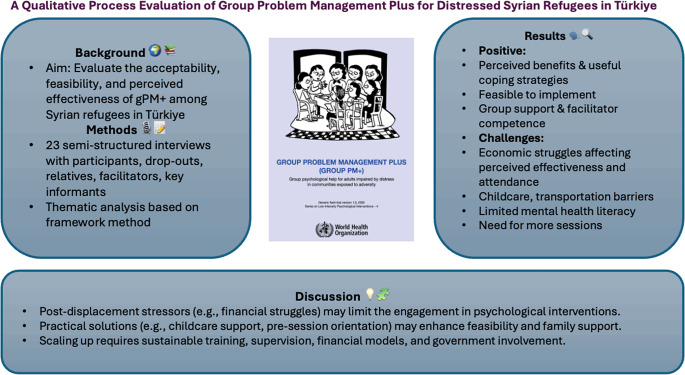 Figure 1
Peer Reviews
No public reviews on file for this paper yet. If you reviewed it on a platform where reviews are public (OpenReview, ICLR, NeurIPS, ICML), you can paste yours below so the community can read it here.
Videos
No videos yet. Explain this paper in a talk, walkthrough, or lecture? Add one.
Taxonomy
TopicsFamilies in Therapy and Culture · Education and experiences of immigrants and refugees