Evidence that cultural groups differ in their abilities to detect fake accents: a follow up
Jonathan R. Goodman, Robert A. Foley

TL;DR
People from different cultural groups vary in their ability to detect fake accents, with native speakers performing better overall.
Contribution
Follow-up data using a global dataset confirms that native listeners are better at detecting fake accents than non-native listeners.
Findings
Native listeners outperformed non-native listeners in detecting fake accents.
There was some variation in performance between different cultural groups.
The results support the idea that accent detection relates to trustworthiness signals.
Abstract
We recently reported that cultural group membership may be a predictor of the likelihood that an individual will detect a faked accent in a recording. Here, we present follow-up data to our original study using a larger data set comprised of responses from the across the world. Our findings are in line with our previous work and suggest that native listeners perform better at this task than do non-native listeners overall, although with some between-group variation. We discuss our findings within the context of signals of trustworthiness and suggest future avenues of research.
Genes, proteins, chemicals, diseases, species, mutations and cell lines named across the full text — each resolved to its canonical identifier and authoritative record.
Click any figure to enlarge with its caption.
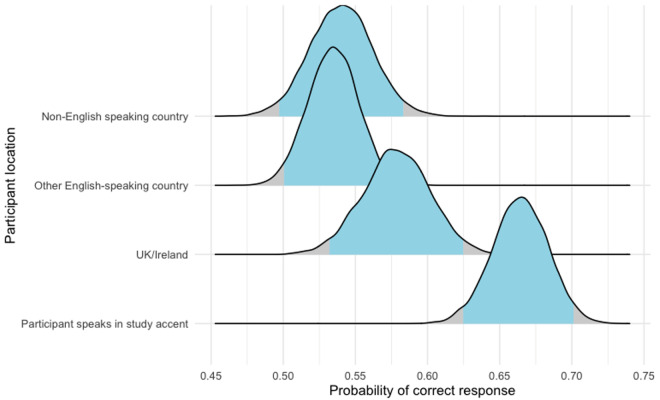 Figure 1
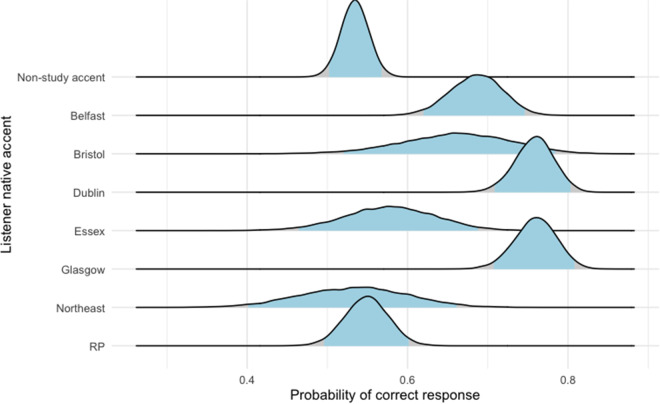 Figure 2
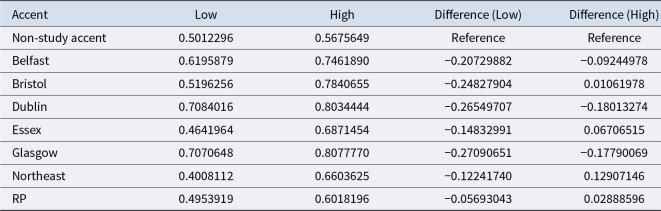 Figure 3
Peer Reviews
No public reviews on file for this paper yet. If you reviewed it on a platform where reviews are public (OpenReview, ICLR, NeurIPS, ICML), you can paste yours below so the community can read it here.
Videos
No videos yet. Explain this paper in a talk, walkthrough, or lecture? Add one.
Taxonomy
TopicsAuthorship Attribution and Profiling