Lifestyle, genetic risk, plasma pTau217, and incident cognitive impairment in WRAP
Rachel L. Studer, Karly A. Cody, Julie E. Oomens, Ramiro Eduardo Rea Reyes, Nathaniel A. Chin, Kimberly D. Mueller, Bruce P. Hermann, Rachael E. Wilson, Rebecca E. Langhough, Erin M. Jonaitis, Sterling C. Johnson

TL;DR
A healthier lifestyle in midlife is linked to a lower risk of cognitive decline, regardless of genetic or biological risk factors like APOE ε4 or pTau217.
Contribution
This study shows that lifestyle risk impacts cognitive impairment independently of APOE ε4 or pTau217 levels.
Findings
Higher lifestyle risk is associated with increased cognitive impairment risk across APOE ε4 carriers and non-carriers.
Lifestyle risk increases cognitive impairment risk across all pTau217 levels.
No significant interactions were found between lifestyle risk and APOE ε4 or pTau217.
Abstract
Whether lifestyle‐based dementia risk in midlife impacts risk of incident cognitive impairment (ICI) in the presence of apolipoprotein E (APOE) ε4 allele or plasma pTau217 remains unknown. In initially cognitively unimpaired participants (N = 1088; baseline age, M(SD) = 57.8(6.5) years) from the Wisconsin Registry for Alzheimer's Prevention (WRAP), we investigated the relationship between lifestyle‐based dementia risk (e.g., low, moderate, and high lifestyle‐based risk tertiles) and risk of ICI when accounting for APOEε4 or plasma pTau217‐ALZpath using Cox regressions (median follow‐up years = 8.2(interquartile range [IQR]: 5.5–10.8)). Less healthy lifestyle tertiles were associated with higher risk of ICI compared to the healthiest tertile across APOEε4 carriers and non‐carriers (moderate, hazard ratio [HR] = 1.58, 95% confidence interval; [CI] 1.17‐2.15, p = 0.003; high, HR = 2.08,…
Genes, proteins, chemicals, diseases, species, mutations and cell lines named across the full text — each resolved to its canonical identifier and authoritative record.
Click any figure to enlarge with its caption.
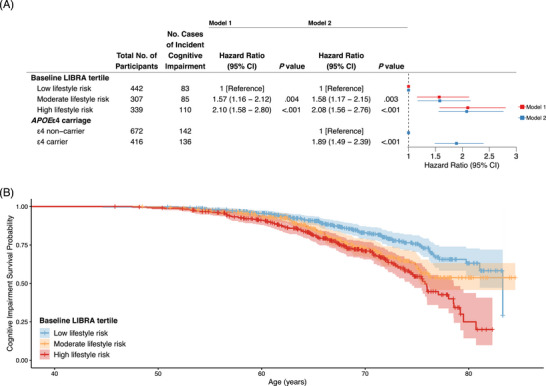 Figure 1
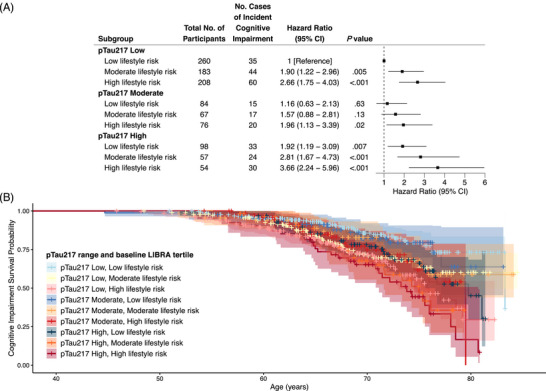 Figure 2
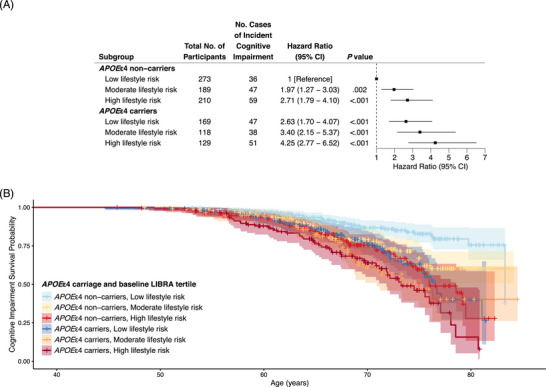 Figure 3
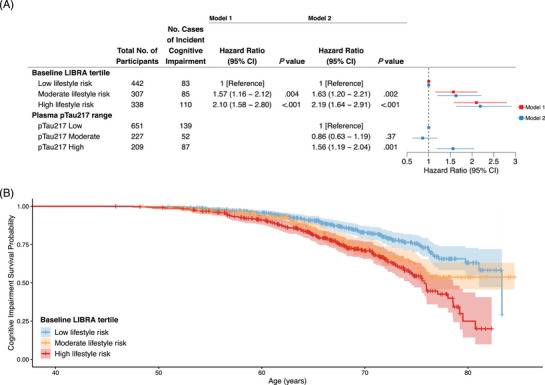 Figure 4
Peer Reviews
No public reviews on file for this paper yet. If you reviewed it on a platform where reviews are public (OpenReview, ICLR, NeurIPS, ICML), you can paste yours below so the community can read it here.
Videos
No videos yet. Explain this paper in a talk, walkthrough, or lecture? Add one.
Taxonomy
TopicsDementia and Cognitive Impairment Research · Alzheimer's disease research and treatments · Nutritional Studies and Diet