Technical Note: Neural Network Architectures for Self-Supervised Body Part Regression Models with Automated Localized Segmentation Application
Michael Fei, Alan B. McMillan

TL;DR
This paper compares neural network architectures for self-supervised body part regression in medical imaging, showing that EfficientNet improves localization and segmentation performance.
Contribution
The study introduces a novel comparison of self-supervised neural networks for anatomical localization and segmentation in CT scans.
Findings
EfficientNet achieved the lowest MAE of 3.18 in body part regression compared to VGG's 6.29.
Localized segmentation models using BPR scores outperformed baselines in 16 out of 20 organs with a DSC of 0.88.
Self-supervised BPR slice scores effectively enhance anatomical localization in CT scans.
Abstract
The advancement of medical image deep learning necessitates tools that can accurately identify body regions from whole-body scans to serve as an essential pre-processing step for downstream tasks. Typically, these deep learning models rely on labeled data and supervised learning, which is labor-intensive. However, the emergence of self-supervised learning is revolutionizing the field by eliminating the need for labels. The purpose of this study was to compare neural network architectures of self-supervised models that produced a body part regression (BPR) slice score to aid in the development of anatomically localized segmentation models. VGG, ResNet, DenseNet, ConvNext, and EfficientNet BPR models were implemented in the MONAI/Pytorch framework. Landmark organs were correlated to slice scores and mean absolute error (MAE) was calculated from the predicted slice and the actual slice of…
Genes, proteins, chemicals, diseases, species, mutations and cell lines named across the full text — each resolved to its canonical identifier and authoritative record.
Click any figure to enlarge with its caption.
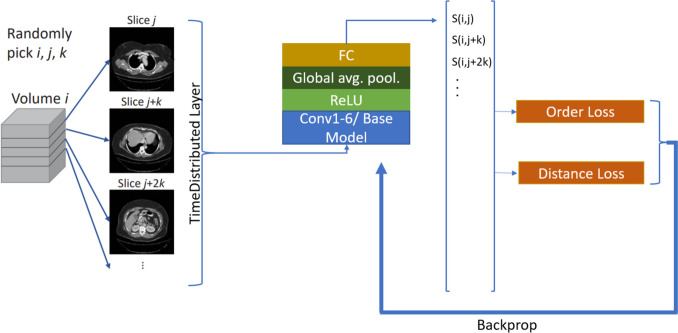 Figure 1
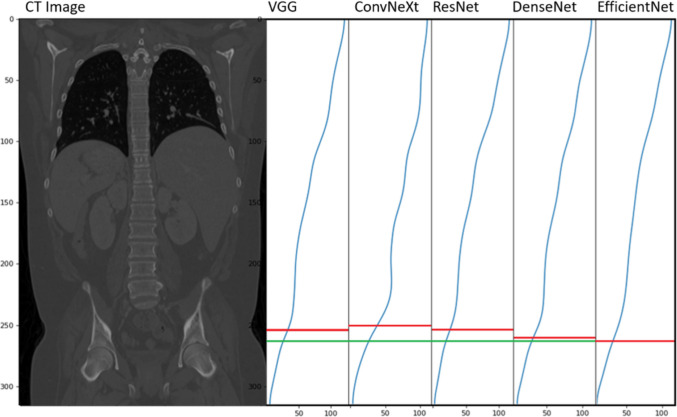 Figure 2
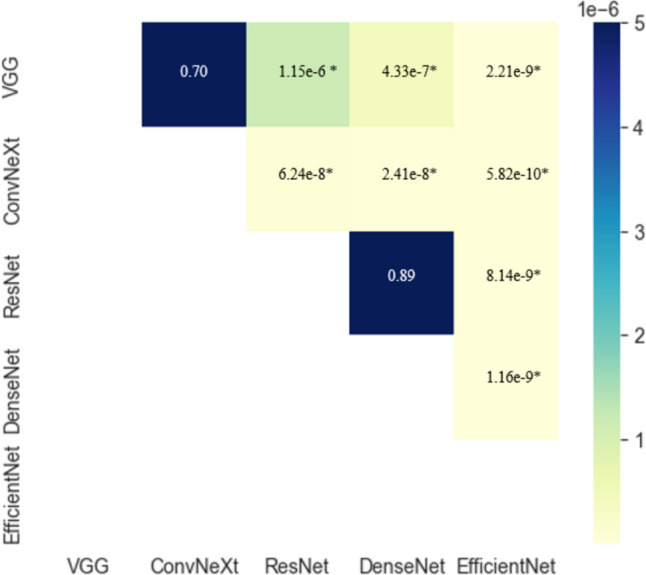 Figure 3
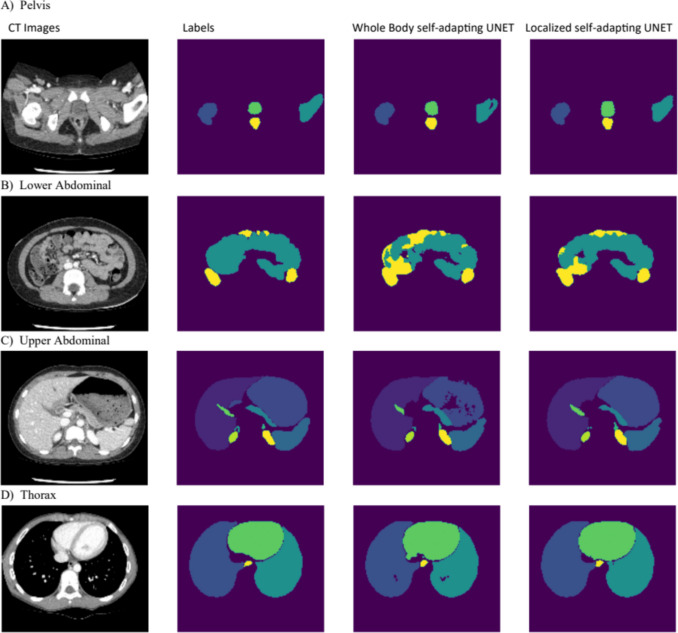 Figure 4
Peer Reviews
No public reviews on file for this paper yet. If you reviewed it on a platform where reviews are public (OpenReview, ICLR, NeurIPS, ICML), you can paste yours below so the community can read it here.
Videos
No videos yet. Explain this paper in a talk, walkthrough, or lecture? Add one.
Taxonomy
TopicsRadiomics and Machine Learning in Medical Imaging · Advanced X-ray and CT Imaging · Medical Imaging and Analysis