Renal clearance of fluorescent agents can compromise image‐guided surgery along the urinary tract
Anne‐Claire Berrens, Tessa Buckle, Matthias N. van Oosterom, Leon J. Slof, Belle M. Melsert, Jakko A. Nieuwenhuijzen, Esther M.K. Wit, Pim J. van Leeuwen, Henk G. van der Poel, Fijs W.B. van Leeuwen

TL;DR
Fluorescent agents cleared by the kidneys can contaminate the surgical field during procedures on the urinary tract, potentially causing false imaging results.
Contribution
This study demonstrates how renally cleared fluorescent agents like fluorescein can compromise image-guided surgery due to urinary tract contamination.
Findings
Fluorescein was detected in urine and surgical fields within 1.3 to 2.4 hours after injection.
Suction combined with irrigation was most effective in reducing fluorescent contamination.
Bladder neck staining occurred in 80% of patients, risking false-positive imaging results.
Abstract
To study the effect of renally cleared fluorescent agents on image‐guided surgery along the urinary tract by using the renally cleared, non‐tumour‐specific, fluorescent dye fluorescein. Sixteen patients who underwent robot‐assisted radical prostatectomy (RARP) with lymph node dissection received an intradermal injection of fluorescein. The slow‐release of the fluorescein from the skin into the lymph‐ and bloodstream were used as a pharmacokinetic model for slow release from receptor‐targeted agents. The presence of fluorescein in the urine and the surgical dissection planes around the prostate (representative of cancer margins) during RARP were evaluated. Suction, gauze and irrigation were used to try and reduce fluorescent background signals according to standard operating protocol. Fluorescein was detected in the urine in the bedside catheter bag after a median of 1.3 h after agent…
Genes, proteins, chemicals, diseases, species, mutations and cell lines named across the full text — each resolved to its canonical identifier and authoritative record.
Click any figure to enlarge with its caption.
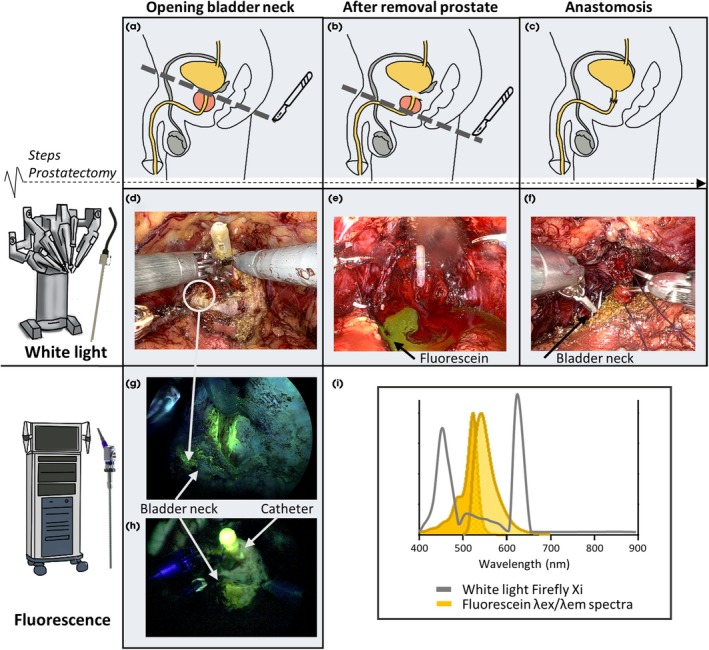 Figure 1
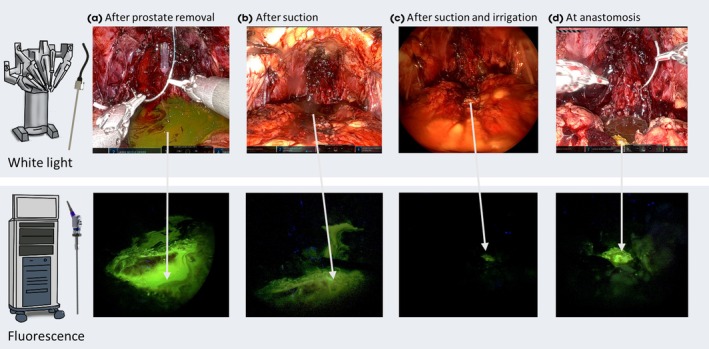 Figure 2
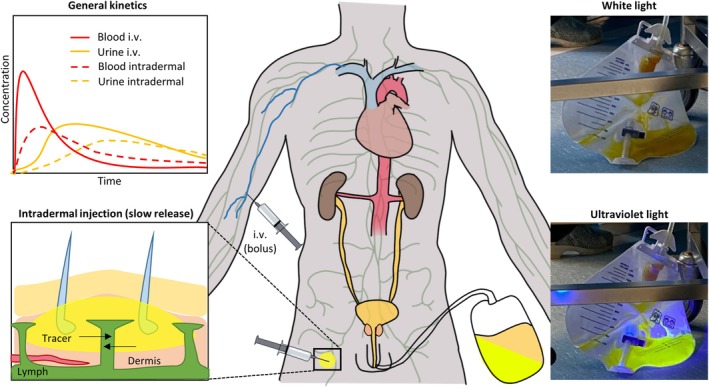 Figure 3
Peer Reviews
No public reviews on file for this paper yet. If you reviewed it on a platform where reviews are public (OpenReview, ICLR, NeurIPS, ICML), you can paste yours below so the community can read it here.
Videos
No videos yet. Explain this paper in a talk, walkthrough, or lecture? Add one.
Taxonomy
TopicsUreteral procedures and complications · Bladder and Urothelial Cancer Treatments · Pediatric Urology and Nephrology Studies