Targeted gene editing and near-universal cDNA insertion of CYBA and CYBB as a treatment for chronic granulomatous disease
Jonas Holst Wolff, Thomas Wisbech Skov, Didde Haslund, Sofie Rahbek Dorset, Anne Louise S. Revenfeld, Clotilde Aussel, Sofie E. Jørgensen, Mette Holm, Martin K. Thomsen, Sandra Ammann, Toni Cathomen, Trine H. Mogensen, Bjarne Kuno Møller, Rasmus O. Bak, Jacob Giehm Mikkelsen

TL;DR
Researchers developed a safer gene editing strategy using D10A Cas9n to treat chronic granulomatous disease by correcting genetic defects in hematopoietic stem cells.
Contribution
A novel D10A Cas9n-based gene editing approach with no detectable off-target activity or chromosomal translocations is introduced for treating CGD.
Findings
Using high-fidelity Cas9 minimizes off-target editing and restores engraftment potential in gene-edited HSPCs.
A D10A Cas9n strategy achieves no detectable off-target activity or chromosomal translocations.
Risk assessments show the D10A Cas9n strategy offers a potentially curative treatment for CGD.
Abstract
Chronic granulomatous disease (CGD) is a severe inborn error of immunity caused by NADPH oxidase defects. Here, we develop CRISPR/Cas9-based gene editing strategies for correction of variants in the CYBA and CYBB genes causing CGD. For X-linked CGD, we also develop a near-universal gene editing strategy by targeted integration of a truncated CYBB cDNA in CD34+ hematopoietic stem and progenitor cells (HSPCs). Throughout, off-target editing and chromosomal translocations are evident, which negatively impact the ability of gene-edited HSPCs to engraft in immunodeficient mice. However, by employing a high-fidelity Cas9 to minimize off-target editing, we demonstrate restoration of the multilineage engraftment potential of gene-edited HSPCs. Moreover, to further improve safety, we develop a D10A Cas9n editing approach with no detectable off-target activity or chromosomal translocations.…
Genes, proteins, chemicals, diseases, species, mutations and cell lines named across the full text — each resolved to its canonical identifier and authoritative record.
Click any figure to enlarge with its caption.
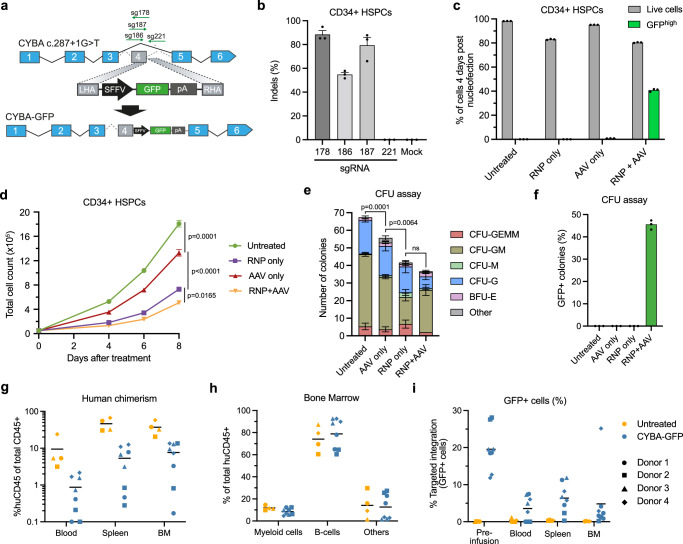 Figure 1
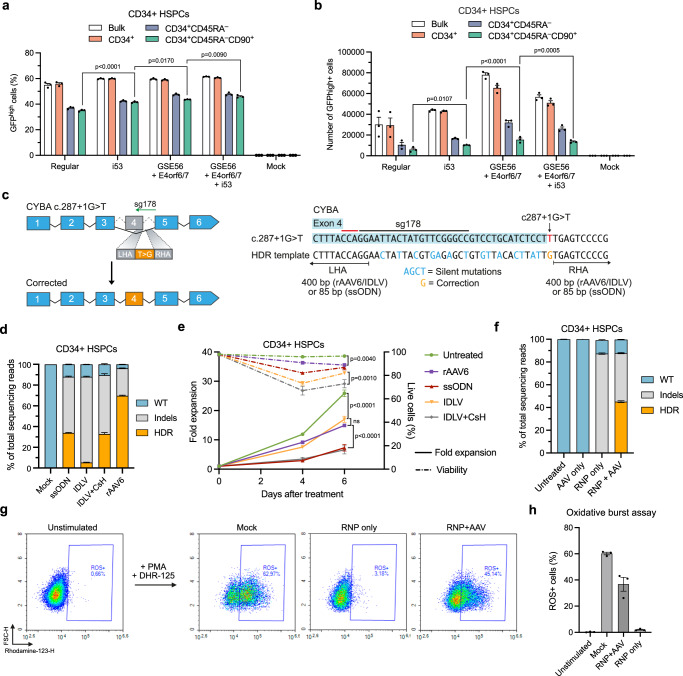 Figure 2
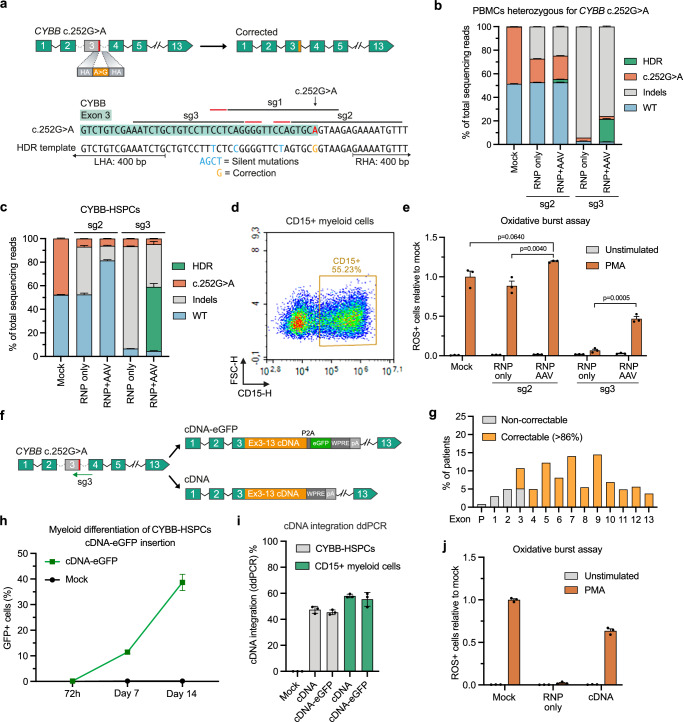 Figure 3
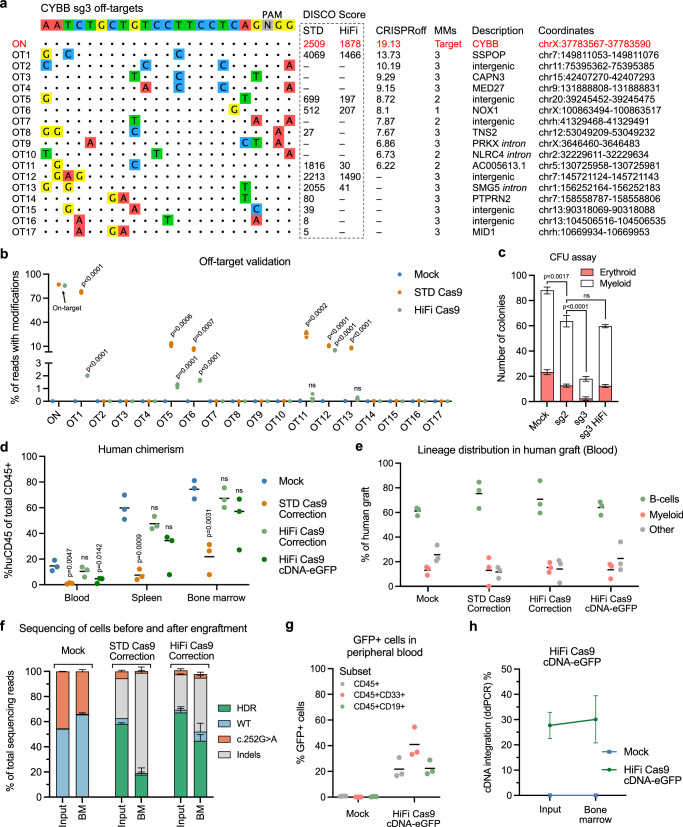 Figure 4
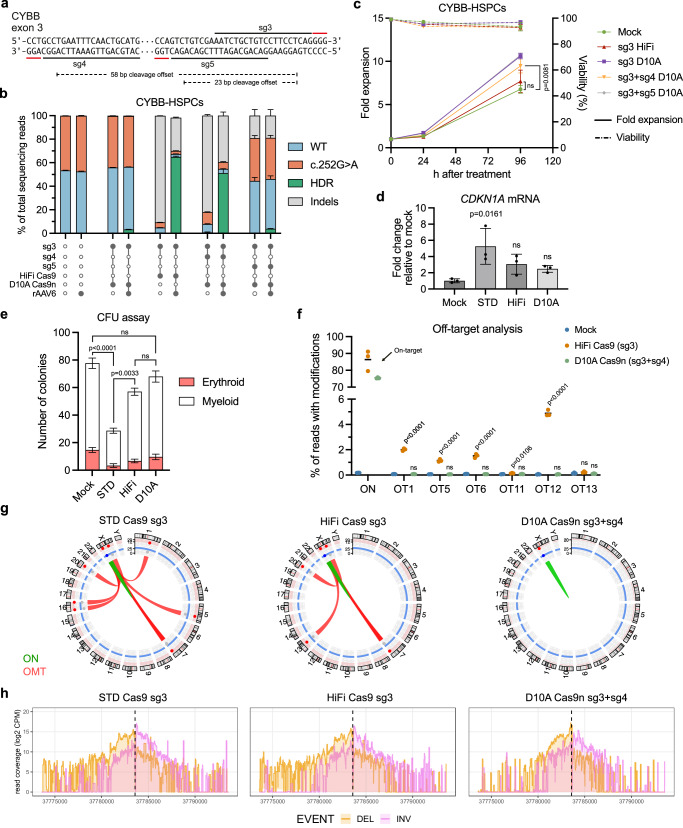 Figure 5
Peer Reviews
No public reviews on file for this paper yet. If you reviewed it on a platform where reviews are public (OpenReview, ICLR, NeurIPS, ICML), you can paste yours below so the community can read it here.
Videos
No videos yet. Explain this paper in a talk, walkthrough, or lecture? Add one.
Taxonomy
TopicsCRISPR and Genetic Engineering · RNA and protein synthesis mechanisms · Advanced biosensing and bioanalysis techniques