ICU environment as a reservoir of KPC-ST307-Klebsiella pneumoniae high-risk clone resistant to ceftazidime-avibactam
Marta Hernández-García, Marta Nieto-Torres, Natalia Guerra-Pinto, Juan Antonio Castillo-Polo, Javier Saez de la Fuente, Malkoa Michelena, Manuel Ponce-Alonso, Cruz Soriano-Cuesta, Cristina Díaz-Agero, Rafael Cantón, Teresa M. Coque, Patricia Ruiz-Garbajosa

TL;DR
The ICU environment was found to be a source of antibiotic-resistant Klebsiella pneumoniae, which spread among patients and sinks during the pandemic.
Contribution
The study identifies the ICU environment as a reservoir for a high-risk antibiotic-resistant Klebsiella pneumoniae clone.
Findings
Ten patients and two ICU sinks were found to be colonized with ceftazidime-avibactam-resistant KPC-ST307-Klebsiella pneumoniae.
The same resistant clone was found in both patients and sinks, suggesting environmental transmission.
The resistant bacteria showed reduced susceptibility to multiple last-line antibiotics.
Abstract
We characterized all ceftazidime-avibactam-resistant KPC-producing K. pneumoniae (KPC-Kp) isolates recovered from both patients and environmental samples at the ICU of our hospital in 2020, during the COVID-19 pandemic initiation. Antimicrobial susceptibility testing (Sensititre-EUMDROXF; disk-diffusion) and WGS analysis (Illumina-Novaseq/Miseq; Oxford Nanopore®-MinION) were performed. Ten patients (16% of ICU patients) were colonized/infected by a ceftazidime-avibactam-resistant KPC-Kp isolate (March-December), six of them during/after treatment with ceftazidime-avibactam. Two ceftazidime-avibactam-resistant KPC-Kp were also recovered from two ICU sinks (July-September). All isolates belonged to ST307 clone and had identical resistance gene content. Six KPC-variants were detected in patient isolates (KPC-62, KPC-92, KPC-150, KPC-66, KPC-53, KPC-46). KPC-92 and KPC-66 variants were also…
Genes, proteins, chemicals, diseases, species, mutations and cell lines named across the full text — each resolved to its canonical identifier and authoritative record.
Click any figure to enlarge with its caption.
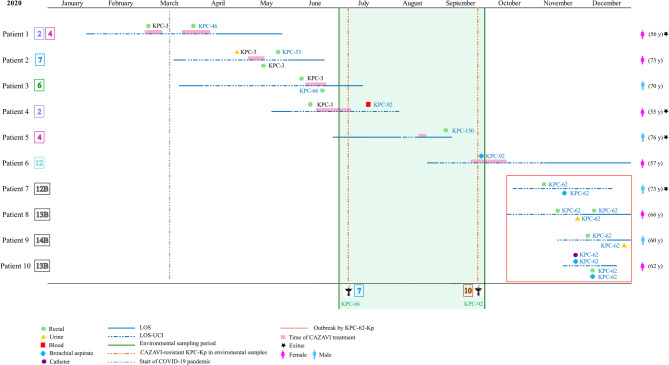 Figure 1
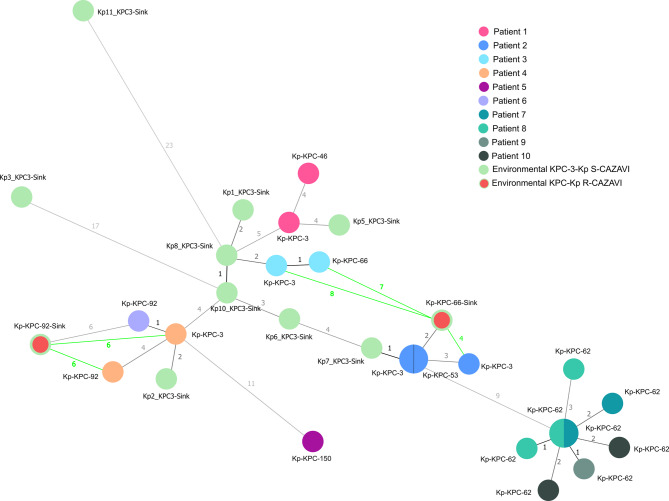 Figure 2
Peer Reviews
No public reviews on file for this paper yet. If you reviewed it on a platform where reviews are public (OpenReview, ICLR, NeurIPS, ICML), you can paste yours below so the community can read it here.
Videos
No videos yet. Explain this paper in a talk, walkthrough, or lecture? Add one.
Taxonomy
TopicsAntibiotic Resistance in Bacteria · Bacterial Identification and Susceptibility Testing · Bacterial biofilms and quorum sensing