A Society-to-Cells approach to evaluating multilevel and interrelated drivers of breast cancer disparities in Black women
Maurade Gormley, Wayne R. Lawrence, Jesse J. Plascak, Electra D. Paskett, Coral Omene, Adana A. M. Llanos

TL;DR
This paper explores how societal and biological factors together contribute to higher breast cancer mortality in Black women.
Contribution
It introduces a Society-to-Cells framework to understand and address breast cancer disparities through multilevel interventions.
Findings
Black women face more aggressive breast cancer subtypes and higher mortality despite medical advances.
Structural and cellular factors interact to perpetuate these disparities.
Systemic reforms are needed to address historical and ongoing inequities in healthcare and neighborhoods.
Abstract
Despite advances in detection and treatment, Black women in the US continue to experience more aggressive breast cancer subtypes and higher mortality. Framed through a Society-to-Cells lens, this review presents a comprehensive framework for understanding how multilevel drivers—from structural forces to cellular responses—interact to perpetuate disparities. Addressing these inequities requires systemic reforms targeting root causes, including policies to redress historical neighborhood disinvestment and eliminate bias within healthcare systems.
Genes, proteins, chemicals, diseases, species, mutations and cell lines named across the full text — each resolved to its canonical identifier and authoritative record.
Click any figure to enlarge with its caption.
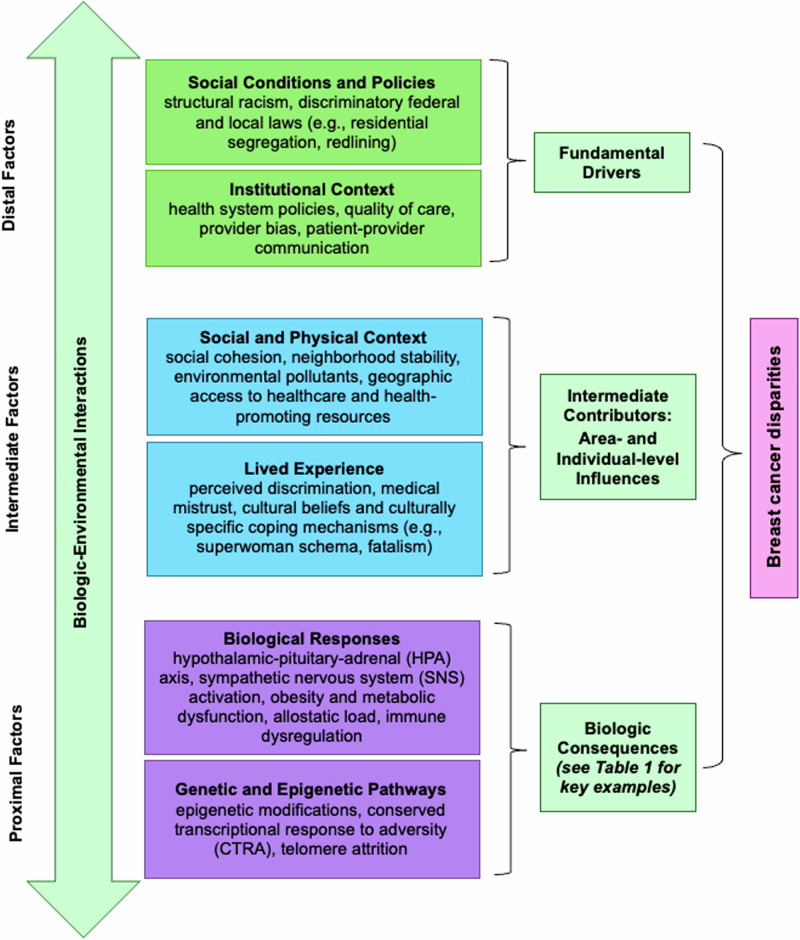 Figure 1
Peer Reviews
No public reviews on file for this paper yet. If you reviewed it on a platform where reviews are public (OpenReview, ICLR, NeurIPS, ICML), you can paste yours below so the community can read it here.
Videos
No videos yet. Explain this paper in a talk, walkthrough, or lecture? Add one.
Taxonomy
TopicsGlobal Cancer Incidence and Screening · Racial and Ethnic Identity Research · Acute Lymphoblastic Leukemia research