The third-generation-philic WIMP: an EFT analysis
Georgios Demetriou, Gino Isidori, Gioacchino Piazza, Emanuelle Pinsard

TL;DR
This paper explores dark matter particles that interact mainly with third-generation particles, showing that current experiments haven't ruled out certain possibilities, and future experiments may detect them.
Contribution
The study introduces a new analysis of third-generation-philic dark matter using effective field theory and explores implications for the electroweak hierarchy problem.
Findings
Current direct-detection constraints on third-generation-philic dark matter interactions are much weaker than for flavor-universal couplings.
A well-defined region for fermionic dark matter with mass in the 1–2 TeV range is consistent with observed relic abundance.
Introducing a vector mediator can recover additional parameter space for both fermion and scalar dark matter candidates.
Abstract
We consider fermionic and scalar dark matter (DM) candidates that couple predominantly to third-generation Standard Model fermions, describing their interactions within an effective field theory framework. We show that current direct-detection constraints on these interactions are more than an order of magnitude weaker than those for flavor-universal couplings: effective scales in the few-TeV range remain allowed by existing data, leaving open the possibility of a connection between this type of new physics and a solution to the electroweak hierarchy problem. Imposing the observed relic abundance from thermal freeze-out within the same effective theory, a well-defined region for a fermionic DM candidate with mass in the 1–2 TeV range emerges. Notably, this region will be fully probed by upcoming direct-detection experiments. Finally, we show that additional parameter space for both…
Genes, proteins, chemicals, diseases, species, mutations and cell lines named across the full text — each resolved to its canonical identifier and authoritative record.
Click any figure to enlarge with its caption.
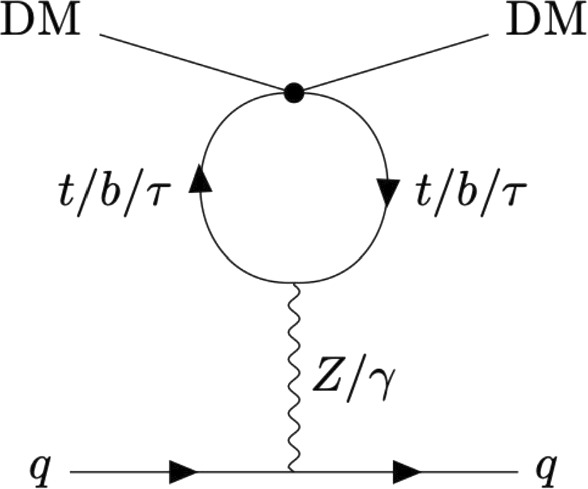 Figure 1
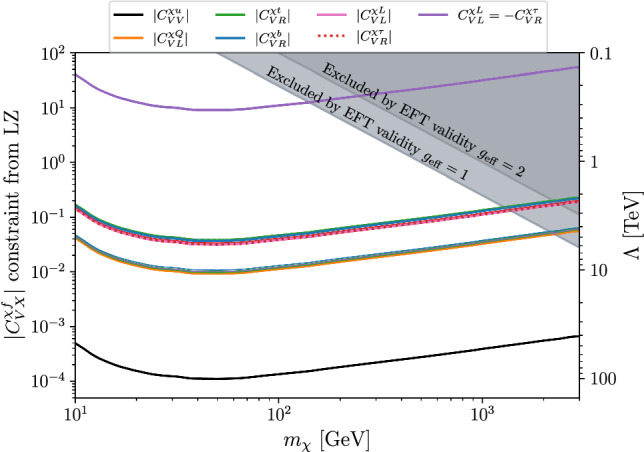 Figure 2
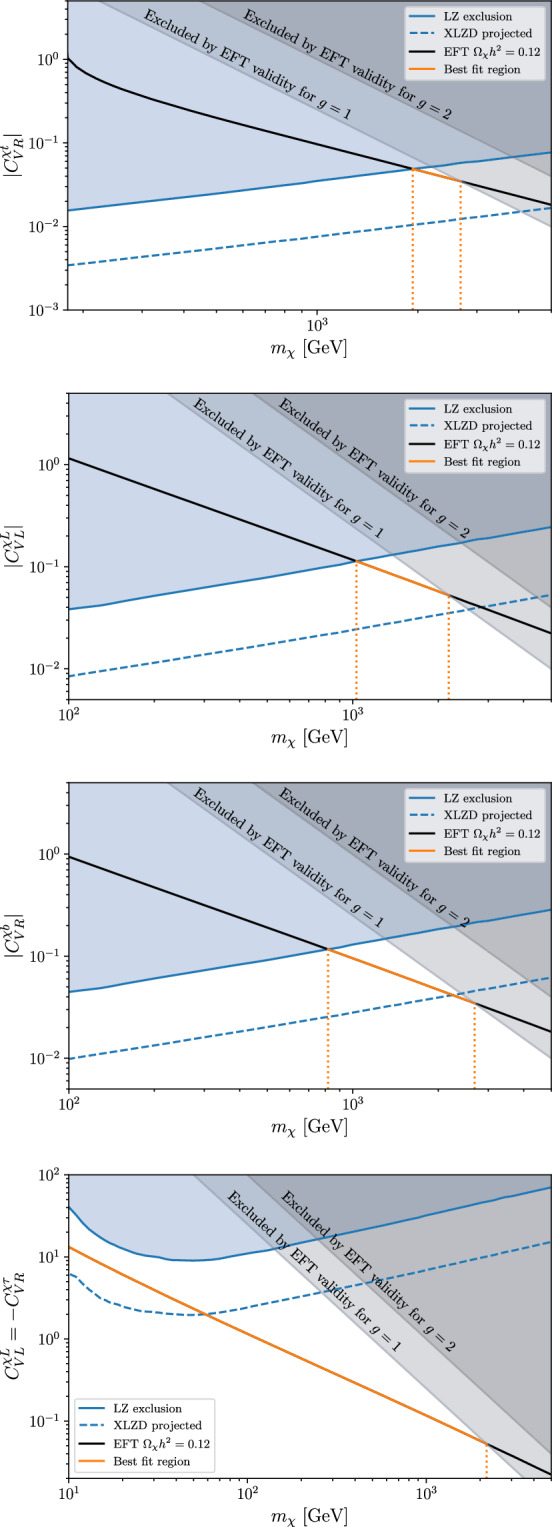 Figure 3
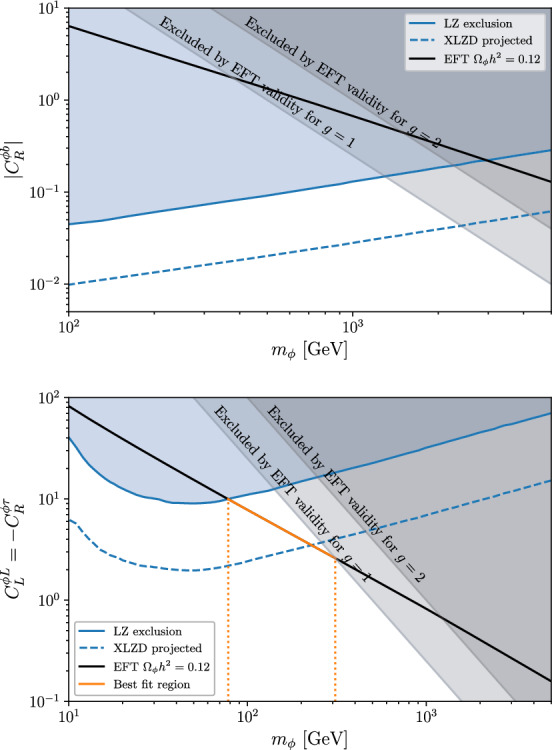 Figure 4
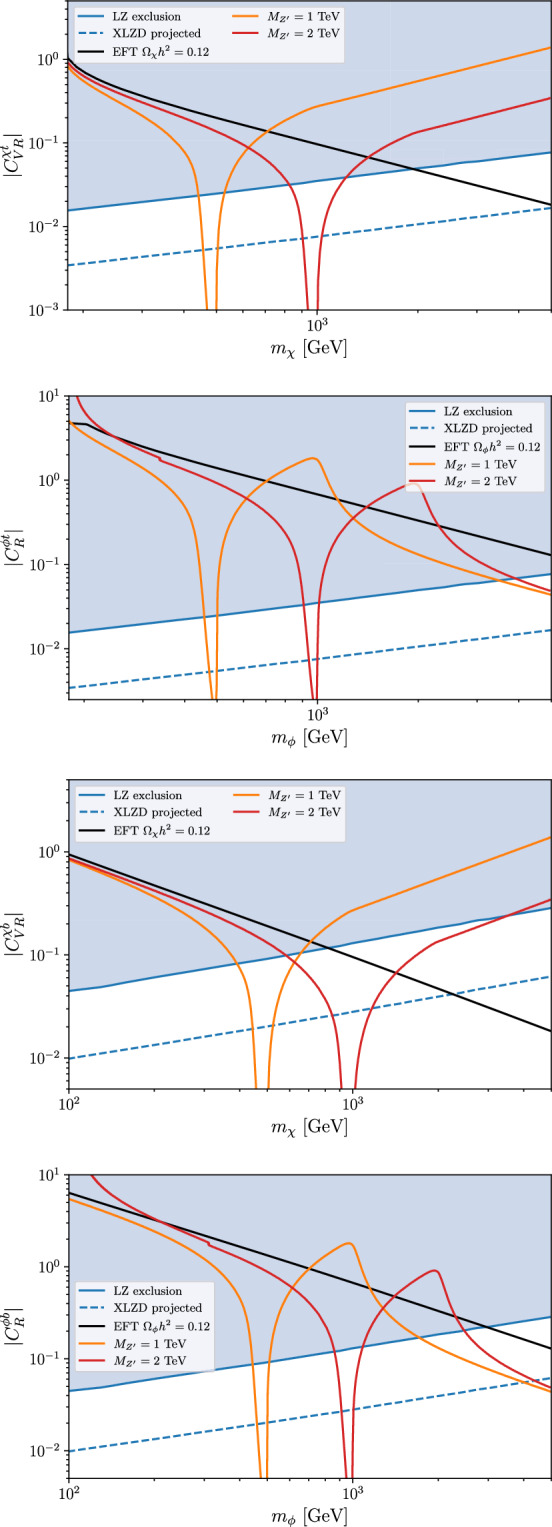 Figure 5
Peer Reviews
No public reviews on file for this paper yet. If you reviewed it on a platform where reviews are public (OpenReview, ICLR, NeurIPS, ICML), you can paste yours below so the community can read it here.
Videos
No videos yet. Explain this paper in a talk, walkthrough, or lecture? Add one.
Taxonomy
TopicsDark Matter and Cosmic Phenomena · Particle physics theoretical and experimental studies · Cosmology and Gravitation Theories