Larval ascariasis elicits a prominent IgA and IgG1/2 antibody response to adult Ascaris excretory/secretory antigens in pigs
Zaneta D. Musimbi, Alexandra Laubschat, Larissa Oser, Robert M. Mugo, Benjamin-Florian Hempel, Philipp Höfler, Josephine Schlosser-Brandenburg, Ankur Midha, Sebastian Rausch, Susanne Hartmann

TL;DR
This study shows that pig infections with roundworms trigger strong antibody responses, especially to adult worm secretions, even during the larval stage.
Contribution
The study reveals a prominent IgA and IgG1/2 response to adult Ascaris antigens during larval infection in pigs.
Findings
ES products reliably detect parasite-specific antibodies in sera at both larval and adult stages.
IgA+ B cells increase in intestinal lymph nodes during the larval stage but decrease at the adult stage.
sIgA levels in the lung correlate with eosinophil numbers, supporting prior mouse studies in definitive hosts.
Abstract
Roundworm infections result in morbidity, causing significant health and economic concerns in humans and pigs, respectively. We investigated the humoral responses of Ascaris suum infected pigs before and after transition from larval to adult stage and confirmed our previous report on the diagnostic value of human Ascaris-specific antibodies. We evaluated the systemic and mucosal humoral responses in Ascaris infected pigs at 14- and 35-days post-infection (dpi). Ascaris-specific antibodies against larval and adult worm antigens and adult excretory/secretory (ES) products in serum, broncho-alveolar lavage fluid and intestinal mucus were quantified by ELISA. IgA+ B cells in jejunal/ileal mesenteric lymph nodes (mLNs) were investigated using flow cytometry. ES products reliably reported parasite-specific IgM, IgA, IgG and IgG1/2 present in sera at 35 dpi (adult stage) and even at 14 dpi…
Genes, proteins, chemicals, diseases, species, mutations and cell lines named across the full text — each resolved to its canonical identifier and authoritative record.
Click any figure to enlarge with its caption.
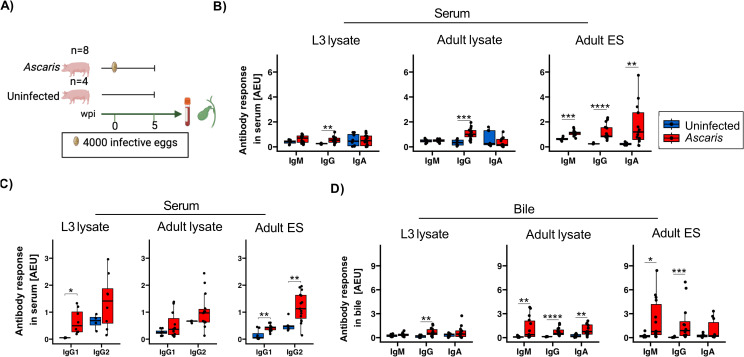 Figure 1
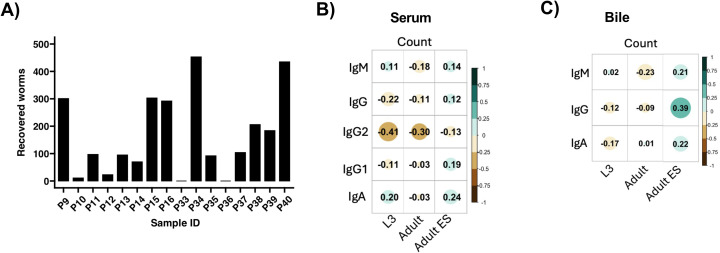 Figure 2
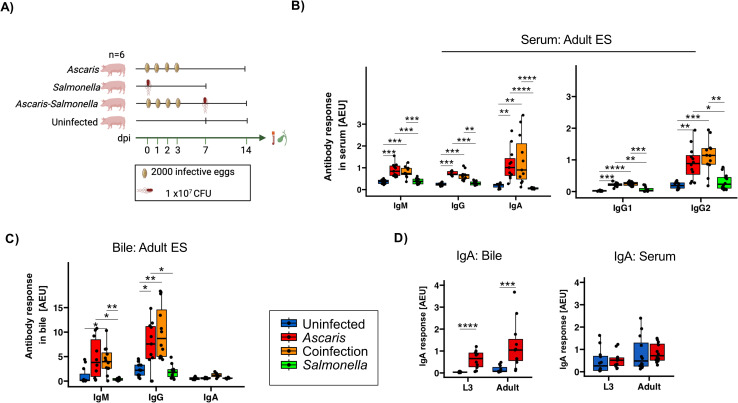 Figure 3
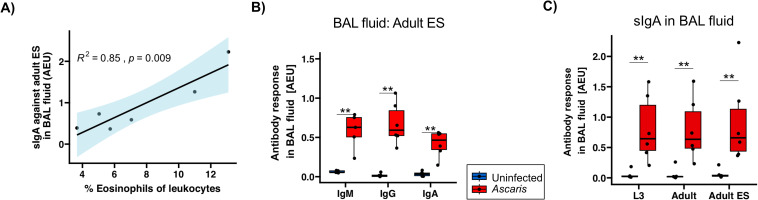 Figure 4
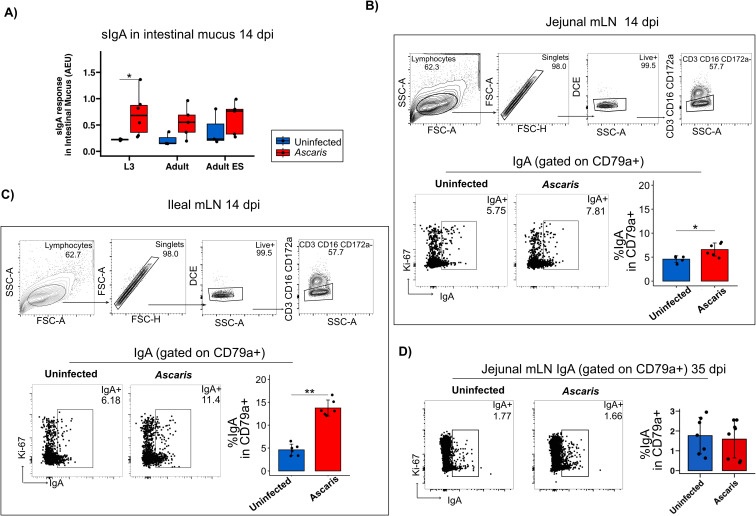 Figure 5
Peer Reviews
No public reviews on file for this paper yet. If you reviewed it on a platform where reviews are public (OpenReview, ICLR, NeurIPS, ICML), you can paste yours below so the community can read it here.
Videos
No videos yet. Explain this paper in a talk, walkthrough, or lecture? Add one.
Taxonomy
TopicsParasites and Host Interactions · Helminth infection and control · Parasite Biology and Host Interactions