Identifying immunoreactive proteins in brucellin for enhanced brucellosis diagnosis: a proteomic approach
Ivanka Krasteva, Mirella Luciani, Federica D’Onofrio, Tiziana Di Febo, Chiara Di Pancrazio, Fabrizia Perletta, Marta Maggetti, Simonetta Ulisse, Luigina Sonsini, Gianluca Orsini, Marco Caporale, Claire Ponsart, Vitomir Djokic, Acacia Ferreira Vicente, Luca Freddi

TL;DR
This study identifies key immunoreactive proteins in brucellin to improve brucellosis diagnosis and reduce false positives.
Contribution
The study characterizes brucellin's protein composition and identifies common immunodominant proteins across different formulations.
Findings
Proteomic analysis identified 123 common proteins across three brucellin formulations.
Key immunodominant proteins like ribosomal L7/L12 and Bacterioferritin were consistently detected.
Mass spectrometry is proposed as a quality control method for brucellin production.
Abstract
The brucellin skin test (BST) detects brucellosis in animals through a cell-mediated immune response to a protein extract from B. melitensis strain 115, which is almost free of lipopolysaccharide. It is highly specific and used to confirm suspected false positive serology results in small ruminants and swine, but not recommended for screening due to low sensitivity. Despite its diagnostic significance, the protein composition of brucellin has not been fully characterized. This study used nLC-ESI-MS/MS analysis and bioinformatics tools to evaluate brucellin’s protein composition and identify immunoreactive proteins. An allergen suspension of purified proteins (free of S-LPS) of EU Standard Brucellin, produced by ANSES, IZS-Teramo (IZSAM) and the former commercialised brucellergene OCB® were used. Proteomic analysis identified 247 (ANSES), 542 (IZSAM) and 183 (OCB) proteins. Two hundred…
Genes, proteins, chemicals, diseases, species, mutations and cell lines named across the full text — each resolved to its canonical identifier and authoritative record.
Click any figure to enlarge with its caption.
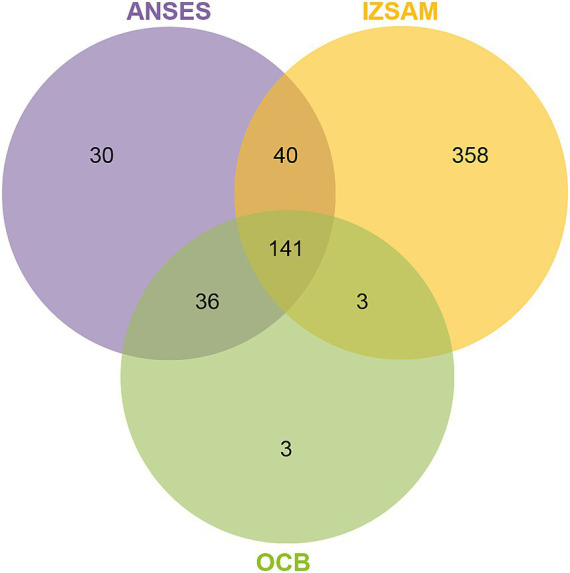 Figure 1
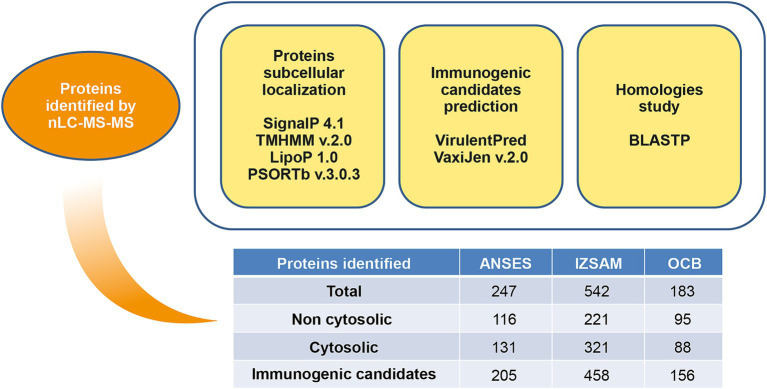 Figure 2
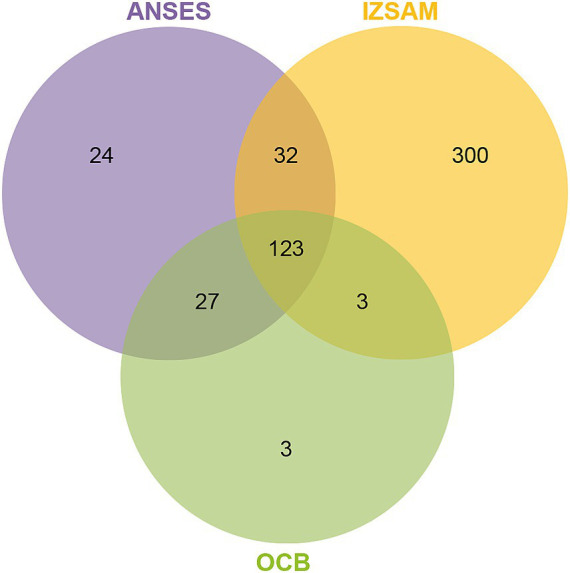 Figure 3
 Figure 4
Peer Reviews
No public reviews on file for this paper yet. If you reviewed it on a platform where reviews are public (OpenReview, ICLR, NeurIPS, ICML), you can paste yours below so the community can read it here.
Videos
No videos yet. Explain this paper in a talk, walkthrough, or lecture? Add one.
Taxonomy
TopicsBrucella: diagnosis, epidemiology, treatment · Bacteriophages and microbial interactions · vaccines and immunoinformatics approaches