DFusMol: predicting molecular properties based on dual-channel attention
Xuan Liu, Wei Du, Haibao Tang, Yingjian Gu, Zhibang Li, Xiaoyang Fu

TL;DR
DFusMol is a new method for predicting molecular properties by combining atomic and motif-level information using a dual-channel attention mechanism, leading to improved accuracy in drug discovery.
Contribution
DFusMol introduces a dual-channel attention framework that integrates atomic and motif-level features for enhanced molecular property prediction.
Findings
DFusMol outperforms state-of-the-art models on six of nine benchmark datasets.
The dual-channel attention mechanism effectively captures hierarchical molecular complexity.
The method shows strong potential for drug design and lead compound screening.
Abstract
Accurate molecular property prediction is fundamental to modern drug discovery and materials design. However, prevailing computational methods are often insufficient, as they rely on single-granularity structural representations that fail to capture the hierarchical complexity of molecular systems. To address this challenge, we propose a new approach to molecular representation learning that incorporates structural information across multiple scales. We design DFusMol (Dual Fusion with Global and Local Attention), a novel framework inspired by multi-modal learning. DFusMol employs graph encoders to capture features from both atomic-level molecular graphs and motif-level graphs derived from chemical rules. A customized global-local attention mechanism then blends these diverse features to build comprehensive molecular representations. Experiments on nine public benchmark datasets reveal…
Genes, proteins, chemicals, diseases, species, mutations and cell lines named across the full text — each resolved to its canonical identifier and authoritative record.
Click any figure to enlarge with its caption.
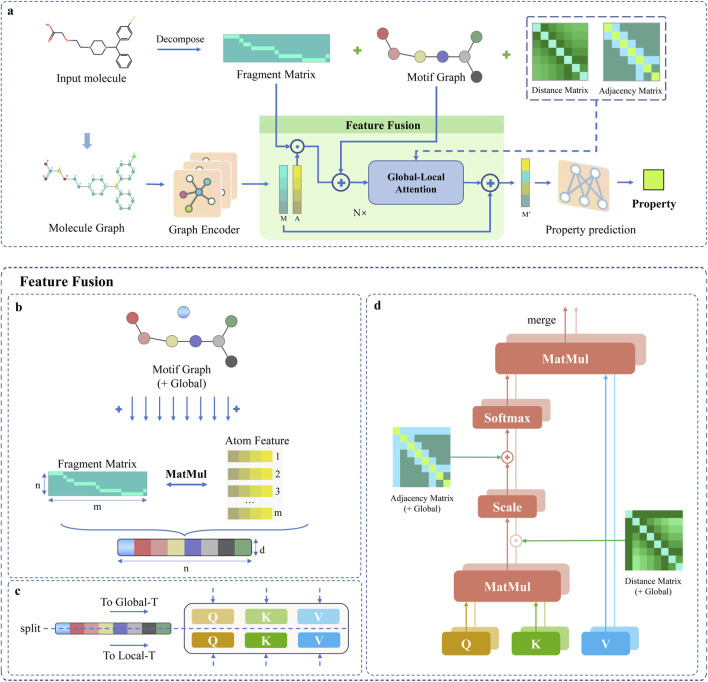 Figure 1
 Figure 2
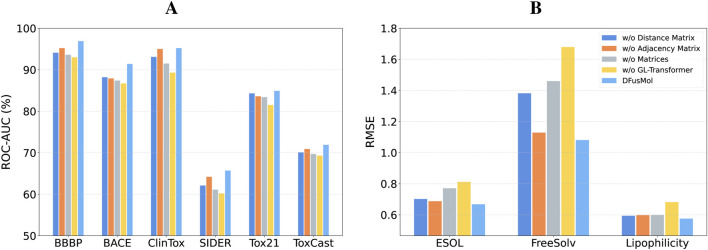 Figure 3
 Figure 4
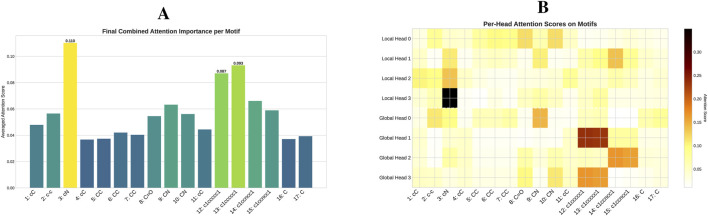 Figure 5
Peer Reviews
No public reviews on file for this paper yet. If you reviewed it on a platform where reviews are public (OpenReview, ICLR, NeurIPS, ICML), you can paste yours below so the community can read it here.
Videos
No videos yet. Explain this paper in a talk, walkthrough, or lecture? Add one.
Taxonomy
TopicsComputational Drug Discovery Methods · Machine Learning in Materials Science · Protein Structure and Dynamics