A Woman with Abdominal Pain
Colton Conrad, Reginald Alouidor, Christopher Allison

TL;DR
A 28-year-old woman with a history of drug use developed rare sigmoid colon intussusception without a typical cause, possibly due to opioid-induced gut motility issues.
Contribution
This case highlights an unusual cause of intussusception in a young adult without a pathologic lead point, linked to chronic opioid use.
Findings
The patient had sigmoid colon intussusception without a detectable lead point.
Chronic opioid use is hypothesized to contribute to decreased gut motility and intussusception.
This case is rare in young adults without underlying pathology.
Abstract
A 28-year-old woman with a history of cocaine and opioid use disorder presented to the emergency department with abdominal pain, nausea, and vomiting for two days. She’d had irregular bowel movements with constipation for quite some time. Physical exam was notable for diffuse peritonitis and melena on digital rectal exam. Patient had a witnessed episode of hematochezia. Computed tomography of the abdomen and pelvis with intravenous contrast demonstrated sigmoid colon intussusception, and the patient underwent emergent surgery for definitive treatment. Specimen was sent to surgical pathology and revealed no lead point. While sigmoid intussusception is not a rare finding, it is exceedingly rare in young adult patients who do not have a pathologic lead point. Lead points are areas of inflammation, lesions, or masses that snag the bowel and initiate the process of telescoping that…
Genes, proteins, chemicals, diseases, species, mutations and cell lines named across the full text — each resolved to its canonical identifier and authoritative record.
Click any figure to enlarge with its caption.
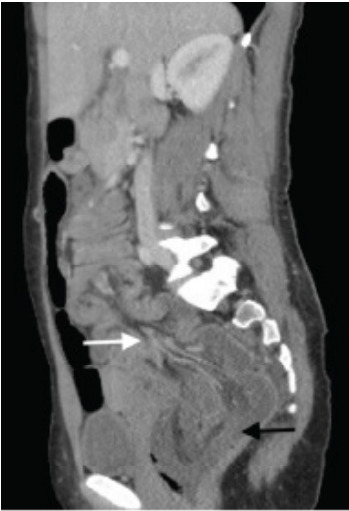 Figure 1
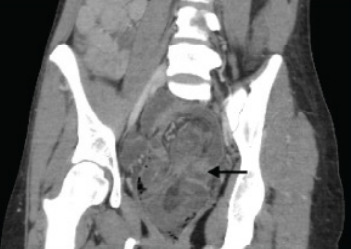 Figure 2
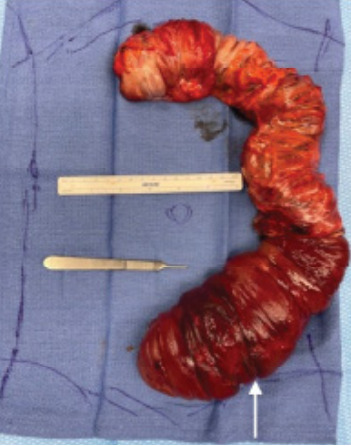 Figure 3
Peer Reviews
No public reviews on file for this paper yet. If you reviewed it on a platform where reviews are public (OpenReview, ICLR, NeurIPS, ICML), you can paste yours below so the community can read it here.
Videos
No videos yet. Explain this paper in a talk, walkthrough, or lecture? Add one.
Taxonomy
TopicsHernia repair and management · Appendicitis Diagnosis and Management
CASE PRESENTATION
A 28-year-old woman with a history of cocaine and heroin use presented with abdominal pain, nausea, and vomiting worsening for two days. On physical exam, the patient was noted to have peritonitis in all four quadrants of the abdomen with absent bowel sounds and melanotic stool on digital rectal exam, as well as a witnessed episode of hematochezia. Vital signs were significant for tachycardia. Laboratory studies were significant only for a leukocytosis of 13.1 x 10^3^/liter (L) (reference range: 4.5–11.0 x 10^3^/L). The patient received antibiotics and antiemetic therapy, as well as pain control. Computed tomography (CT) of the abdomen and pelvis with intravenous (IV) contrast revealed the diagnosis of intussusception involving the sigmoid colon, and the transverse and descending colon, as well as part of the omentum (Images 1 and 2). She underwent emergency surgery for definitive treatment (Image 3).
DISCUSSION
Computed tomography with IV contrast demonstrated sigmoid colon intussusception involving the transverse and descending colon, as well as parts of the omentum with evidence of ischemic necrosis. The patient underwent emergent sigmoidectomy, sub-total colectomy, partial omentectomy, and creation of end-ileostomy. The resected specimen was evaluated by pathology but demonstrated no lead point. Our patient had an extensive history of constipation, likely secondary to her opioid dependence. Opioids act on the mu opioid receptors within the small and large bowel, leading to decreased smooth muscle contractions, diminished colonic peristalsis, and prolonged transit times.1 We hypothesize chronic opioid use contributed to her intussusception. Only one other case report in recent literature describes a patient with intussusception without pathologic lead point in the setting of chronic cocaine and opioid dependence.2 The prevalence of fentanyl contamination in cocaine and methamphetamine is estimated to be greater than 10%.3 Thus, patients who primarily use stimulants may unknowingly consume opioids on a regular basis, putting them at risk for decreased gut motility.
CPC-EM CapsuleWhat do we already know about this clinical entity?Intussusception is relatively rare in adults and is generally associated with older age, adhesions from prior surgeries, inflammatory bowel disease, or malignancy.What is the major impact of the image(s)?The combination of computed tomography images and gross specimen photograph help the reader correlate typical radiographic findings with the physiologic process.How might this improve emergency medicine practice?This case serves as a reminder to consider atypical presentations of intussusception especially in young patients with risk factors such as chronic opioid use.
Intussusception in adults is rare, with an incidence of 2–3 cases per million annually, and comprising only 5% of all cases. Approximately 80–90% of adult intussusception cases extend from pathologic lead points that may represent inflammatory bowel disease, diverticular disease, polyps, or malignancy.4 The remaining 10–20% of intussusception cases without a pathologic lead point are termed “idiopathic.” The diagnostic modality of choice is CT with IV contrast, which may elucidate an existing lead point. Definitive treatment is resection via laparotomy, which exposes the entire colon for evaluation.5
The reference list from the paper itself. Each links out to its DOI / PubMed record.
- 1Galligan JJ Sternini C Insights into the role of opioid receptors in the GI tract: experimental evidence and therapeutic relevance Handb Exp Pharmacol 2017239363782820495710.1007/164_2016_116PMC 6310692 · doi ↗ · pubmed ↗
- 2Satoi S Wilson S Park E Intussusception resulting from uncontrolled severe opioid-induced constipation and/or chronic cocaine use Am J Gastroenterol 2021116 S 1448
- 3Wagner KD Fiuty P Page K Prevalence of fentanyl in methamphetamine and cocaine samples collected by community-based drug checking services Drug Alcohol Depend 202312521109853782698810.1016/j.drugalcdep.2023.110985 PMC 10688611 · doi ↗ · pubmed ↗
- 4Marinis A Yiallourou A Samanides L Intussusception of the bowel in adults: a review World J Gastroenterol 2009154407111915244310.3748/wjg.15.407PMC 2653360 · doi ↗ · pubmed ↗
- 5Huang BY Warshauer DM Adult intussusception: diagnosis and clinical relevance Radiol Clin North Am 20034161137511466166210.1016/s 0033-8389(03)00116-7 · doi ↗ · pubmed ↗