Letter to the Editor: Idiopathic Hypertrophic Pachymeningitis presenting as Occipital Neuralgia with associated Chiari Malformation
José L Ruiz-Sandoval, Marco A Sánchez Torres, Jefte Felipe Uribe-Martínez, Amado Jimenez-Ruiz

Abstract
Genes, proteins, chemicals, diseases, species, mutations and cell lines named across the full text — each resolved to its canonical identifier and authoritative record.
Click any figure to enlarge with its caption.
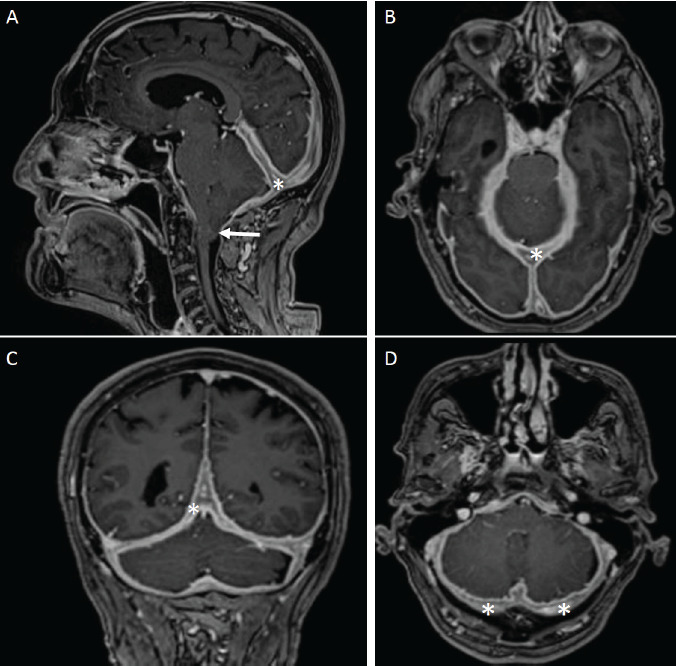 Figure 1
Peer Reviews
No public reviews on file for this paper yet. If you reviewed it on a platform where reviews are public (OpenReview, ICLR, NeurIPS, ICML), you can paste yours below so the community can read it here.
Videos
No videos yet. Explain this paper in a talk, walkthrough, or lecture? Add one.
Taxonomy
TopicsIgG4-Related and Inflammatory Diseases
We read the case report published by Auboire et al., regarding a case of idiopathic pachymeningitis, presenting as occipital neuralgia1. We would like to enrich the presented discussion by presenting a recent case seen in our Neurology Department, with similar clinical features, but distinct radiologic findings.
A previously healthy 76-year-old man, with a history of a three-year progressively worsening headache, was seen in the out-patient neurology clinic. Headache semiology included short (a few seconds) bouts of paroxistic occipital “stabbing” pain, related to positional head movements. The pain radiated to the superficial posterior and anterior part of the right scalp, with an accompanying cramplike sensation in the right occiput, a presentation consistent with occipital neuralgia (Arold's Neuralgia). He also experienced vertigo, dysarthria, and right arm incoordination. A contrast-enhanced cranial MRI showed diffuse regular pachymeningeal enhancement (Panel A, B, C, and D; asterisk), and a 12-mm caudal cerebellar tonsil descent (type 1 Arnold-Chiari malformation) (Panel A, Arrow). Immunological workup was normal (including IgG-4 quantification), and other infectious and neoplastic causes were reasonably excluded (in a resource-limited setting). A meningeal biopsy was unavailable, due to the ongoing COVID-19 pandemic. We established a diagnosis of idiopathic hypertrophic cranial pachymeningitis (IHCP). After receiving 50mg prednisone per day for three months, the patient experienced complete remission of the observed symptoms, and was lost to follow-up.
IHCP is an inflammatory condition, characterized by localized or diffuse thickening of the dura mater in the brain or upper spinal cord regions2. It may be secondary to inflammatory, infectious, or neoplastic causes. When none are found, it may be classified as a primary disorder3. It usually presents with headache and cranial nerve palsies, but can involve posterior fossa structures, and present clinically with cerebellar dysfunction. Occipital neuralgia is a distinctive form of headache, involving the posterior head in the distributions of the occipital nerves (greater occipital, lesser occipital, and third occipital). A secondary cause of occipital nerve damage must always be considered, such as the one presented here. IHCP affects older patients, and usually has an excellent response to steroids and immunosuppression. To our knowledge, this is the first case description of IHCP presenting with occipital neuralgia and associated cerebellar descent.
The reference list from the paper itself. Each links out to its DOI / PubMed record.
- 1Auboire L Boutemy J Constans J Le Gallou T Busson P Bienvenu B Idiopathic hypertrophic pachymeningitis presenting with occipital neuralgia Afr Health Sci 2015 Mar 121513022583456510.4314/ahs.v 15i 1.42PMC 4370138 · doi ↗ · pubmed ↗
- 2Charleston L Cooper W An Update on Idiopathic Hypertrophic Cranial Pachymeningitis for the Headache Practitioner Curr Pain Headache Rep 2020 Oct 2410573280347510.1007/s 11916-020-00893-5 · doi ↗ · pubmed ↗
- 3Abrantes FF Moraes MPM de Rezende Filho FM Pedroso JL Barsottini OGPA clinical approach to hypertrophic pachymeningitis Arq Neuropsiquiatr 2020 Dec 78127978043329542010.1590/0004-282X 20200073 · doi ↗ · pubmed ↗