Mitochondrial genome of a Bolivian River Dolphin (Inia boliviensis)
Kristin Coury, Ellen Bronson, Claudia Venegas Cuzmar, Sharon Deem, Jacqueline M. Doyle

TL;DR
This paper presents the mitochondrial genome of the Bolivian river dolphin, aiding conservation efforts for this endangered species.
Contribution
The study provides the first sequenced mitochondrial genome of the Bolivian river dolphin (Inia boliviensis).
Findings
The mitochondrial genome is 16,591 base pairs long with specific nucleotide composition.
The genome will help improve understanding of population genetics for conservation.
Tissue samples were collected during rescue operations to study fragmented dolphin populations.
Abstract
Inia boliviensis, the endemic Bolivian river dolphin, is threatened by anthropogenic activities including diversion of waterways for irrigation of agricultural fields, habitat degradation through deforestation, and the construction of hydroelectric dams. Within the department of Santa Cruz in Bolivia, conservation partners are committed to the capture and relocation of river dolphins that have been isolated through seasonally changing waterways, which are exacerbated by anthropogenic changes to local rivers’ courses. During these rescue attempts, tissue samples were taken to better understand the genetic composition of the fragmented populations. Herein, we describe the newly sequenced and assembled Bolivian river dolphin mitochondrial genome. The genome assembly is 16,591 base pairs in length, with an overall base composition of 32.75% adenine, 25.85% thymine, 28.35% cytosine, and…
Genes, proteins, chemicals, diseases, species, mutations and cell lines named across the full text — each resolved to its canonical identifier and authoritative record.
Click any figure to enlarge with its caption.
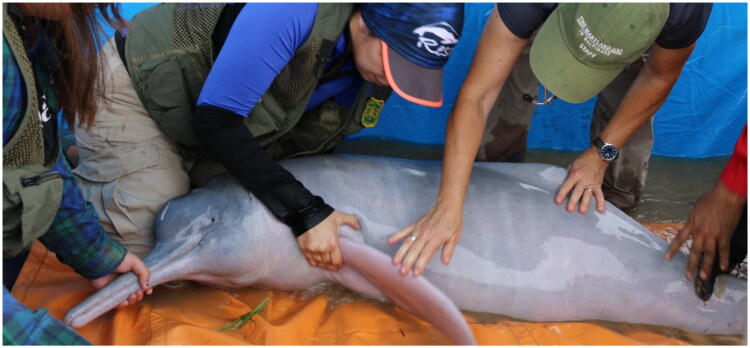 Figure 1
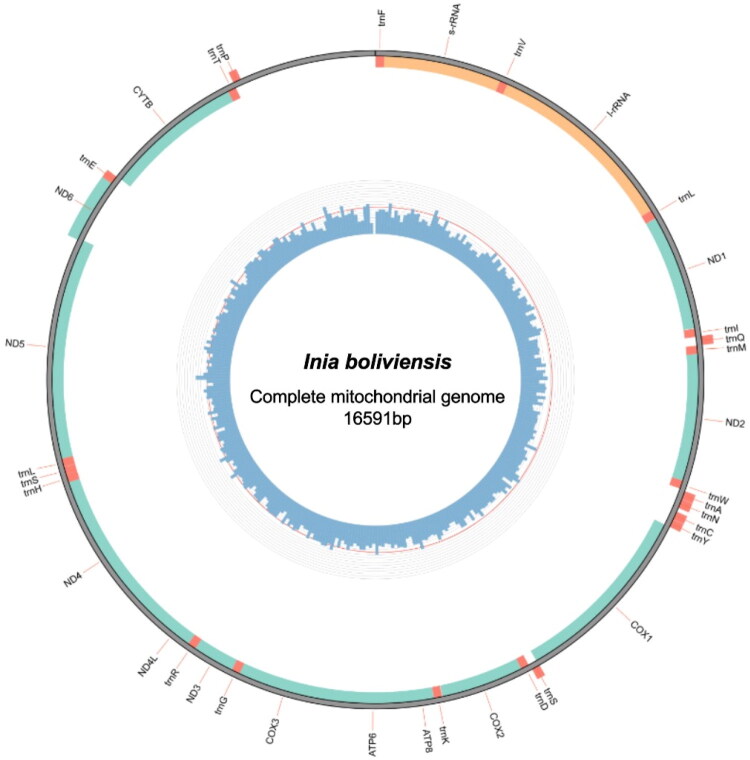 Figure 2
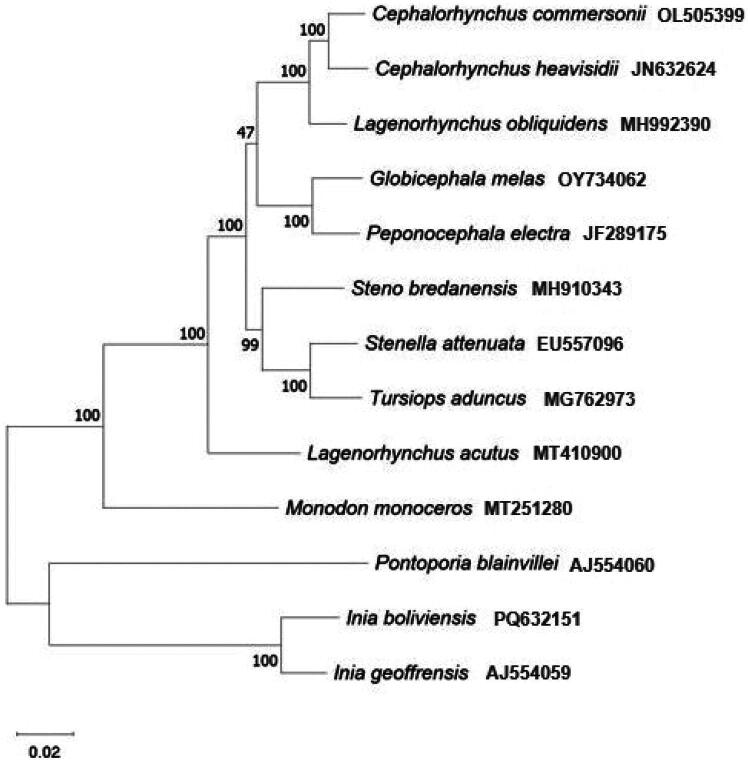 Figure 3
- —the Maryland Zoo in Baltimore, the Saint Louis Zoo, and Towson University Fisher College of Science and Mathematics
Peer Reviews
No public reviews on file for this paper yet. If you reviewed it on a platform where reviews are public (OpenReview, ICLR, NeurIPS, ICML), you can paste yours below so the community can read it here.
Videos
No videos yet. Explain this paper in a talk, walkthrough, or lecture? Add one.
Taxonomy
TopicsMarine animal studies overview · Aquaculture disease management and microbiota · Identification and Quantification in Food
Introduction
Inia boliviensis (D’Orbigny 1834) is endemic to the waters of the upper Madeira River basin of Bolivia. These dolphins (locally referred to as bufeos) are morphologically distinct (Pilleri and Gihr 1977; Emin-Lima et al. 2022), genetically differentiated, and largely isolated from the Amazon River dolphin, or boto (Inia geoffrensis) (Ruiz-García et al. 2008; Hollatz et al. 2011; Hrbek et al. 2014; Gravena et al. 2014) by a series of rapids and the Teotȏnio waterfalls. However, the same anthropogenic pressures that affect botos are also harming the remaining populations of Bolivian river dolphins. Habitat degradation and fragmentation through building of hydroelectric dams, deforestation, and water diversion for agricultural irrigation have sharpened conservation concerns for these vulnerable populations (Aliaga-Rossel 2015). A team based at the Noel Kempff Mercado Natural History Museum in the department of Santa Cruz has committed to the relocation of geographically isolated individuals (Aliaga-Rossel and Escobar-WW 2020). These rescue attempts are completed in tandem with conservation partners and aim to mitigate harm from infrastructure and agricultural practices. In both 2018 and 2022, veterinarians from the Maryland Zoo in Baltimore and Saint Louis Zoo assisted in rescues of stranded bufeos, collecting individual biometric and medical data, and tissue samples for genetic analysis.
Compared to marine cetaceans, river dolphins at large are grossly underrepresented in genomic research. For example, publications on the genomics of Delphinidae species outnumber those available for Iniidae species eight-fold (Scopus searches 1 and 2) (SCOPUS search terms “genomics + Delphinidae”; SCOPUS search terms “genomics + Iniidae”). However, researchers have used mitochondrial markers and nuclear microsatellites to better understand the evolutionary history (Banguera-Hinestroza et al. 2002; Ruiz-García, 2010; Gravena et al. 2014, 2015), genetic richness (Ruiz-García et al. 2008, 2024; Aliaga-Rossel, 2015), gene flow (Vianna et al. 2010; Ruiz-García 2010; Gravena et al. 2014, 2015; Aliaga-Rossel 2015; Ruiz-García et al. 2024), and effective population sizes (Gravena et al. 2014) of remaining, fragmented populations of Inia boliviensis. Assembling the complete bufeo mitogenome will be an essential aid in documenting genetic variation among populations and between species (Figure 1).
Pictured is an Inia boliviensis individual during a rescue. Inia boliviensis individuals are distinguished from Inia geoffrensis individuals by cranial differences including a smaller braincase and narrower, longer rostrum (Emin-Lima et al. 2022). Additionally, these species are geographically separated by rapids along the Madeira River. Photo credit: Rosario Arispe.
Materials and methods
18_3 was part of a group of dolphins that had become isolated in an oxbow lake (63°27’30”W and 16°12’20”S) over the course of many years, becoming completely isolated from the Rio Grande in Santa Cruz, Bolivia. In 2018, a team corralled the animal with a net system and moved it to land for assessment and transport. 18_3 was then placed in a padded, wet pool where it received a veterinary exam including blood samples, biometric data collection, and satellite tag placement. The tissue that was displaced during tag placement in the dorsal fin was stored in 90% ethanol for later analysis. The animal was transported and released ∼18 km from the capture site in adjacent waters of the Rio Grande. The tissue sample is stored at −20 °C at Towson University in Baltimore County, Maryland (Jacqueline Doyle, [email protected]) under voucher/accession number 18_3_S. We extracted DNA (deoxyribonucleic acid) using potassium acetate extraction (Sambrook and Russell 2000). A whole genome DNA library was prepared using a Kapa Hyper prep kit and sequenced with NovaSeq6000. We generated 594,598,924 paired-end, 150 bp reads. We used bbmap to subsample 10% of the first 200,000 paired-end reads in the raw sequence files before assembling the mitogenome using the MitoZ pipeline (Meng et al. 2019). The MitoZ pipeline incorporates fastp (Chen et al. 2018) for removing adaptors, discarding short reads and trimming poor quality bases from sequencing reads and MEGAHIT (Li et al. 2015) for genome assembly. MitoZ also incorporates a Perl-based script, MiTfi and infernal-1.1.1 (Nawrocki and Eddy 2013; Meng et al. 2019); to annotate the assembly. Read depths averaged 72 replicates and are represented in Supplementary Figure S1. Alignment was performed using ClustalW (Thompson et al. 1994) algorithm in Molecular Evolutionary Genetics Analysis (MEGA) software (Tamura et al. 2021). The Maximum Likelihood phylogenetic tree was constructed using complete mitogenome sequences in MEGA software (Tamura et al. 2021). We used the Tamura-Nei model to calculate distance and bootstrapping with 1000 replicates to evaluate the statistical support for the tree (Tamura and Nei 1993).
Results
The mitogenome of Inia boliviensis is 16,591 base pairs in length, with an overall base composition of 32.75% adenine, 25.85% thymine, 28.35% cytosine, and 13.05% guanine. The mitogenome includes 13 protein-coding genes (PCGs), 22 transfer RNA genes (tRNAs), and 2 ribosomal RNA genes (rRNAs) (Figure 2). The major strand has 12 PCGs (ND1, ND2, COX1, COX2, ATP8, APT6, COX3, ND3, ND4L, ND4, ND5, and CYTB), 14 tRNA genes (tmT^(ugu)^,tmF^(gaa)^, trnV^(uac)^, trnL^(uaa)^, trnl^(gau)^, trnm^(cau)^, trnW^(uca)^, trnD^(guc)^, trnK^(uuu)^, trnG^(ucc)^, trnR^(ucg)^, trnH^(gug)^, trnS^(gcu)^, and trnL^(uag)^), and both rRNA genes (s-rRNA and l-rRNA). The minor strand has one PCG (ND6) and eight tRNA genes (tmP^(ugg)^, trnQ^(uug)^, trnA^(ugc)^, trnN^(guu)^, trnC^(gca)^, trnY^(gua)^, trnS^(uga)^, and trnE^(uuc)^).
The complete, circular mitochondrial genome for inia boliviensis. Genes are color-coded with red representing tRNA genes, orange as rRNA genes, and green as protein coding genes (PCGs). Guanine, cytosine (GC) content is indicated by the blue ring within the genome. The red line indicates 50% GC content. This figure was generated using Circos (Krzywinski et al. 2009) as implemented by the MitoZ pipeline (Figure 3).
The maximum likelihood tree of 13 cetacean mitogenomes representing 80% or greater percent identity to 18_3 mitogenome in Standard Nucleotide BLAST search (National Center for Biotechnology Information [NCBI] Nucleotide Basic Local Alignment Search Tool [BLAST] 2024). The mitochondrial genomes of the following species were used: Cephalorhynchus commersonii OL505399 (Wang 2021), Cephalorhynchus heavisidii JN632624 (Hassanin et al. 2012), Lagenorhynchus obliquidens MH992390 (Jackman et al. 2019), Steno bredanensis MH910343 (Park et al. 2019), Stenella attenuata EU557096 (Xiong et al. 2009), Tursiops aduncus MG762973 (Gray et al. 2018), Globicephala melas OY734062 (2003), Peponocephala electra JF289175 (Vilstrup et al. 2011), Lagenorhynchus acutus MT410900 (Margaryan 2020), Monodon monoceros MT251280 (Louis et al. 2020), Pontoporia blainvillei AJ554060 (Arnason et al. 2004), Inia boliviensis PQ632151 (Doyle et al. 2025), and Inia geoffrensis AJ554059 (Siciliano et al. 2016). Numbers at each node are bootstrap values and scale represents branch length.
Discussion and conclusion
This mitogenome assembly will contribute to our understanding of evolutionary relationships in the Inia lineages. The taxonomy of Inia is of ongoing debate and arguments have been made for 1 to 4 distinct species (Hrbek et al. 2014; Siciliano et al. 2016; Society for Marine Mammalogy Committee on Taxonomy [SMMCT] 2021; Emin-Lima et al. 2022) Furthermore, the complete mitogenome will likely inform management strategies. For example, newly discovered mitochondrial markers, coupled with eDNA techniques, could be used to noninvasively test for the species presence in areas where it is not feasible to directly sample animals, or where species identification may be challenging (Ruiz-García et al. 2024). In addition, the annotation of mitochondrial markers will guide documentation of genetic variation and potentially inform the relocation of dolphins rescued from isolated waterways.
Supplementary Material
Supplementary Materials.pdf
The reference list from the paper itself. Each links out to its DOI / PubMed record.
- 12003. Globicephala melas (long-finned pilot whale) direct submission. Wellcome Sanger Institute, Tree of Life, Wellcome Genome Campus.
- 2Aliaga-Rossel E, Escobar-WW M. 2020. Translocation of trapped Bolivian river dolphins (Inia boliviensis). J Cetac Res Man. 21:17–23.
- 3Aliaga-Rossel E. 2015. Conservation of the River Dolphin (Inia boliviensis) in Bolivia. In: Ruiz-García M, Shostell JM, editors. Biology, evolution and conservation of river dolphins within South America and Asia: unknown dolphins in danger. Boca Raton (FL): Nova Science Pub Inc.; p. 55–70.
- 4Arnason U, Gullberg A, Janke A. 2004. Mitogenomic analyses provide new insights into cetacean origin and evolution. Gene. 333:27–34. doi:10.1016/j.gene.2004.02.010.15177677 · doi ↗ · pubmed ↗
- 5Banguera-Hinestroza E, Cárdenas H, Ruiz-García M, Marmontel M, Gaitán E, Vázquez R, García-Vallejo F. 2002. Molecular identification of evolutinarily significant units in the Amazon River Dolphin Inia sp. (Cetacea: Iniidae). J Hered. 93(5):312–322. doi:10.1093/jhered/93.5.312.12547919 · doi ↗ · pubmed ↗
- 6Chen S, Zhou Y, Chen Y, Gu J. 2018. FASTP: an ultra-fast all-in-one FASTQ preprocessor. Bioinform. 34:17.10.1093/bioinformatics/bty 560PMC 612928130423086 · doi ↗ · pubmed ↗
- 7Doyle JM, Coury K, Bronson E, Venegas C, Deem S. 2025. Mitochondrion Inia boliviensis (Bolivian bufeo). Direct Submission NCBI Genome Project.
- 8Emin-Lima R, Machado FA, Siciliano S, Gravena W, Aliaga-Rossel E, de Sousa e Silva J, Jr, Hingst-Zaher E, de Oliveira LR. 2022. Morphological disparity in the skull of Amazon River dolphins of the genus Inia (Cetacea, Iniidae) is inconsistent with a single taxon. J Mamm. 103(6):1278–1289. doi:10.1093/jmammal/gyac 039. · doi ↗