Suggestions for resin research under the COST Action EU-PoTaRCh
Vítor João Pereira Domingues Martinho, Jakub Brózdowski, İnci Caglayan, Lilia Ortiz Rodríguez, M. V. Velasco-García, Marco Biagi

TL;DR
This paper explores resin research to improve forest profitability and management, especially in regions affected by forest fires.
Contribution
The study identifies research gaps and trends in resin-related literature through bibliometric analysis.
Findings
A Scopus search yielded 4127 documents on natural or plant resin for analysis.
Bibliometric analysis revealed significant gaps and trends in resin research.
Findings aim to guide future research on resin's economic and environmental dimensions.
Abstract
Forest management and planning is not an easy task due to, often, some intermittence in the incomes obtained by the landowners. In fact, namely in timber production, the producers must wait years to get revenues from the investments carried out on the lands they use. These frameworks become forest activities, in some circumstances, not attractive for the investors and, consequently, for adjusted management. The forest by-products appear as an opportunity to increase the profitability of the forest lands and motivate the land owners for more effective planning. This is crucial, namely in countries where forest fires, for example, are real problems for economic activity, populations and the environment. In this context, this study, developed within the scope of the COST Action PoTaRCh, intends to bring more insights and suggestions for the scientific research about resin. For that, a…
Genes, proteins, chemicals, diseases, species, mutations and cell lines named across the full text — each resolved to its canonical identifier and authoritative record.
Click any figure to enlarge with its caption.
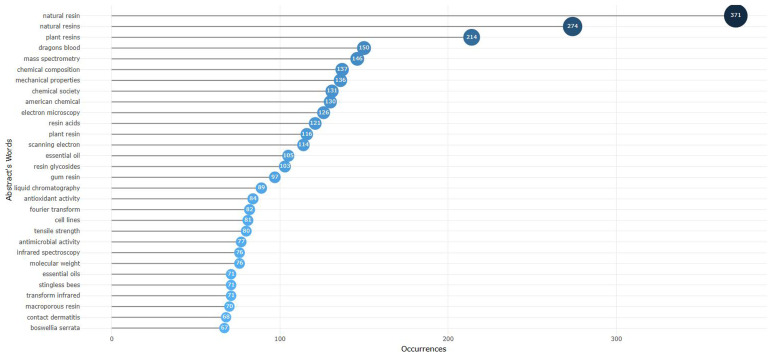 Figure 1
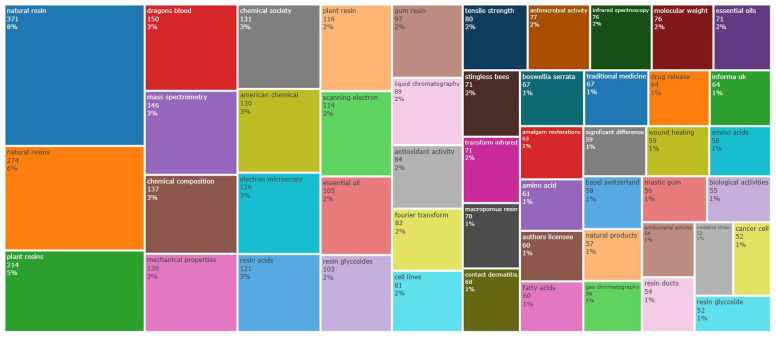 Figure 2
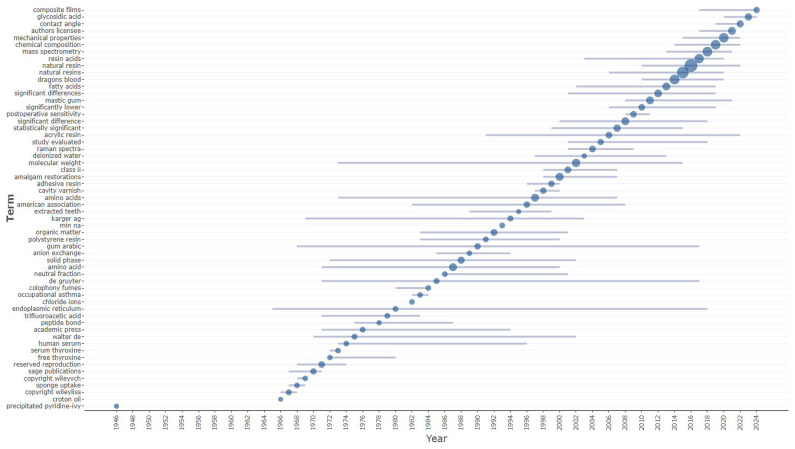 Figure 3
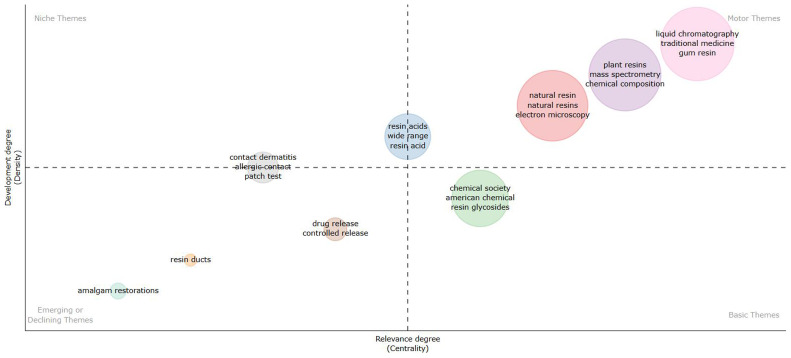 Figure 4
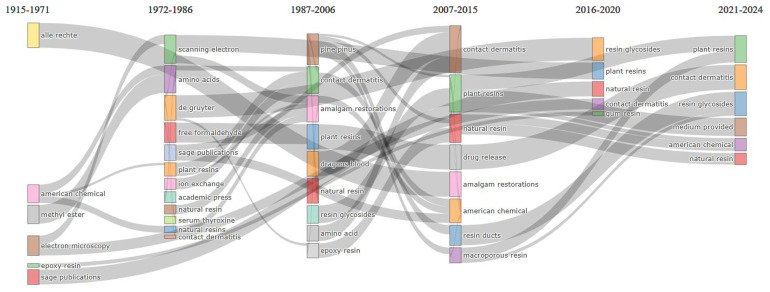 Figure 5
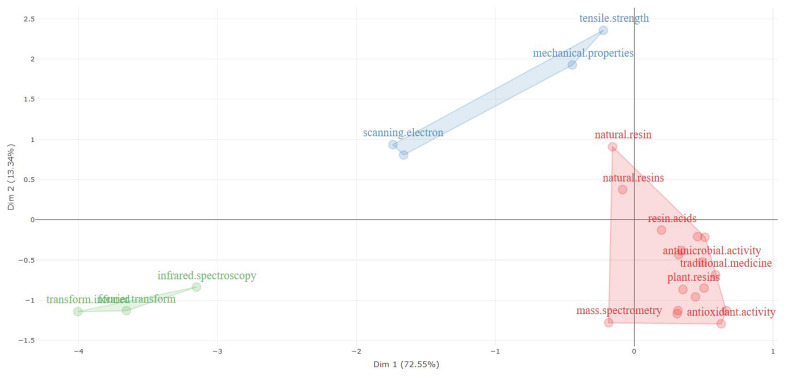 Figure 6
| Description | Results |
|---|---|
|
| |
| Timespan | 1915:2024 |
| Sources (Journals, Books, etc) | 1742 |
| Documents | 4127 |
| Annual Growth Rate % | 4.74 |
| Document Average Age | 25.7 |
| Average citations per doc | 20.59 |
| References | 95836 |
|
| |
| Keywords Plus (ID) | 21866 |
| Author's Keywords (DE) | 6881 |
|
| |
| Authors | 12538 |
| Authors of single-authored docs | 626 |
|
| |
| Single-authored docs | 687 |
| Co-Authors per Doc | 3.96 |
| International co-authorships % | 12.41 |
|
| |
| article | 3663 |
| book | 2 |
| book chapter | 46 |
| conference paper | 108 |
| conference review | 2 |
| data paper | 4 |
| editorial | 11 |
| erratum | 4 |
| letter | 46 |
| note | 29 |
| retracted | 1 |
| review | 201 |
| short survey | 10 |
| Source | Articles |
|---|---|
| Molecules | 97 |
| Contact Dermatitis | 65 |
| Phytochemistry | 45 |
| International Journal of Biological Macromolecules | 43 |
| Journal of Chromatography A | 42 |
| Fitoterapia | 40 |
| Food Chemistry | 40 |
| Journal of Agricultural and Food Chemistry | 37 |
| Scientific Reports | 34 |
| Natural Product Research | 33 |
| Plos One | 33 |
| Journal of Natural Products | 31 |
| Journal of Ethnopharmacology | 28 |
| Meditsina Truda I Promyshlennaya Ekologiya | 28 |
| Gigiena i Sanitariia | 26 |
| Journal of Combinatorial Chemistry | 26 |
| Zhongguo Zhongyao Zazhi | 25 |
| Organic Letters | 20 |
| Journal of the American Chemical Society | 19 |
| Planta Medica | 19 |
| Journal of Natural Medicines | 18 |
| Analytical Biochemistry | 17 |
| International Journal of Molecular Sciences | 17 |
| Operative Dentistry | 17 |
| Analytical and Bioanalytical Chemistry | 16 |
| The Journal of Prosthetic Dentistry | 16 |
| Tree Physiology | 16 |
| Chemistry and Biodiversity | 15 |
| Biotechnic and Histochemistry | 14 |
| Journal of The American Dental Association | 14 |
| Source | h_index |
|---|---|
| Molecules | 26 |
| Food Chemistry | 23 |
| Journal of Agricultural and Food Chemistry | 23 |
| Phytochemistry | 21 |
| Journal of Combinatorial Chemistry | 19 |
| Journal of Chromatography A | 18 |
| Fitoterapia | 17 |
| Journal of Natural Products | 17 |
| Contact Dermatitis | 16 |
| International Journal of Biological Macromolecules | 16 |
| Plos One | 16 |
| Journal of Ethnopharmacology | 15 |
| Tree Physiology | 14 |
| Organic Letters | 13 |
| Operative Dentistry | 12 |
| Phytomedicine | 12 |
| Planta Medica | 12 |
| Analytical and Bioanalytical Chemistry | 11 |
| Organic Geochemistry | 11 |
| Scientific Reports | 11 |
| Analytical Chemistry | 10 |
| Industrial Crops and Products | 10 |
| Journal of The American Chemical Society | 10 |
| Natural Product Research | 10 |
| Spectrochimica Acta - Part A: Molecular and Biomolecular Spectroscopy | 10 |
| The Journal of Prosthetic Dentistry | 10 |
| International Journal of Molecular Sciences | 9 |
| Journal of the American Dental Association | 9 |
| Analytical Biochemistry | 8 |
| Biomedicine and Pharmacotherapy | 8 |
| Author | Articles |
|---|---|
| Li J | 37 |
| Wang X | 25 |
| Ono M | 23 |
| Zhang H | 22 |
| Chen Y | 20 |
| Kinjo J | 20 |
| Liu Y | 20 |
| Okawa M | 20 |
| Yoshimitsu H | 20 |
| Yasuda S | 19 |
| Wang J | 18 |
| Zhang J | 18 |
| Cheng Y-X | 17 |
| Chen X | 16 |
| Li Y | 16 |
| Pereda-Miranda R | 16 |
| Wang L | 16 |
| Zhang Y | 16 |
| Anderson KB | 15 |
| Song Z | 15 |
| Wang H | 15 |
| Wang Y | 15 |
| Al-Harrasi A | 14 |
| Chen H | 14 |
| Leonhardt SD | 14 |
| Nohara T | 14 |
| Spivak M | 14 |
| Zhang L | 14 |
| JR | 13 |
| Miyashita H | 13 |
| Author | h_index |
|---|---|
| Li J | 16 |
| Wang X | 14 |
| Chen Y | 13 |
| Zhang H | 13 |
| Liu Y | 12 |
| Pereda-Miranda R | 12 |
| Spivak M | 12 |
| Chen H | 11 |
| Anderson KB | 10 |
| Chen X | 10 |
| Edwards Hgm | 10 |
| Leonhardt SD | 10 |
| Li K | 10 |
| Li Y | 10 |
| Song J | 10 |
| Wang C | 10 |
| Wang J | 10 |
| Wang L | 10 |
| Zhang J | 10 |
| Al-Harrasi A | 9 |
| Colombini MP | 9 |
| Lu Y | 9 |
| Merrifield RB | 9 |
| Wang H | 9 |
| Zhang Y | 9 |
| Cheng Y-X | 8 |
| Kinjo J | 8 |
| Liu X | 8 |
| Nohara T | 8 |
| Okawa M | 8 |
| Affiliation | Articles |
|---|---|
| Tokai University | 111 |
| Beijing University of Chinese Medicine | 90 |
| National and Kapodistrian University of Athens | 62 |
| Chinese Academy of Medical Sciences and
| 59 |
| University of Nizwa | 59 |
| Sojo University | 55 |
| Fukuoka University | 54 |
| China Pharmaceutical University | 53 |
| Nanjing University of Chinese Medicine | 53 |
| Northwest Aandf University | 53 |
| Shandong University | 51 |
| Nanjing Forestry University | 50 |
| Guangdong Pharmaceutical University | 49 |
| University of Alberta | 48 |
| Institute of Chemical Industry of Forest Products | 46 |
| Shenyang Pharmaceutical University | 46 |
| University of São Paulo | 46 |
| King Saud University | 43 |
| Peking Union Medical College | 43 |
| Universidad Nacional Autónoma de México | 42 |
| Jiangnan University | 40 |
| Guangxi University for Nationalities | 39 |
| Silpakorn University | 39 |
| Notreported | 38 |
| University of Messina | 38 |
| Mashhad University of Medical Sciences | 35 |
| University of Minnesota | 34 |
| Aristotle University of Thessaloniki | 32 |
| Nantong University | 31 |
| Shenzhen University Health Science Center | 31 |
| Country | Number of
|
|---|---|
| China | 2830 |
| USA | 1728 |
| India | 989 |
| Brazil | 885 |
| Japan | 674 |
| Italy | 595 |
| Germany | 555 |
| UK | 481 |
| France | 386 |
| Iran | 270 |
| Greece | 251 |
| Spain | 249 |
| Canada | 225 |
| Egypt | 224 |
| Mexico | 214 |
| Poland | 189 |
| South Korea | 178 |
| Australia | 168 |
| Thailand | 163 |
| Turkey | 161 |
| Saudi Arabia | 144 |
| Finland | 143 |
| Romania | 140 |
| Switzerland | 130 |
| Belgium | 118 |
| Sweden | 117 |
| Austria | 114 |
| Chile | 99 |
| Indonesia | 90 |
| Pakistan | 83 |
| Country | Total
|
|---|---|
| China | 7512 |
| USA | 6685 |
| India | 3645 |
| Brazil | 3555 |
| Germany | 2837 |
| Italy | 2465 |
| Malaysia | 1498 |
| France | 1492 |
| United Kingdom | 1277 |
| Austria | 1178 |
| Canada | 1149 |
| Japan | 1112 |
| Egypt | 1055 |
| Iran | 1032 |
| Greece | 889 |
| Australia | 876 |
| Switzerland | 701 |
| Thailand | 671 |
| Korea | 661 |
| Mexico | 595 |
| Spain | 554 |
| Turkey | 531 |
| Finland | 483 |
| Denmark | 472 |
| Poland | 430 |
| Chile | 343 |
| Singapore | 302 |
| Belgium | 297 |
| Oman | 292 |
| Israel | 284 |
| word | cluster |
|---|---|
| natural.resin | 1 |
| natural.resins | 1 |
| plant.resins | 1 |
| dragons.blood | 1 |
| mass.spectrometry | 1 |
| chemical.composition | 1 |
| resin.acids | 1 |
| plant.resin | 1 |
| essential.oil | 1 |
| resin.glycosides | 1 |
| gum.resin | 1 |
| liquid.chromatography | 1 |
| antioxidant.activity | 1 |
| cell.lines | 1 |
| antimicrobial.activity | 1 |
| traditional.medicine | 1 |
| biological.activities | 1 |
| mechanical.properties | 2 |
| electron.microscopy | 2 |
| scanning.electron | 2 |
| tensile.strength | 2 |
| fourier.transform | 3 |
| infrared.spectroscopy | 3 |
| transform.infrared | 3 |
- —Horizon Europe Framework Programme
Peer Reviews
No public reviews on file for this paper yet. If you reviewed it on a platform where reviews are public (OpenReview, ICLR, NeurIPS, ICML), you can paste yours below so the community can read it here.
Videos
No videos yet. Explain this paper in a talk, walkthrough, or lecture? Add one.
Taxonomy
TopicsConservation Techniques and Studies · Metallurgy and Cultural Artifacts
Introduction
The literature survey shows that, despite some efforts to apply bibliometric analysis in the fields associated with natural/plant resin ^ 1, 2 ^, there is still space to explore even more of the several dimensions related to this, often called, forest by-product (in a more reductive approach). Natural resin and gums are relevant complements of timber production in forest areas ^ 3 ^.
Bibliometric assessment is an approach that may produce relevant insights as support for the researchers, policymakers and other stakeholders in the diverse science fields, including in the forest domains, allowing to identification of gaps and trends in the literature ^ 4 ^. This is particularly important when, in some topics, we need to deal with a great number of documents to survey and understand what was already done and what we still need to do ^ 5 ^.
The literature also reveal also that some fields have been poorly addressed in the topics considered in this research, namely those associated with the following areas ^ 6 ^: social sciences; economics econometrics and finance; business, management and accounting; and decision sciences.
On the other hand, the areas related to “agricultural and biological sciences” have deserved a relevant attention of the researchers. Some of these studies give relevance to the resin synthesis by the trees ^ 7 ^ and others on the resin produced by bees (propolis) ^ 8 ^. The propolis is a resinous combination ^ 9 ^ that is obtained from plant resin ^ 10 ^ and used by the honeybees for their needs in beehives ^ 11 ^. This bee glue has several benefits for human health and has been used as an antioxidant or anti-inflammatory, for example ^ 12 ^. In some cases, propolis has been considered as a substitute for antibiotics ^ 13 ^, including in the poultry industry ^ 14 ^. Nonetheless, pests and pathogens, for example, create difficulties for the honeybee’s activities, where the role of the propolis still needs deeper analysis ^ 15, 16 ^.
Other research focuses associated with natural/plant resin are the following: extraction techniques, related economic dimensions and environmental impacts ^ 17 ^; tree response to wounding and fungi ^ 18 ^; Dragon’s Blood reddish resin oil ^ 19 ^; resin tapping ^ 20 ^; and the benefits of Chios mastic gum for human health ^ 21 ^.
Considering these perspectives, the aim of this study is to bring more insights into the diverse dimensions of natural/plant resin and make further suggestions for the work plan of COST Action CA22155 (EU-PoTaRCh) ^ 22 ^.
Methods
This COST Action has as its scope the “Network for forest by-products charcoal, resin, tar, potash” and aims to analyse, over time, the productions that may be obtained in the forest lands, beyond the timber, highlighting chemical, biological, environmental, socioeconomic and cultural dimensions. EU-PoTaRCh is organised into five working groups focused on fields related to heritage, analytical approaches, archaeology, history and future scenarios ^ 22 ^. To achieve the objectives proposed in this research, 4127 documents were obtained from the Scopus database ^ 6 ^, in a search carried out on 02 November 2024 (for the topics: “natural resin” or “plant resin”), and were assessed through bibliometric analysis, following the procedures proposed by the Bibliometrix software ^ 23– 27 ^.
Suggestions, gaps and trends from bibliometric analysis
For the study here presented, the period 1915–2024 was considered, for a total of 1742 sources, 4127 documents, 4.74% of annual growth rate, 20.59 average citations per document, 12538 authors, 3.96 co-authors per document and 12.41% of international co-authorships ( Table 1). Molecules, Contact Dermatitis, Phytochemistry, International Journal of Biological Macromolecules, Journal of Chromatography A, Fitoterapia, Food Chemistry and Journal of Agricultural and Food Chemistry are between the top 30 most important sources about the topics of natural resin or plant resin ( Table 2). Some of these sources are also among those with the highest impact within the sample considered ( Table 3). The most productive authors and those with the highest impact within the sample taken into account are presented in Table 4 and Table 5, respectively.
The most important affiliations are the following ( Table 6): Tokai University; Beijing University of Chinese Medicine; National and Kapodistrian University of Athens; Chinese Academy of Medical Sciences and Peking Union Medical College; University of Nizwa; Sojo University; Fukuoka University; and China Pharmaceutical University. China, USA, India, Brazil, Japan, Italy, Germany, UK, France, Iran, Greece and Spain are the most productive countries ( Table 7) and are among the most cited nations ( Table 8).
Beyond the topics of search considered in this study (natural resin and plant resin), dragon’s blood and mass spectrometry are examples of the most frequent words in the abstracts of the 4127 documents taken into account in this analysis ( Figure 1). Other words appear with lower frequency, such as ( Figure 2): amalgam restorations; fatty acids; traditional medicine; natural products; wound healing; mastic gum; antibacterial activity; resin ducts; biological activities; oxidative stress; and resin glycoside.
Most frequent words (in abstracts) related to natural resin or plant resin.
TreeMap (in abstracts) related to natural resin or plant resin.
On the other hand, composite films, glycosidic acid, mechanical properties, chemical composition, mass spectrometry, resin acids, natural resin, dragon’s blood, fatty acids and mastic gum are trending terms ( Figure 3). Figure 4 shows (considering information in abstracts and Walktrap clustering algorithm) that amalgam restorations, resin ducts, drug release and controlled release are emerging or declining themes. Resin glycosides is an important theme, but not yet well developed. Electron microscopy, mass spectrometry, chemical composition, traditional medicine and gum resin are important and well-developed themes. Figure 5 (taking into account information in abstracts, Walktrap as clustering algorithm and inclusion index weighted by word-occurrences as weight index) confirms that plant resin and natural resin are trending themes. Figure 6 and Table 9 (factorial analysis in abstracts and multiple correspondence analysis) highlight three clusters for the words present in the abstracts and show that the words considered in cluster 1 are central for the research of the topics here addressed, considering the documents surveyed.
Trend topics (in abstracts) related to natural resin or plant resin.
Thematic map related to natural resin or plant resin.
Thematic evolution related to natural resin or plant resin.
Factorial analysis related to natural resin or plant resin.
Discussion and conclusions
This research was developed under the work plan of the COST Action PoTaRCh and aims to bring more contributions to the understanding of the several dimensions related to resin and presents suggestions for future studies associated with these topics. To achieve these objectives, a bibliometric analysis was carried out, following the procedures proposed by the Bibliometrix software. These documents were obtained from the Scopus database, in a search performed on 02 November 2024, for the topics “natural resin” or “plant resin”.
The literature highlights the importance of the natural/plant resin for forest management, considering that this by-product may be an interesting complement of the forest owners’ income. The consideration of alternative and sustainable sources of revenues on forest land, beyond wood production, is crucial to motivate more adjusted forestry planning, namely in contexts where such adjustments are needed and urgent. This is particularly indispensable in frameworks where forest fire prevention requires innovative and effective approaches. The bibliometric analysis may bring important highlights in the literature survey on any topic, including in the fields related to the forest dimensions. On the specific topics covered here, the literature survey reveals that the scientific areas associated with social sciences, economics and management may be further explored in future research. In turn, the areas associated with agricultural and biological sciences have been addressed by a relevant number of documents. In these studies, a relevant part considered the different dimensions of the propolis (resinous combination produced by bees from plant resin). Other studies analysed extraction techniques, tree response to external aggressions, dragon’s blood resin and resin tapping, for example.
The bibliometric assessment highlights a modest international co-authorship of 12.41% and that the most important sources (number of documents and citations) are related, for example, to contact dermatitis, phytochemistry, biological macromolecules, chromatography and food chemistry. This shows that there is shows that there is space to be explored in other sources with scopes more multidisciplinary and focused on other scientific areas. The most productive countries, the topics here addressed, are China, the USA, India and Brazil, revealing that some European countries, for example, where the natural/plant resin has a historical relevance may add important contributions to these fields. The bibliometric analysis also shows that natural resin, plant resin, dragon’s blood, mass spectrometry, chemical composition, resin acids, essential oils, resin glycosides, gum resin, antioxidant activity and traditional medicine are central topics for the topics natural/plant resin. Some of them are also trending topics, such as chemical composition, mass spectrometry, resin acids, natural resin and dragon’s blood.
In terms of practical implications, this research highlights trending themes related to natural/plant resin topics and that some scientific areas, such as social sciences, economics and management, could be further addressed by the literature. In terms of policy recommendations, it is suggested to promote more transdisciplinary approaches in the analyses related to the different dimensions of resin production and collection, to better support the various stakeholders in managing and planning the natural/plant resin activities. For future research, it would be important to increase international co-authorships, promote transdisciplinary co-authorships and consider other bibliometric methodologies.
The reference list from the paper itself. Each links out to its DOI / PubMed record.
- 1Jiajia L Bingjian Z : Research status of binders in ancient painted cultural relics -based on data analysis of research papers from the web of science. Sciences of Conservation and Archaeology. 2019;31:119–129.
- 2Rosa RS Lannes SC da S : Hop extracts and their utilizations: perspectives based on the last 10 years of research. Braz J Pharm Sci. 2024;60: e 23905. 10.1590/s 2175-97902024 e 23905 · doi ↗
- 3Sharma SC Prasad N Pandey SK : Mechanization in processing commercially significant natural resins and gums: a review. Ind Crops Prod. 2024; Part 2222: 119630. 10.1016/j.indcrop.2024.119630 · doi ↗
- 4Mourao PR Martinho VD : Forest entrepreneurship: a bibliometric analysis and a discussion about the co-authorship networks of an emerging scientific field. J Clean Prod. 2020;256: 120413. 10.1016/j.jclepro.2020.120413 · doi ↗
- 5Martinho VD Mourão PR : Circular economy and economic development in the European Union: a review and bibliometric analysis. Sustainability. 2020;12(18): 7767. 10.3390/su 12187767 · doi ↗
- 6Scopus scopus database. Reference Source
- 7Al-Harrasi A Khan AL Rehman NU : Biosynthetic diversity in triterpene cyclization within the boswellia genus. Phytochemistry. 2021;184: 112660. 10.1016/j.phytochem.2021.112660 33524859 · doi ↗ · pubmed ↗
- 8Aliakbarian M Jazinaki MS Bahari H : Effects of propolis consumption on liver enzymes and obesity indices in adults: a systematic review and dose-response meta-analysis. Curr Dev Nutr. 2024;8(9): 104438. 10.1016/j.cdnut.2024.104438 39296926 PMC 11407979 · doi ↗ · pubmed ↗