A curated crowdsourced dataset of Luganda and Swahili speech for text-to-speech synthesis
Andrew Katumba, Sulaiman Kagumire, Joyce Nakatumba-Nabende, John Quinn, Sudi Murindanyi

TL;DR
This paper introduces a high-quality, curated speech dataset in Luganda and Kiswahili to improve text-to-speech systems in low-resource languages.
Contribution
A new crowdsourced speech dataset for Luganda and Kiswahili with rigorous curation and preprocessing for TTS research.
Findings
The dataset includes over 19 hours of Luganda and 15 hours of Kiswahili speech from six female speakers per language.
A multi-step curation process improved data consistency and quality using acoustic clustering and speech quality scoring.
The dataset supports reproducible TTS research and speech generation in under-resourced African languages.
Abstract
This data article describes a curated, crowdsourced speech dataset in Luganda and Kiswahili, created to support text-to-speech (TTS) development in low-resource settings. The dataset is derived from Mozilla’s Common Voice corpus and includes only validated utterances from female speakers. A multi-step curation process was used to enhance the consistency and quality of the data. Speakers were first manually selected based on similarities in intonation, pitch, and rhythm, then validated using acoustic clustering with pitch features and mel-frequency cepstral coefficients (MFCCs). Audio files were preprocessed to remove leading and trailing silences using WebRTC voice activity detection, denoised with a causal waveform-based DEMUCS model, and filtered using WV-MOS, an automatic speech quality scoring tool. Only clips with a predicted MOS score of 3.5 or higher were retained. The final…
Genes, proteins, chemicals, diseases, species, mutations and cell lines named across the full text — each resolved to its canonical identifier and authoritative record.
Click any figure to enlarge with its caption.
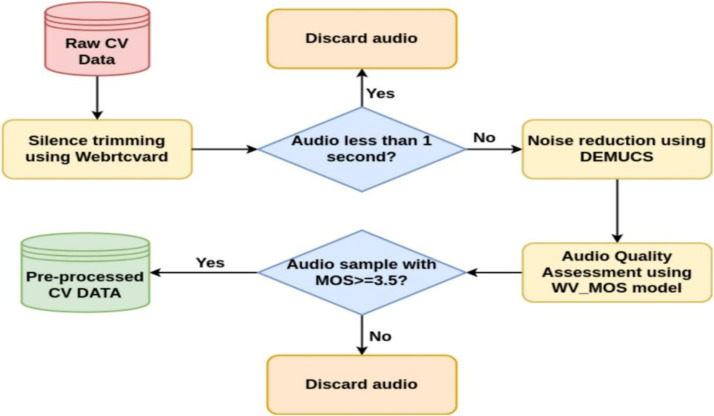 Figure 1
Peer Reviews
No public reviews on file for this paper yet. If you reviewed it on a platform where reviews are public (OpenReview, ICLR, NeurIPS, ICML), you can paste yours below so the community can read it here.
Videos
No videos yet. Explain this paper in a talk, walkthrough, or lecture? Add one.
Taxonomy
TopicsSpeech Recognition and Synthesis · Speech and Audio Processing · Phonetics and Phonology Research
Specifications TableSubjectComputer SciencesSpecific subject areaText-to-speech data for low-resource African languages (Luganda and Kiswahili)Type of dataAudio, CSVData CollectionSpeech recordings and their transcriptions were sourced from Mozilla Common Voice (Luganda v12.0 and Swahili v15.0) [1]. Only validated clips from female speakers were selected. Audio was preprocessed using WebRTC Voice Activity Detection (for trimming silences), a causal DEMUCS model (for denoising), and WV-MOS scoring (to filter low-quality clips). Transcriptions were included as text entries in accompanying CSV files, along with metadata such as speaker ID and clip duration.Data source locationInstitution: Makerere UniversityCity: KampalaCountry: UgandaData accessibilityRepository name: Mendeley DataData identification number: 10.17632/nb8b25h9nj.3Direct URL to data: https://data.mendeley.com/datasets/nb8b25h9nj/3Related research articleAuthor’s name: Katumba, A., Kagumire, S., Nakatumba-Nabende, J., Quinn, J. and Murindanyi, S.Title: Building Text-to-Speech Models for Low-Resourced Languages From Crowdsourced DataJournal: Applied AI Letters, DOI: https://doi.org/10.1002/ail2.117
Value of the Data
1
- •This data provides a curated and ready-to-use set of speech recordings and transcriptions for Luganda and Kiswahili, enabling the development of TTS or speech systems in settings with limited existing resources.
- •Researchers and developers working on speech synthesis, multilingual NLP, or voice technologies for African languages can benefit from using this dataset.
- •The dataset supports experiments on multi-speaker TTS, speaker consistency, and the effectiveness of crowdsourced speech for neural synthesis models.
- •The data is already cleaned, denoised, and quality-filtered, making it suitable for direct use in training end-to-end TTS models.
Background
2
The motivation behind compiling this dataset was to support the development of text-to-speech (TTS) models for low-resource African languages, particularly Luganda and Kiswahili. Existing TTS systems typically rely on large single-speaker studio-quality corpora, which are expensive and often unavailable for many underrepresented languages. This dataset was constructed to explore whether carefully selected and preprocessed crowdsourced data could serve as a practical alternative. The audio and transcripts were sourced from Mozilla’s Common Voice platform, a public initiative that collects multilingual speech from volunteers. A pipeline was developed to select consistent speakers, apply noise reduction, trim silence, and filter for audio quality. The dataset includes audio from six female speakers per language and is intended to be directly usable in end-to-end neural TTS pipelines.
This dataset was used in the accompanying article [2], which investigates synthesis using crowdsourced data. This data article provides the full curated dataset used in that study, along with detailed documentation and a reproducible format for use by other researchers working on speech synthesis in low-resource settings.
Data Description
3
This dataset comprises curated and preprocessed speech recordings and corresponding transcriptions in Luganda and Kiswahili, aimed at supporting research in low-resource text-to-speech (TTS) synthesis. The data was extracted from the validated splits of Mozilla Common Voice Luganda (v12.0) and Kiswahili (v15.0), then passed through a multi-step pipeline to ensure consistency, clarity, and suitability for TTS modeling. The dataset includes 7842 Luganda utterances totaling approximately 19.2 h and 6324 Kiswahili utterances totaling approximately 15.1 h of audio.
The dataset is organized into two main folders, Luganda/ and Kiswahili/, each containing:
- •wavs.zip: a ZIP archive of .wav audio clips from six female speakers, denoised, trimmed, and filtered for quality.
- •metadata.csv: a file listing each audio file’s name and corresponding transcription.
All audio clips are in 16-bit mono .wav format at a sampling rate of 22.05 kHz. Each utterance is stored in an individual audio file. Metadata files include two columns: filename and transcript.
Experimental Design, Materials, and Methods
4
This dataset was derived from Mozilla Common Voice (CV) Luganda (v12.0) and Kiswahili (v15.0), which are among the few open-source resources available for African languages. Unlike well-established TTS datasets such as LJSpeech (a 13-hour single-speaker English corpus recorded in studio conditions) and CSS10 (a multi-language, single-speaker dataset for 10 languages), Common Voice provides diverse, crowdsourced, multi-speaker recordings that are not originally optimized for TTS. Despite their variability, Common Voice datasets offer a promising foundation for scalable TTS development in low-resource settings, provided that careful preprocessing and quality filtering are applied.
Prior studies have explored how Common Voice can be repurposed for TTS. Van Niekerk et al. [6] trained competitive English TTS models by filtering Common Voice data for quality and consistency. Giraldo et al. [7] similarly developed Catalan TTS datasets using perceptual quality metrics like NISQA and speech enhancement tools such as VoiceFixer. Our work builds on these approaches and adapts them to African language constraints, introducing a multi-stage pipeline focused on speaker consistency, audio quality, and reproducibility. Key improvements include a hybrid speaker selection method combining manual listening and acoustic clustering, waveform-level denoising using DEMUCS [4], and speech quality filtering using WV-MOS, rather than traditional SNR or ASR-based heuristics. These steps are tailored to address the unique challenges of working with crowdsourced African language data and to ensure that the resulting dataset is suitable for TTS model training.
Speaker selection
4.1
We identified the top 20 female speakers for each language based on utterance count and manually reviewed 5 samples per speaker. Human evaluators ranked speakers by consistency in pitch, rhythm, and clarity. Six speakers whose voices were unanimously preferred were selected. Acoustic features including pitch, energy, MFCCs, and rhythm were extracted and clustered using k-means to confirm that selected speakers were acoustically distinct and internally consistent.
Audio preprocessing
4.2
We applied a multi-stage preprocessing pipeline as shown in Fig. 1.
- 1.Silence trimming: We used WebRTC Voice Activity Detection (VAD) to remove leading and trailing silence. This method is commonly used in telephony and speech applications to isolate active speech regions while preserving key acoustic cues. We applied a 90 % voiced-frame threshold and 300 ms padding to reduce clipping artifacts.
- 2.Noise removal: A real-time version of the DEMUCS model was applied for waveform-level denoising. This causal encoder-decoder model is optimized for removing both stationary and non-stationary background noise while maintaining speech integrity. DEMUCS has demonstrated strong performance in enhancing raw waveform quality for ASR and speech enhancement tasks, especially under noisy conditions [6].
- 3.Quality filtering: We used WV-MOS, a wav2vec-based model that predicts Mean Opinion Scores (MOS), to automatically assess the perceptual quality of each utterance. Only samples scoring ≥3.5 were retained. WV-MOS correlates well with human judgments and has been used in TTS and voice cloning pipelines to ensure high fidelity. Fig. 1. Overview of the Luganda and Kiswahili TTS dataset curation pipeline.Fig 1:
Fig. 1 illustrates an overview of the dataset curation pipeline. The diagram illustrates the main stages in the preprocessing workflow after speaker selection: silence trimming using WebRTC VAD, noise reduction using DEMUCS, and quality filtering with WV-MOS. The result is a curated, high-quality dataset of multi-speaker speech suitable for training text-to-speech models in low-resource languages.
Data structure
4.3
Each utterance is stored as a mono .wav file sampled at 16 kHz. The filenames follow the Common Voice naming convention. Each audio clip is paired with a row in a CSV file containing filename and transcript fields. The structure is consistent across both languages. A sample of the dataset content is shown in Table 1.Table 1. Sample excerpts from each language’s metadata.Table 1:FilenameDescriptionLugandacommon_voice_lg_23,717,981.wavNze nnakoowa okukima amazzi kuba temunsasula buli lwe ngakima.common_voice_lg_23,718,760.wavNeebaza nnyo ssezaala wange kuba yangabira ente.common_voice_lg_23,718,761.wavNtudde nnyo kati omugongo gunnuma.Kiswahilicommon_voice_sw_28,905,667.wavPia mara nyingi aliandika katika magazeti.common_voice_sw_28,902,728.wavPia katika upishi na kutengeneza vyakula mbalimbali kama aisikrimu.common_voice_sw_28,905,313.wavMakao makuu ya eneohilo ni Kouassi-Kouassikro.
Tools and code
4.4
We used open-source tools for all steps in the pipeline:
No manual annotations or proprietary software were used. The entire preprocessing pipeline can be reproduced using standard Python libraries and the referenced open-source tools.
Limitations
This dataset is derived from Mozilla Common Voice, which is a crowdsourced platform originally designed for automatic speech recognition, not for text-to-speech. As such, several limitations exist. First, the recording conditions are uncontrolled, which introduces variation in background noise, microphone quality, and speaking environments. Although denoising and quality filtering were applied, some variability may remain. Second, the dataset comprises only short utterances (1–30 s), limiting its suitability for training models that require longer, prosodically rich input. Lastly, the Kiswahili and Luganda portions of the Common Voice dataset differ in overall recording quality, which may reflect in downstream modeling outcomes
Ethics Statement
The authors confirm that they have read and comply with the ethical requirements for publication in Data in Brief. This dataset does not involve human subjects, animal experiments, or data collected from social media platforms. All speech recordings were obtained from Mozilla Common Voice, a public, open-source platform in which contributors voluntarily donate their voice data under a Creative Commons license. The data used in this work were already publicly available and anonymized, and no personally identifiable information is included.
Credit Author Statement
Andrew Katumba: Conceptualization, Supervision, Funding acquisition, Writing - Review & Editing. Sulaiman Kagumire: Data curation, Software, Formal analysis, Methodology, Investigation, Writing – Original Draft, Visualization, Writing - Review & Editing. Joyce Nakatumba-Nabende: Conceptualization, Supervision, Funding acquisition, Writing - Review & Editing. John Quinn: Conceptualization, Supervision, Funding acquisition, Investigation. Sudi Murindanyi: Investigation, Writing – Original Draft, Visualization, Writing - Review & Editing.
The reference list from the paper itself. Each links out to its DOI / PubMed record.
- 1Ardila R.Branson M.Davis K.Henretty M.Kohler M.Meyer J.…Weber G.Common voice: a massively-multilingual speech corpusar Xiv Prepr.2019 ar Xiv:1912.06670.
- 2Katumba A.Kagumire S.Nakatumba-Nabende J.Quinn J.Murindanyi S.Building text-to-speech models for low-resourced languages from crowdsourced data Appl. AI Lett.622025 e 11710.1002/ail 2.117 · doi ↗
- 3Git Hub - webrtcvad: python interface to the Web RTC voice activity detector. https://github.com/wiseman/py-webrtcvad, (accessed 23 November 2023).
- 4Defossez A.Synnaeve G.Adi Y.Real time speech enhancement in the waveform domainar Xiv Prepr.2020 ar Xiv:2006.12847
- 5Andreev P.Alanov A.Ivanov O.Vetrov D.Hifi++: a unified framework for neural vocoding, bandwidth extension and speech enhancementar Xiv Prepr.122022 ar Xiv:2203.13086
- 6Ogun S.Colotte V.Vincent E.Can we use common voice to train a multi-speaker TTS system?2022 IEEE Spoken Language Technology Workshop (SLT)2023 IEEE 900905
- 7Giraldo J.Llopart-Font M.Peiró-Lilja A.Armentano-Oller C.Sant G.Külebi B.Enhancing crowdsourced audio for text-to-speech modelsar Xiv Prepr.2024 ar Xiv:2410.13357