Scientific opinion as regards the specifications of the food additives acetic, lactic, tartaric, mono‐ and diacetyltartaric, mixed acetic and tartaric acids esters of mono‐ and diglycerides of fatty acids (E 472a,b,d,e,f)
Laurence Castle, Monica Andreassen, Gabriele Aquilina, Maria Lourdes Bastos, Polly Boon, Biagio Fallico, Reginald FitzGerald, Maria Jose Frutos Fernandez, Bettina Grasl‐Kraupp, Ursula Gundert‐Remy, Rainer Gürtler, Eric Houdeau, Marcin Kurek, Henriqueta Louro, Sabina Passamonti

TL;DR
This paper evaluates data to update specifications for certain food additives and assesses their dietary exposure and safety.
Contribution
The paper provides a scientific assessment of new data for amending EU specifications of E 472a,b,d,e,f additives and evaluates their dietary exposure.
Findings
Technical data support amendments for E 472a, E 472b, and E 472e.
No supporting data were provided for E 472d and E 472f, so amendments are not supported.
Dietary exposure estimates for E 472d, E 472e, and E 472f are below their acceptable daily intake levels.
Abstract
Acetic, lactic, tartaric, mono‐ and diacetyltartaric, mixed acetic and tartaric acids esters of mono‐ and diglycerides of fatty acids (E 472a,b,d,e,f) were re‐evaluated in 2020 by the Food Additives and Flavourings (FAF) Panel. The Panel issued several recommendations to amend the specifications of these food additives in Commission Regulation (EU) No 231/2012. The present opinion deals with the assessment of the data provided by interested business operators (IBOs) in support of an amendment of the EU specifications for these food additives. It also includes an assessment of dietary exposure to E 472d, E 472e and E 472f. The Panel concluded that the technical data provided by an IBO support amendments to the specifications for E 472a, E 472b and E 472e in Commission Regulation (EU) No 231/2012. However, regarding E 472d and E 472f, the Panel was unable to confirm that technical data…
Genes, proteins, chemicals, diseases, species, mutations and cell lines named across the full text — each resolved to its canonical identifier and authoritative record.
Click any figure to enlarge with its caption.
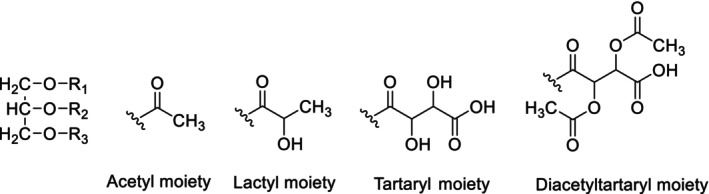 FIGURE 1
| Commission Regulation (EU) No 231/2012 | |
|---|---|
|
| Esters of glycerol with acetic and fatty acids occurring in food fats and oils. They may contain small amounts of free glycerol, free fatty acids, free acetic acid and free glycerides |
|
| Clear, mobile liquids to solids, from white to pale yellow in colour |
|
| |
| Test for glycerol | Passes test |
| Test for fatty acids | Passes test |
| Test for lactic acid | Passes test |
| Solubility | Insoluble in water. Soluble in ethanol |
|
| |
| Acids other than acetic and fatty acids | Less than 1% |
| Free glycerol | Not more than 2% |
| Arsenic | Not more than 3 mg/kg |
| Lead | Not more than 2 mg/kg |
| Mercury | Not more than 1 mg/kg |
| Cadmium | Not more than 1 mg/kg |
| Total acetic acid | Not less than 9% and not more than 32% |
| Free fatty acids (and acetic acid) | Not more than 3% estimated as oleic acid |
| Total glycerol | Not less than 14% and not more than 31% |
| Sulphated ash | Not more than 0.5% determined at 800 ± 25°C |
| Commission Regulation (EU) No 231/2012 | |
|---|---|
|
| Esters of glycerol with lactic acid and fatty acids occurring in food fats and oils. They may contain small amounts of free glycerol, free fatty acids, free lactic acid and free glycerides |
|
| Clear, mobile liquids to waxy solids of variable consistency, from white to pale yellow in colour |
|
| |
| Test for glycerol | Passes test |
| Test for fatty acids | Passes test |
| Test for lactic acid | Passes test |
| Solubility | Insoluble in cold water but dispersible in hot water |
|
| |
| Acids other than lactic and fatty acids | Less than 1% |
| Free glycerol | Not more than 2% |
| Arsenic | Not more than 3 mg/kg |
| Lead | Not more than 2 mg/kg |
| Mercury | Not more than 1 mg/kg |
| Cadmium | Not more than 1 mg/kg |
| Total lactic acid | Not less than 13% and not more than 45% |
| Free fatty acids (and lactic acid) | Not more than 3% estimated as oleic acid |
| Total glycerol | Not less than 13% and not more than 30% |
| Sulphated ash | Not more than 0.5% (800 ± 25°C) |
| Commission Regulation (EU) No 231/2012 | |
|---|---|
|
| Esters of glycerol with tartaric acid and fatty acids occurring in food fats and oils. They may contain small amounts of free glycerol, free fatty acids, free tartaric acid and free glycerides |
|
| Sticky viscous yellowish liquids to hard yellow waxes |
|
| |
| Test for glycerol | Passes test |
| Test for fatty acids | Passes test |
| Test for tartaric acid | Passes test |
|
| |
| Acids other than citric and fatty acids | Less than 1.0% |
| Free glycerol | Not more than 2% |
| Total glycerol | Not less than 12% and not more than 29% |
| Arsenic | Not more than 3 mg/kg |
| Lead | Not more than 2 mg/kg |
| Mercury | Not more than 1 mg/kg |
| Cadmium | Not more than 1 mg/kg |
| Total tartaric acid | Not less than 15% and not more than 50% |
| Free fatty acid | Not more than 3% estimated as oleic acid |
| Sulphated ash | Not more than 0.5% (800 ± 25°C) |
| Commission Regulation (EU) No 231/2012 | |
|---|---|
|
| Mixed esters of glycerol with mono‐ and diacetyltartaric acids (obtained from tartaric acid) and fatty acids occurring in food fats and oils. They may contain small amounts of free glycerol, free fatty acids, free tartaric and acetic acids and their combinations and free glycerides. Contains also tartaric and acetic esters of fatty acids |
|
| Sticky viscous liquids through a fat‐like consistency to yellow waxes which hydrolyse in moist air to liberate acetic acid |
|
| |
| Test for glycerol | Passes test |
| Test for fatty acids | Passes test |
| Test for tartaric acid | Passes test |
| Test for acetic acid | Passes test |
|
| |
| Acids other than acetic, tartaric and fatty acids | Less than 1% |
| Free glycerol | Not more than 2% |
| Total glycerol | Not less than 11% and not more than 28% |
| Sulphated ash | Not more than 0.5% determined at 800 ± 25°C |
| Arsenic | Not more than 3 mg/kg |
| Lead | Not more than 2 mg/kg |
| Mercury | Not more than 1 mg/kg |
| Cadmium | Not more than 1 mg/kg |
| Total tartaric acid | Not less than 10% and not more than 40% |
| Total acetic acid | Not less than 8% and not more than 32% |
| Acid value | Not less than 40 and not more than 130 |
| Commission Regulation (EU) No 231/2012 | |
|---|---|
|
| Esters of glycerol with acetic and tartaric acids and fatty acids occurring in food fats and oils. They may contain small amounts of free glycerol, free fatty acids, free tartaric and acetic acids and free glycerides. May contain mono‐ and diacetyltartaric esters of mono‐ and diglycerides of fatty acids |
|
| Sticky liquids to solids, from white to pale‐yellow in colour |
|
| |
| Test for glycerol | Passes test |
| Test for fatty acids | Passes test |
| Test for tartaric acid | Passes test |
| Test for acetic acid | Passes test |
|
| |
| Acids other than acetic, tartaric and fatty acids | Less than 1.0% |
| Free glycerol | Not more than 2% |
| Total glycerol | Not less than 12% and not more than 27% |
| Sulphated ash | Not more than 0.5% (800 ± 25°C) |
| Arsenic | Not more than 3 mg/kg |
| Lead | Not more than 2 mg/kg |
| Mercury | Not more than 1 mg/kg |
| Cadmium | Not more than 1 mg/kg |
| Total acetic acid | Not less than 10% and not more than 20% |
| Total tartaric acid | Not less than 20% and not more than 40% |
| Free fatty acids | Not more than 3% estimated as oleic acid |
| LOQ (mg/kg) | Analytical technique | Number of samples | Number of samples < LOQ | Quantified reported values in mg/kg (number of samples) | |
|---|---|---|---|---|---|
|
| 0.5 | GF‐AAS | 1 | 1 | – |
| 0.05 | ICP‐MS | 1 | 1 | – | |
| 0.1 | ICP‐MS | 2 | 2 | – | |
| 0.05 | ICP‐MS | 2 | 2 | – | |
| 0.6 | ICP‐OES | 3 | 3 | – | |
| 0.05 | ICP‐MS | 5 | – | 0.05 (4), 0.1 (1) | |
|
| 0.01 | CV‐AAS | 1 | 1 | – |
| 0.005 | ICP‐MS | 1 | 1 | – | |
| 0.02 | ICP‐MS | 2 | 2 | – | |
| 0.005 | CV‐AAS | 2 | 2 | – | |
| 0.1 | ICP‐OES | 3 | 3 | – | |
| 0.005 | ICP‐MS | 5 | – | 0.005 (4), 0.01 (1) | |
|
| 0.1 | GF‐AAS | 1 | 1 | – |
| 0.01 | ICP‐MS | 1 | 1 | – | |
| 0.01 | ICP‐MS | 2 | 2 | – | |
| 0.02 | ICP‐MS | 2 | 2 | – | |
| 0.2 | ICP‐OES | 3 | 3 | – | |
| 0.02 | ICP‐MS | 5 | – | 0.02 (5) | |
|
| 0.5 | GF‐AAS | 1 | 1 | – |
| 0.1 | ICP‐MS | 1 | 1 | – | |
| 0.1 | ICP‐MS | 2 | 2 | – | |
| 0.02 | ICP‐MS | 2 | 2 | – | |
| 0.8 | ICP‐OES | 3 | 3 | – | |
| 0.02 | ICP‐MS | 5 | – | 0.02 (5) |
| Lead | Mercury | Cadmium | Arsenic |
|---|---|---|---|
| 0.6 mg/kg | 0.1 mg/kg | 0.2 mg/kg | 0.8 mg/kg |
| LOQ (% | Analytical technique | Number of samples | Number of samples < LOQ | Quantified reported values in % |
|---|---|---|---|---|
| 0.009 | GC | 5 | – | 0.1–0.6 (5) |
| 0.1 | GC | 1 | 1 | – |
| 0.1 | GC | 2 | 1 | 0.2 (1) |
| 0.03 | GC | 3 | 2 | 0.03 (1) |
| LOQ (% | Analytical technique | Number of samples | Number of samples < LOQ |
|---|---|---|---|
| 0.02 | GC | 6 | 6 |
| 0.1 | GC | 2 | 2 |
| 0.03 | GC | 3 | 3 |
| LOQ (mg/kg) | Analytical technique | Number of samples | Number of samples < LOQ | Quantified reported values in mg/kg (number of samples) | |
|---|---|---|---|---|---|
|
| 0.05 | ICP‐MS | 2 | – | 0.08 (2) |
| 0.1 | ICP‐MS | 2 | 2 | – | |
| 0.05 | ICP‐MS | 2 | 2 | – | |
| 0.05 | ICP‐MS | 1 | 1 | – | |
| 0.6 | ICP‐OES | 3 | 3 | – | |
| 0.015 | ICP‐MS | 4 | 3 | 0.016 (1) | |
| 0.02 | ICP‐MS | 1 | 1 | – | |
| 0.05 | ICP‐MS | 5 | – | 0.05 (5) | |
|
| 0.005 | ICP‐MS | 2 | 2 | – |
| 0.02 | ICP‐MS | 2 | 2 | – | |
| 0.005 | CV‐AAS | 2 | 2 | – | |
| 0.05 | ICP‐MS | 1 | 1 | – | |
| 0.1 | ICP‐OES | 3 | 3 | – | |
| 0.01 | ICP‐MS | 5 | 5 | – | |
| 0.005 | ICP‐MS | 5 | – | 0.005 (5) | |
|
| 0.01 | ICP‐MS | 2 | 2 | – |
| 0.01 | ICP‐MS | 2 | 2 | – | |
| 0.02 | ICP‐MS | 2 | 2 | – | |
| 0.01 | ICP‐MS | 1 | 1 | – | |
| 0.2 | ICP‐OES | 3 | 3 | – | |
| 0.01 | ICP‐MS | 5 | 5 | – | |
| 0.02 | ICP‐MS | 5 | – | 0.02 (5) | |
|
| 0.1 | ICP‐MS | 2 | 2 | – |
| 0.1 | ICP‐MS | 2 | 2 | – | |
| 0.02 | ICP‐MS | 2 | 2 | – | |
| 0.1 | ICP‐MS | 1 | 1 | – | |
| 0.8 | ICP‐OES | 3 | 3 | – | |
| 0.04 | ICP‐MS | 5 | 5 | – | |
| 0.02 | ICP‐MS | 5 | – | 0.02 (5) |
| Lead | Mercury | Cadmium | Arsenic |
|---|---|---|---|
| 0.6 mg/kg | 0.1 mg/kg | 0.2 mg/kg | 0.8 mg/kg |
| LOQ (% | Analytical technique | Number of samples | Number of samples < LOQ | Quantified reported values in % |
|---|---|---|---|---|
| 0.009 | GC | 5 | – | 0.2–0.5 (5) |
| 0.1 | GC | 1 | 1 | – |
| 0.1 | GC | 2 | 2 | – |
| 0.03 | GC | 3 | 1 | 0.2–0.3 (2) |
| 0.05 | GC | 1 | 1 | – |
| Not provided | GC | 2 | – | 0.2 (2) |
| LOQ (% | Analytical technique | Number of samples | Number of samples < LOQ |
|---|---|---|---|
| 0.009 | GC | 5 | 5 |
| 0.02 | GC | 10 | 10 |
| 0.1 | GC | 2 | 2 |
| 0.03 | GC | 3 | 3 |
| 0.05 | GC | 2 | 2 |
| 0.05 | GC | 1 | 1 |
| LOQ (mg/kg) | Analytical technique | Number of samples | Number of samples < LOQ | Quantified reported values in mg/kg (number of samples) | |
|---|---|---|---|---|---|
|
| 0.05 | ICP‐MS | 4 | 4 | – |
| 0.1 | ICP‐MS | 7 | 7 | – | |
| 0.6 | ICP‐OES | 3 | 3 | – | |
| 0.01 | ICP‐MS | 1 | – | 0.043 (1) | |
| 0.01 | ICP‐MS | 1 | – | 0.01 (1) | |
| 0.05 | ICP‐MS | 4 | – | 0.05 (4) | |
|
| 0.005 | ICP‐MS | 4 | 4 | – |
| 0.02 | ICP‐MS | 7 | 7 | – | |
| 0.1 | ICP‐OES | 3 | 3 | – | |
| 0.01 | ICP‐MS | 1 | 1 | – | |
| 0.005 | ICP‐MS | 5 | ‐ | 0.005 (5) | |
|
| 0.01 | ICP‐MS | 4 | 3 | 0.08 (1) |
| 0.01 | ICP‐MS | 7 | 7 | – | |
| 0.2 | ICP‐OES | 3 | 3 | – | |
| 0.01 | ICP‐MS | 1 | – | 0.036 (1) | |
| 0.02 | ICP‐MS | 5 | – | 0.02 (5) | |
|
| 0.1 | ICP‐MS | 4 | 4 | – |
| 0.1 | ICP‐MS | 7 | 7 | – | |
| 0.8 | ICP‐OES | 3 | 3 | – | |
| 0.02 | ICP‐MS | 1 | – | 0.027 (1) | |
| 0.02 | ICP‐MS | 5 | – | 0.02 (4), 0.07 (1) |
| Lead | Mercury | Cadmium | Arsenic |
|---|---|---|---|
| 0.6 mg/kg | 0.1 mg/kg | 0.2 mg/kg | 0.8 mg/kg |
| LOQ (%) | Analytical technique | Number of samples | Number of samples < LOQ | Quantified reported values in % (number of samples) |
|---|---|---|---|---|
| 0.009 | GC | 5 | – | 0.1–0.3 |
| 0.1 | GC | 1 | 1 | – |
| 0.1 | GC | 3 | – | 0.1–0.8 |
| 0.4 | GC | 1 | – | 0.4 |
| 0.05 | GC | 2 | 2 | – |
| LOQ (%) | Analytical technique | Number of samples | Number of samples < LOQ | Quantified reported values in g/kg (number of samples) |
|---|---|---|---|---|
| 0.009 | GC | 5 | 5 | – |
| 0.02 | GC | 6 | 5 | 0.05 (1) |
| 0.1 | GC | 2 | 2 | – |
| 0.05 | GC | 2 | 2 | – |
| 0.01 | GC | 2 | 2 | – |
| 0.1 | GC | 3 | 3 | – |
| Food category number | Food categories | E‐number | Restrictions/exception | MPL (mg/L or mg/kg as appropriate) |
|---|---|---|---|---|
| 1.3 | Unflavoured fermented milk products, heat‐treated after fermentation | Group I |
| |
| 1.4 | Flavoured fermented milk products including heat‐treated products | Group I |
| |
| 1.6.3 | Other creams | Group I |
| |
| 1.7.1 | Unripened cheese excluding products falling in category 16 | Group I | Except mozzarella |
|
| 1.7.5 | Processed cheese | Group I |
| |
| 1.7.6 | Cheese products (excluding products falling in category 16) | Group I |
| |
| 1.8 | Dairy analogues, including beverage whiteners | Group I |
| |
| 2.2.2 | Other fat and oil emulsions including spreads as defined by Council Regulation (EC) No 1234/2007 and liquid emulsions | Group I |
| |
| 2.3 | Vegetable oil pan spray | Group I |
| |
| 3 | Edible ices | Group I |
| |
| 4.2.1 | Dried fruit and vegetables | Group I |
| |
| 4.2.2 | Fruit and vegetables in vinegar, oil or brine | Group I |
| |
| 4.2.4.1 | Fruit and vegetable preparations excluding compote | Group I |
| |
| 4.2.5.4 | Nut butters and nut spreads | Group I |
| |
| 4.2.6 | Processed potato products | Group I |
| |
| 5.1 | Cocoa and Chocolate products as covered by Directive 2000/36/EC | Group I | Only energy‐reduced or with no added sugar |
|
| 5.2 | Other confectionery including breath freshening microsweets | Group I |
| |
| 5.3 | Chewing gum | Group I |
| |
| 5.4 | Decorations, coatings and fillings, except fruit‐based fillings covered by category 4.2.4 | Group I |
| |
| 6.2.2 | Starches | Group I |
| |
| 6.3 | Breakfast cereals | Group I |
| |
| 6.4.2 | Dry pasta | Group I | Only gluten free and/or pasta intended for hypoproteic diets in accordance with Directive 2009/39/EC |
|
| 6.4.4 | Potato gnocchi | Group I | Except fresh refrigerated potato gnocchi |
|
| 6.4.5 | Fillings of stuffed pasta (ravioli and similar) | Group I |
| |
| 6.5 | Noodles | Group I |
| |
| 6.6 | Batters | Group I |
| |
| 6.7 | Pre‐cooked or processed cereals | Group I |
| |
| 7.1 | Bread and rolls | Group I | Except products in 7.1.1 and 7.1.2 |
|
| 7.1.1 | Bread prepared solely with the following ingredients: wheat flour, water, yeast or leaven, salt | E 472d, E 472e, E 472f |
| |
| 7.2 | Fine bakery wares | Group I |
| |
| 8.3.1 | Non‐heat‐treated meat products | Group I |
| |
| 8.3.2 | Heat‐treated meat products | Group I | Except |
|
| 8.3.3 | Casings and coatings and decorations for meat | Group I |
| |
| 9.2 | Processed fish and fishery products including molluscs and crustaceans | Group I |
| |
| 9.3 | Fish roe | Group I | Only processed fish roe |
|
| 10.2 | Processed eggs and egg products | Group I |
| |
| 11.2 | Other sugars and syrups | Group I |
| |
| 12.1.2 | Salt substitutes | Group I |
| |
| 12.2.2 | Seasonings and condiments | Group I |
| |
| 12.3 | Vinegars and diluted acetic acid (diluted with water to 4–30% by volume) | Group I |
| |
| 12.4 | Mustard | Group I |
| |
| 12.5 | Soups and broths | Group I |
| |
| 12.6 | Sauces | Group I |
| |
| 12.7 | Salads and savoury‐based sandwich spreads | Group I |
| |
| 12.8 | Yeast and yeast products | Group I |
| |
| 12.9 | Protein products, excluding products covered in category 1.8 | Group I |
| |
| 13.2 | Dietary foods for special medical purposes defined in Directive 1999/21/EC (excluding products from food category 13.1.5) | Group I |
| |
| 13.3 | Dietary foods for weight control diets intended to replace total daily food intake or an individual meal (the whole or part of the total daily diet) | Group I |
| |
| 13.4 | Foods suitable for people intolerant to gluten as defined by Regulation (EC) No 41/2009 | Group I | Including dry pasta |
|
| 14.1.2 | Fruit juices as defined by Directive 2001/112/EC and vegetable juices | Group I | Only vegetable juices |
|
| 14.1.3 | Fruit nectars as defined by Directive 2001/112/EC and vegetable nectars and similar products | Group I | Only vegetable nectars |
|
| 14.1.4 | Flavoured drinks | Group I |
| |
| 14.1.5.2 | Other | Group I | Excluding unflavoured leaf tea; including flavoured instant coffee |
|
| 14.2.3 | Cider and perry | Group I |
| |
| 14.2.4 | Fruit wine and made wine | Group I |
| |
| 14.2.5 | Mead | Group I |
| |
| 14.2.6 | Spirit drinks as defined in Regulation (EC) No 110/2008 | Group I | Except whisky or whiskey |
|
| 14.2.7.1 | Aromatised wines | Group I |
| |
| 14.2.7.2 | Aromatised wine‐based drinks | Group I |
| |
| 14.2.7.3 | Aromatised wine‐product cocktails | Group I |
| |
| 14.2.8 | Other alcoholic drinks including mixtures of alcoholic drinks with non‐alcoholic drinks and spirits with less than 15% of alcohol | Group I |
| |
| 15.1 | Potato‐, cereal‐, flour‐ or starch‐based snacks | Group I |
| |
| 15.2 | Processed nuts | Group I |
| |
| 16 | Desserts excluding products covered in category 1, 3 and 4 | Group I |
| |
| 17.1 | Food supplements supplied in a solid form, excluding food supplements for infants and young children | Group I |
| |
| 17.2 | Food supplements supplied in a liquid form, excluding food supplements for infants and young children | Group I |
| |
| 18 | Processed foods not covered by categories 1–17, excluding foods for infants and young children | Group I |
|
| Annex III to regulation (EC) No 1333/2008 | E 472d | E 472e | E 472f |
|---|---|---|---|
|
| – | x | – |
|
| x | x | x |
|
| x | x | x |
|
| x | x | x |
|
| x | x | x |
| Food additive | |||
|---|---|---|---|
| E 472d | E 472e | E 472f | |
|
| |||
| Use levels ( | 4 | 39 | 3 |
| Food categories covered | 3 | 9 | 2 |
| Authorised food categories | 67 | 67 | 67 |
|
| |||
| Use levels ( | – | 113 | – |
| Food categories covered | – | 41 | – |
| Use of the additive | Table(s) | Name of the scenario | Food additive(s) | Population | Concentration data | FCs considered |
|---|---|---|---|---|---|---|
| Direct use of the food additive according to Annex II | 21, 22 | Maximum level exposure assessment scenario | E 472d,e | General population |
Max use levels Annex II (since all FCs authorised QS) | FCs for which use levels Annex II were submitted, except FSMPs |
| 21, 22 | Refined non brand loyal scenario | E 472d,e | General population |
Typical use levels Annex II | FCs for which use levels Annex II were submitted, except FSMPs | |
| 21, 22, 24 | FSMP scenario | E 472d,e,f | General population |
Max use levels Annex II for FSMPs Typical use levels Annex II for remaining FCs | FCs for which use levels Annex II were submitted, including FSMPs | |
| Direct use of the food additive according to Annex II along with additional use resulting from carry‐over in accordance with Annex III | 23 | Maximum level exposure assessment scenario | E 472e | General population |
Max use levels Annex II Max use levels Annex III |
FCs for which use levels were submitted, except FSMPs and food supplements |
| 23 | Refined non‐brand loyal scenario | E 472e | General population |
Typical use levels Annex II Typical use levels Annex III (or max use levels when typical use levels were not reported) | FCs for which use levels were submitted, except FSMPs and food supplements | |
| 23 | FSMP scenario | E 472e | General population |
Max use levels Annex II and III for FSMPs Typical use levels Annex II and Annex III for the remaining FCs (or max use levels when typical use levels were not reported) | FCs for which use levels Annex II or III were submitted, except food supplements | |
| 23 | ‘Food supplements consumer only’ scenario | E 472e | Food supplements consumers only |
Max use levels Annex III for food supplements Typical reported levels Annex II and Annex III for the remaining FCs (or max use levels when typical use levels were not reported) | FCs for which use levels Annex II or III were received, except FSMPs |
| Estimated exposure (mg/kg bw per day) | Infants (12 weeks to 11 months) | Toddlers (12–35 months) | Children (3–9 years) | Adolescents (10–17 years) | Adults (18–64 years) | The elderly (≥ 65 years) |
|---|---|---|---|---|---|---|
|
| ||||||
| Mean | < 0.1–2.7 | 0.3–6.9 | < 0.1–7.3 | < 0.1–3.8 | 0.3–2.0 | 0.4–2.2 |
| 95th percentile | < 0.1–11.4 | 1.5–19.0 | < 0.1–17.4 | 0.2–11.2 | 1.2–6.1 | 1.3–6.6 |
|
| ||||||
| Mean | < 0.1–1.1 | 0.1–2.9 | < 0.1–3.0 | < 0.1–1.6 | 0.1–0.8 | 0.2–0.9 |
| 95th percentile | < 0.1–4.7 | 0.6–7.9 | < 0.1–7.2 | 0.1–4.6 | 0.5–2.5 | 0.5–2.7 |
|
| ||||||
| Mean | < 0.1–50.2 | 2.7–129.4 | 1.5–131.7 | 0.8–71.8 | 18.6–46.1 | 20.5–46.7 |
| 95th percentile | < 0.1–157.0 | 12.2–242.0 | 6.3–268.8 | 3.0–146.0 | 43.5–107.2 | 43.3–94.4 |
| Estimated exposure (mg/kg bw per day) | Infants (12 weeks to 11 months) | Toddlers (12–35 months) | Children (3–9 years) | Adolescents (10–17 years) | Adults (18–64 years) | The elderly (≥ 65 years) |
|---|---|---|---|---|---|---|
|
| ||||||
| Mean | 1.5–24.6 | 3.8–66.0 | 4.8–62.8 | 1.3–34.6 | 9.0–21.8 | 9.8–22.2 |
| 95th percentile | 7.5–78.8 | 11.4–121.3 | 12.0–126.9 | 3.8–69.6 | 20.7–50.8 | 21.1–44.1 |
|
| ||||||
| Mean | 0.4–5.9 | 1.8–18.3 | 2.2–15.9 | 0.5–8.8 | 2.2–5.4 | 2.3–5.6 |
| 95th percentile | 2.7–20.8 | 5.3–35.1 | 5.4–32.1 | 1.6–18.1 | 5.2–11.8 | 5.2–11.4 |
|
| ||||||
| Mean | 1.4–50.5 | 4.6–138.0 | 4.8–134.6 | 3.1–78.3 | 19.4–48.1 | 20.8–47.3 |
| 95th percentile | 6.3–157.0 | 15.4–251.3 | 14.5–272.1 | 9.1–161.3 | 44.0–112.0 | 46.0–94.4 |
| Estimated exposure (mg/kg bw per day) | Infants (12 weeks to 11 months) | Toddlers (12–35 months) | Children (3–9 years) | Adolescents (10–17 years) | Adults (18–64 years) | The elderly (≥ 65 years) |
|---|---|---|---|---|---|---|
|
| ||||||
| Mean | 3.3–119.4 | 12.9–130.1 | 22.2–96.2 | 10.3–50.9 | 15.5–32.5 | 14.3–34.8 |
| 95th percentile | 14.8–157.1 | 31.3–279.7 | 41.7–187.2 | 20.9–98.5 | 32.3–67.5 | 29.5–63.9 |
|
| ||||||
| Mean | 1.1–34.3 | 5.7–44.8 | 9.9–36.9 | 4.5–16.7 | 4.8–10.9 | 4.3–11.5 |
| 95th percentile | 5.9–52.3 | 13.7–87.5 | 17.5–67.0 | 8.1–32.0 | 10.3–19.7 | 8.9–20.7 |
|
| ||||||
| Mean | 2.5–53.5 | 8.4–160.1 | 12.4–141.0 | 6.8–82.6 | 21.7–51.1 | 22.7–52.2 |
| 95th percentile | 8.5–166.7 | 21.3–263.1 | 25.1–277.1 | 14.7–164.1 | 47.1–118.0 | 47.1–100.5 |
|
| ||||||
| Mean | – | – | 10.6–30.9 | 4.7–16.7 | 4.9–10.8 | 3.5–13.6 |
| 95th percentile | – | – | 21.8–68.2 | 9.1–31.0 | 10.1–19.9 | 9.7–15.6 |
| Estimated exposure (mg/kg bw per day) | Infants (12 weeks to 11 months) | Toddlers (12–35 months) | Children (3–9 years) | Adolescents (10–17 years) | Adults (18–64 years) | The elderly (≥ 65 years) |
|---|---|---|---|---|---|---|
|
| ||||||
| Mean | < 0.1–50.2 | 2.7–129.4 | 1.5–131.7 | 0.8–71.8 | 18.6–46.1 | 20.5–46.7 |
| 95th percentile | < 0.1–157.0 | 12.2–242.0 | 6.3–268.8 | 3.0–146.0 | 43.5–107.2 | 43.3–94.4 |
| Sources of uncertainties | Direction |
|---|---|
|
| |
| Different methodologies/representativeness/underreporting/misreporting/no portion size standard | +/− |
| Methodology used to estimate high percentiles (95th) long‐term (chronic) exposure based on data from food consumption surveys covering only a few days | + |
|
| |
| Correspondence of (proposed) use levels to the food items in the Comprehensive Database: uncertainties to which types of food the levels refer | +/− |
| Uncertainty in possible national differences in use levels in foods | +/− |
| Use levels considered applicable to all foods within each FC considered, whereas it is unlikely that all foods belonging to a FC will contain E 472d,e,f, individually or in combination, as food additives (according to Mintel's GNPD, on average 1% of all foods across the Mintel subcategories with at least one food labelled with E 472d, E 472e or E 472f was labelled to contain E 472e. This percentage was lower in the case of E 472d and E 472f) | + |
| Use levels of E 472e in FCs 7.1 were used for FCs 7.1 and 7.1.1 (use levels provided for FC 7.1.1 were lower than those for FC 7.1) | + |
| Use levels reported for niche products considered representative for all foods within the FC when no use levels for more common foods within the same FC were available (relevant for E 472e, scenario Annex II and Annex III) | + |
|
| |
| Maximum level exposure assessment scenario | |
|
Based on the maximum reported levels for all FCs as provided by the IBOs | + |
|
For E 472e (scenario Annex II and III), only the maximum use level related to the use according to Annex II was considered, assuming that it would cover also the use of E 472e according to Annex III | − |
| Refined non‐brand loyal scenario | |
|
Based on typical use levels provided by the IBOs | +/− |
|
For E 472e (scenario Annex II and III), maximum use levels were used when typical use levels resulting from its use according to Annex III were not available | + |
|
For E 472e (scenario Annex II and III), the Panel used an average of the reported typical levels under Annex III, regardless of the source (e.g. colouring or flavouring), rather than summing the use levels from each reported source | − |
| FSMP scenario | |
|
Based on the maximum reported levels for FSMP as provided by the IBOs and on typical use levels for remaining FCs | + |
|
Based on the assumption that the use levels of E 472e,d,f for FSMPs were applicable to all food items belonging to FCs 7.1 ‘Bread and rolls’, 7.2 ‘Fine bakery wares’ and/or 14.1.4 ‘Flavoured drinks’ | + |
| Food supplements consumers only scenario | |
|
Based on the maximum reported levels for food supplements as provided by the IBOs and on typical use levels for remaining FCs | + |
| Infants | Toddlers | Children | Adolescents | Adults | The elderly | |||||||
|---|---|---|---|---|---|---|---|---|---|---|---|---|
| (12 weeks to 11 months) | (12–35 months) | (3–9 years) | (10–17 years) | (18–64 years) | (≥ 65 years) | |||||||
| Min | Max | Min | Max | Min | Max | Min | Max | Min | Max | Min | Max | |
|
| ||||||||||||
|
| ||||||||||||
| Mean | 0.5 | 2.5 | 2.4 |
| 2.5 | 27.0 | 1.2 | 7.9 | 0.4 | 3.8 | 0.2 | 3.2 |
| 95th percentile | 5.2 | 12.4 | 8.5 | 81.7 | 7.9 |
| 3.9 | 29.5 | 1.5 | 13.6 | 0.9 | 15.5 |
|
| ||||||||||||
| Mean | 0.5 | 5.2 | 2.0 |
| 2.8 | 38.6 | 1.2 | 12.9 | 0.8 | 6.9 | 0.6 | 6.2 |
| 95th percentile | 4.4 | 26.6 | 6.2 | 98.2 | 7.5 |
| 3.8 | 33.9 | 2.9 | 20.2 | 1.9 | 17.5 |
| Impurity/constituent/HBGV/RP | Basis/reference |
|---|---|
| Lead (Pb)/0.5 μg/kg bw per day (BMDL01) |
The reference point is based on a study demonstrating perturbation of intellectual development in children with the critical response size of 1 point reduction in IQ. The EFSA CONTAM Panel mentioned that a 1 point reduction in IQ is related to a 4.5% increase in the risk of failure to graduate from high school and that a 1 point reduction in IQ in children can be associated with a decrease of later productivity of about 2%. A risk cannot be excluded if the exposure exceeds the BMDL01 (MOE lower than 1) EFSA CONTAM Panel ( |
| Inorganic mercury (iHg)/4 μg/kg bw per week (TWI) |
The HBGV was set using kidney weight changes in male rats as the pivotal effect. Based on the BMDL10 of 0.06 mg/kg bw per day, expressed as mercury, and an uncertainty factor of 100 to account for inter‐ and intraspecies differences, with conversion to a weekly basis and rounding to one significant figure, a TWI for inorganic mercury of 4 μg/kg bw per week, expressed as mercury was established EFSA CONTAM Panel ( |
| Cadmium (Cd)/2.5 μg/kg bw per week (TWI) |
The derivation of the reference point is based on a meta‐analysis to evaluate the dose–response relationship between selected urinary cadmium and urinary beta‐2‐microglobulin as the biomarker of tubular damage recognised as the most useful biomarker in relation to tubular effects. A group‐based BMDL5 of 4 μg Cd/g creatinine for humans was derived. A chemical specific adjustment factor of 3.9 was applied to account for human variability in urinary cadmium within each dose‐subgroup in the analysis resulting in a reference point of 1.0 μg Cd per g creatinine. In order to remain below 1 μg Cd/g creatinine in urine in 95% of the population by age 50, the average daily dietary cadmium intake should not exceed 0.36 μg Cd/kg bw, corresponding to a weekly dietary intake of 2.5 μg Cd/kg bw EFSA CONTAM Panel ( |
| Inorganic arsenic (iAs)/0.06 μg/kg bw per day (BMDL05) |
The reference point is based on a benchmark dose lower confidence limit (BMDL05) of 0.06 μg/kg bw per day identified for skin cancer. The reference point is considered to cover lung cancer, bladder cancer, skin lesions, ischaemic heart disease, chronic kidney disease, respiratory disease, spontaneous abortion, stillbirth, infant mortality and neurodevelopmental effects. A MOE of 1 would correspond to the exposure level that is associated with a 5% increase relative to the background incidence for skin cancer, based on the available data. A MOE of 1 raises a health concern Because there are no precedents in EFSA for identification of a MOE of low concern when using a BMDL derived from human cancer data, the CONTAM Panel decided not to determine a value for a MOE of low concern EFSA CONTAM Panel ( |
| 3‐Monochloropropanediol (3‐MCPD) and 3‐MCPD fatty acid esters/2 μg/kg bw per day (TDI) |
The HBGV is based on increased incidence of kidney tubular hyperplasia. BMD analysis using model averaging resulted in a BMDL10 of 0.20 mg/kg bw per day in male rats, which was selected as the reference point for renal effects. This reference point was considered to derive a group TDI of 2 μg/kg bw per day for 3‐MCPD and 3‐MCPD fatty acid esters and was considered protective also for effects on male fertility EFSA CONTAM Panel ( |
| Glycidyl‐esters (GEs)/10,200 μg/kg bw per day (T25) |
Based on the EFSA Guidance on substances that are genotoxic and carcinogenic, T25 values were calculated for the incidence of tumours observed in rats and mice following long‐term exposure to glycidol. A T25 of 10.2 mg/kg bw per day for peritoneal mesothelioma in male rats was used as the reference point. An MOE of 25,000 or higher is considered of low health concern EFSA CONTAM Panel ( |
| Erucic acid/7000 μg /kg bw per day (TDI) |
The heart is the principal target organ for toxic effects after exposure to erucic acid. Myocardial lipidosis was identified by EFSA as the critical effect for chronic exposure to erucic acid. This effect is reversible and transient during prolonged exposure. A tolerable daily intake (TDI) of 7000 μg/kg bw per day for erucic acid was established, based on a no observed adverse effect level of 0.7 g/kg bw per day for lipidosis in young rats and newborn piglets EFSA CONTAM Panel ( |
| Acrolein/7.5 μg/kg bw per day (provisional TC) |
A provisional tolerable concentration (TC) was developed on the basis of the NOEL for non‐neoplastic lesions in the gastrointestinal tract of rats WHO ( |
| Toxic elements concentrations in E 472a | Pb | Hg | Cd | As |
|---|---|---|---|---|
| (i) Current limits in the EU specifications for E 472a | 2 | 1 | 1 | 3 |
| (ii) Lowest technologically achievable levels proposed by the IBO, considering the highest reported LOQ | 0.6 | 0.1 | 0.2 | 0.8 |
| (iii) Considering the lowest reported LOQ and applying a factor of 10 | 0.5 | 0.05 | 0.1 | 0.2 |
|
| ||||
| Exposure to E 472a (mg/kg bw/day) |
|
|
|
|
| 29 | 9 | 5 | 8 | < 1 |
| 96 | 3 | 17 | 27 | < 1 |
|
| ||||
|
Exposure to E 472a (mg/kg bw/day) |
|
|
|
|
| 29 | 29 | < 1 | 2 | 3 |
| 96 | 9 | 2 | 5 | < 1 |
|
| ||||
|
Exposure to E 472a (mg/kg bw/day) |
|
|
|
|
| 29 | 34 | < 1 | < 1 | 10 |
| 96 | 10 | < 1 | 3 | 3 |
| Exposure to E 472a (mg/kg bw/day) | % of the TDI for the sum of 3‐MCPD and 3‐MCPD fatty acid esters (expressed as 3‐MCPD) at maximum amount level reported of 0.9 mg/kg |
|---|---|
| 29 | 1 |
| 96 | 4 |
| Exposure to E 472a (mg/kg bw/day) | MOE for glycidyl esters (expressed as glycidol) at the lowest technologically achievable level (5 mg/kg) |
|---|---|
| 29 | 70,103 |
| 96 | 21,317 |
|
| ||||
| Exposure to E 472b (mg/kg bw/day) | MOE for Pb at 2 mg/kg | % of the TWI for iHg at 1 mg/kg | % of the TWI for Cd at 1 mg/kg | MOE for iAs at 3 mg/kg |
| 41 | 6 | 7 | 12 | < 1 |
| 103 | 2 | 18 | 29 | < 1 |
|
| ||||
| Exposure to E 472b (mg/kg bw/day) | MOE for Pb at 0.6 mg/kg | % of the TWI for iHg at 0.1 mg/kg | % of the TWI for Cd at 0.2 mg/kg | MOE for iAs at 0.8 mg/kg |
| 41 | 20 | < 1 | 2 | 2 |
| 103 | 8 | 2 | 6 | < 1 |
|
| ||||
| Exposure to E 472b (mg/kg bw/day) | MOE for Pb at 0.2 mg/kg | % of the TWI for iHg at 0.05 mg/kg | % of the TWI for Cd at 0.1 mg/kg | MOE for iAs at 0.2 mg/kg |
| 41 | 81 | < 1 | 1 | 7 |
| 103 | 32 | < 1 | 3 | 3 |
| Exposure to E 472b (mg/kg bw/day) | % of the TDI for the sum of 3‐MCPD and 3‐MCPD fatty acid esters (expressed as 3‐MCPD) at maximum amount level reported (3 mg/kg) |
|---|---|
| 41 | 6 |
| 103 | 15 |
| Exposure to E 472b (mg/kg bw per day) | MOE for glycidyl esters (expressed as glycidol) at the lowest technologically achievable level (5 mg/kg) |
|---|---|
| 41 | 49,395 |
| 103 | 19,825 |
|
| ||||
| Exposure to E 472e (mg/kg bw/day) | MOE for Pb at 2 mg/kg | % of the TWI for iHg at 1 mg/kg | % of the TWI for Cd at 1 mg/kg | MOE for iAs at 3 mg/kg |
| 45 | 6 | 8 | 13 | < 1 |
| 87 | 3 | 15 | 24 | < 1 |
|
| ||||
| Exposure to E 472e (mg/kg bw/day) | MOE for Pb at 0.6 mg/kg | % of the TWI for iHg at 0.1 mg/kg | % of the TWI for Cd at 0.2 mg/kg | MOE for iAs at 0.8 mg/kg |
| 45 | 19 | < 1 | 3 | 2 |
| 87 | 10 | 2 | 5 | < 1 |
|
| ||||
| Exposure to E 472e (mg/kg bw/day) | MOE for Pb at 0.1 mg/kg | % of the TWI for iHg at 0.05 mg/kg | % of the TWI for Cd at 0.1 mg/kg | MOE for iAs at 0.2 mg/kg |
| 45 | 111 | < 1 | 1 | 7 |
| 87 | 57 | < 1 | 2 | 3 |
| Exposure to E 472e (mg/kg bw/day) | % of the TC for acrolein (at 1 mg/kg in E 472e) |
|---|---|
| 45 | < 1 |
| 87 | 1.2 |
| Exposure to E 472e (mg/kg bw/day) | % of the TDI for the sum of 3‐MCPD and 3‐MCPD fatty acid esters (expressed as 3‐MCPD) at the rounded up from the maximum reported level (4 mg/kg) |
|---|---|
| 45 | 9 |
| 87 | 17 |
| Exposure to E 472e (mg/kg bw/day) | MOE for glycidyl esters (expressed as glycidol) at the lowest technologically achievable level (5 mg/kg) |
|---|---|
| 45 | 45,333 |
| 87 | 23,450 |
| Commission Regulation (EU) No 231/2012 | Comment/justification for revision | ||
|---|---|---|---|
|
|
| ||
| Definition | See Tables |
The Panel recommended a modification of the definition indicating that the food additive is produced by an esterification of mono‐ and diglycerides of fatty acids that meet the specifications for E 471 In the case of E 472a: acetic acid that meets the specifications for E260 (Commission Regulation (EU) No 231/2012) In the case of E 472b: lactic acid that meets the specifications for E 270 (Commission Regulation (EU) No 231/2012) and, therefore, specification limits for butanetriols, acrolein and erucic acid would not be needed |
The Panel recommended a modification of the definition indicating that the food additive is produced by an esterification of mono‐ and diglycerides of fatty acids that meet the specifications for E 471 (Commission Regulation (EU) No 231/2012) with tartaric acid meeting the specifications for E 334 (Commission Regulation (EU) No 231/2012) and, therefore, specification limits for butanetriols, acrolein, oxalates and erucic acid would not be needed for E 472e The Panel also recommends modifying the statement ‘Contains also tartaric and acetic esters of fatty acids.’ by ‘May contain also tartaric esters of fatty acids and monoacetyltartaric esters of fatty acids’ |
| Assay | See Tables | Unchanged | |
| Description | See Tables | Unchanged | |
| Identification | See Tables | Unchanged | |
|
Infrared absorption spectrum | See Tables | Unchanged | |
| Tests for glycerol and polyglycerols | See Tables | Considering the Panel recommendation for the modification of the definition, this parameter is no longer needed | |
| Tests for fatty acids | See Tables | Unchanged | |
| Solubility | See Tables | Unchanged | |
| Purity | See Tables | Unchanged | |
| Sulphated ash | See Tables | Unchanged | |
| Acids other than fatty acids | See Tables | Unchanged | |
| Free fatty acids | See Tables | Unchanged | |
| Total glycerol and polyglycerol | See Tables | Considering the Panel recommendation for the modification of the definition, this parameter is no longer needed | |
| Free glycerol and polyglycerol | See Tables | Considering the Panel recommendation for the modification of the definition, this parameter is no longer needed | |
| Arsenic | Not more than 3 mg/kg for | Maximum limit to be lowered on the basis of the information provided and on the considerations of the Panel | |
| Lead | Not more than 2 mg/kg | Maximum limit to be lowered on the basis of the information provided and on the considerations of the Panel | |
| Mercury | Not more than 1 mg/kg | Maximum limit to be lowered on the basis of the information provided and on the considerations of the Panel | |
| Cadmium |
Not more than 1 mg/kg | Maximum limit to be lowered on the basis of the information provided and on the considerations of the Panel | |
| Sum of 3‐MCPD and 3‐MCPD fatty acid esters (expressed as 3‐MCPD) | Not presently specified | Maximum limit to be included on the basis of the information provided and the considerations of the Panel | |
| Glycidyl esters (expressed as glycidol) | Not presently specified | Maximum limit to be included on the basis of the information provided and the considerations of the Panel | |
Peer Reviews
No public reviews on file for this paper yet. If you reviewed it on a platform where reviews are public (OpenReview, ICLR, NeurIPS, ICML), you can paste yours below so the community can read it here.
Videos
No videos yet. Explain this paper in a talk, walkthrough, or lecture? Add one.
Taxonomy
TopicsFood Industry and Aquatic Biology
INTRODUCTION
1
The re‐evaluation of acetic, lactic, citric, tartaric, mono‐ and diacetyltartaric, mixed acetic and tartaric acids esters of mono‐ and diglycerides of fatty acids (E 472a,b,c,d,e,f) as food additives was completed by EFSA in 2020 (EFSA FAF Panel, 2020). The EFSA Panel on Food Additives and Flavourings (FAF Panel) issued several recommendations to amend the specifications of these food additives in Commission Regulation (EU) No 231/2012.1
The data gaps and uncertainties identified by the FAF Panel required a follow‐up by the European Commission by means of a call for additional data.2
The follow‐up of the re‐evaluation of E 472c was performed in a separate opinion by the FAF Panel (EFSA FAF Panel, 2025).
The present opinion deals with the assessment of the data provided by one interested business operator (IBO) in support of an amendment of the EU specifications for acetic acid, lactic acid, mono‐ and diacetyltartaric acids esters of mono‐ and diglycerides of fatty acids (E 472a,b,e).
According to the European Commission call for data, 2 since EFSA has established a numerical Acceptable Daily Intake (ADI) for tartaric, mono‐ and diacetyltartaric, mixed acetic and tartaric acids esters of mono‐ and diglycerides of fatty acids (E 472d,e,f), numerical maximum use levels should be defined for all their permitted uses. Accordingly, all current authorisations at quantum satis should be revised. In addition, the follow‐up activities related to the re‐evaluation of tartaric acid‐tartrates (E 334–337, 354) will require an updated dietary exposure assessment for tartaric acid, taking into account the additional contribution from the food additives E 472d,e,f. Therefore, the present opinion deals with the calculation of the dietary exposure to mono‐ and diacetyltartaric acids, mixed acetic and tartaric acid esters of mono‐ and diglycerides of fatty acids (E 472d,e,f) based on information submitted by IBOs to the European Commission.
Background and Terms of Reference as provided by the European Commission
1.1
Background
1.1.1
The use of food additives is regulated under the European Parliament and Council Regulation (EC) No 1333/2008 on food additives.3 Only food additives that are included in the Union list, in particular in Annex II to that Regulation, may be placed on the market and used in foods under the conditions of use specified therein. Moreover, food additives shall comply with the specifications as referred to in Article 14 of that Regulation and laid down in Commission Regulation (EU) No 231/2012.
Acetic acid esters of mono‐ and diglycerides of fatty acids (E 472a), lactic acid esters of mono‐ and diglycerides of fatty acids (E 472b), tartaric acid esters of mono‐ and diglycerides of fatty acids (E 472d), mono‐ and diacetyltartaric acid esters of mono‐ and diglycerides of fatty acids (E 472e) and mixed acetic and tartaric acid esters of mono‐ and diglycerides of fatty acids (E 472f) are authorised for use as food additives in the Union. Since these food additives were permitted in the Union before 20 January 2009, they belong to the group of food additives which are subject to a new risk assessment by the European Food Safety Authority (EFSA), according to Commission Regulation (EU) No 257/20104 and in line with the provisions of Regulation (EC) No 1333/2008.
EFSA completed the re‐evaluation of acetic acid, citric acid, tartaric acid, mono‐ and diacetyltartaric acid, mixed acetic and tartaric acid esters of mono‐ and diglycerides of fatty acids (E 472a–f) as food additives and published the scientific opinion on 11 March 2020.5 EFSA considered that there is no need for a numerical acceptable daily intake (ADI) for E 472a,b,c. The Panel established ADIs for E 472d,e,f based on the group ADI of 240 mg/kg body weight (bw) per day, expressed as tartaric acid, for L(+)‐tartaric acid‐tartrates (E334–337, 351) and considering the total amount of L(+)‐tartaric acid in each food additive. EFSA made some recommendations for the European Commission to consider revising the EU specifications for acetic and tartaric acid esters of mono‐ and diacetyltartaric acid, mixed acetic and tartaric acid esters of mono‐ and diglycerides of fatty acids (E 472a–f).
Consequently, the European Commission issued in January 2021 a call for data requesting business operators to submit technical data addressing EFSA's recommendations regarding E 472a,b,d,e,f. For citric acid esters of mono‐ and diglycerides of fatty acids (E 472c), EFSA organised a call for data since the European Commission requested EFSA to address the data gaps identified in the scientific opinion on the re‐evaluation of E 472c as a food additive during its upcoming assessment for uses in food for infants below 16 weeks of age. Following the publication of the call for data regarding E 472a,b,d,e,f, IBOs have submitted data in reply to the call.
In parallel, follow‐up activities of the re‐evaluation of L(+)‐tartaric acid (E 334), sodium tartrates (E 335), potassium tartrates (E 336), potassium sodium tartrate (E 337), metatartaric acid (E 353) and calcium tartrate (E 354) are also ongoing that would require an updated dietary exposure assessment for tartaric acid, encompassing also the contribution from the food additives E 472d,e,f.
Consequently, the European Commission has decided to consult EFSA on this matter.
Terms of reference
1.1.2
In accordance with Article 29(1)(a) of Regulation (EC) No 178/2002,6 the European Commission requests the European Food Safety Authority (EFSA) to provide a scientific opinion to:
- Update the previous dietary exposure assessment for tartaric acid esters of mono‐ and diglycerides of fatty acids (E 472d), mono‐ and diacetyltartaric acid esters of mono‐ and diglycerides of fatty acids (E 472e) and mixed acetic and tartaric acid esters of mono‐ and diglycerides of fatty acids (E 472f) taking into account the data submitted in response to the EC call for data on their uses and use levels; and
- Confirm that the technical data provided by interested business operators adequately support an amendment of the specifications of the food additives acetic acid esters of mono‐ and diglycerides of fatty acids (E 472a), lactic acid esters of mono‐ and diglycerides of fatty acids (E 472b), tartaric acid esters of mono‐ and diglycerides of fatty acids (E 472d), mono‐ and diacetyltartaric acid esters of mono‐ and diglycerides of fatty acids (E 472e) and mixed acetic and tartaric acid esters of mono‐ and diglycerides of fatty acids (E 472f) in line with the recommendation made by EFSA during the re‐evaluation of the safety of these food additives.
Summary of the EFSA re‐evaluation
1.2
In 2020, the FAF Panel provided a scientific opinion re‐evaluating the safety of acetic acid, lactic acid, citric acid, tartaric acid, mono‐ and diacetyltartaric acids, mixed acetic and tartaric acid esters of mono‐ and diglycerides of fatty acids (E 472a–f) as food additives (EFSA FAF Panel, 2020). The Panel assumed that E 472a–f are extensively hydrolysed in the gastrointestinal (GI) tract and/or (pre‐) systemically after absorption into their individual hydrolysis products, which are all normal dietary constituents and are metabolised or excreted intact. No adverse effects relevant for humans have been identified from the toxicological database available for E 472a–f.
The Panel considered that there was no need for a numerical acceptable daily intake (ADI) for E 472a,b,c. However, an ADI of 480 mg/kg bw per day has been established for E 472d and an ADI of 600 mg/kg bw per day for E 472e,f based on the group ADI of 240 mg/kg bw per day, expressed as tartaric acid, for L(+)‐tartaric acid‐tartrates (E 334–337, 354). This was based on the consideration that L(+)‐tartaric acid constitutes a maximum of 50% by weight of E 472d and 40% of E 472e,f. Considering the dietary exposure estimates at that time, there was no safety concern at their reported uses and use levels.
However, the Panel recommended the European Commission to.
- revise the EU specifications for E 472d,e,f by specifying that only L(+)‐tartaric acid can be used in the manufacturing process;
- set lower limits for toxic elements (arsenic, lead, mercury and cadmium) in the EU specifications for E 472a,b,d,e,f in order to ensure that the food additives will not be a significant source of exposure to those toxic elements in food and include maximum limits for mercury, arsenic and cadmium, in addition to lead, in the EU specifications for E 472c;
- revise the EU specifications for E 472a–f including maximum limits for impurities currently set in the EU specifications for glycerol (E 422) as well as those recommended by the Panel in the re‐evaluation of glycerol (E 422) (EFSA ANS Panel, 2017a);
- revise the EU specifications for E 472a–f including maximum limits for trans‐fatty acids because hydrogenated fats and/or oils, which may contain significant amounts of trans‐fatty acids, can be used as starting materials for E 472a–f;
- revise the EU specifications for E 472a–f including maximum limits for glycidyl esters/glycidol and 3‐MCPD esters, because it is likely that residues of those substances occur in the food additives E 472a–f, if they are present in the raw materials used in the manufacturing process of these food additives or formed during the manufacturing process;
- revise the EU specifications for E 472a–f including maximum limits for erucic acid, since erucic acid can be present among the fatty acids in edible oils, which can be used for the manufacturing process of E 472a–f;
- include maximum limits for oxalates in the EU specifications for E 472c,d,e,f, since oxalate can be present in citric acid and L(+)‐tartaric acid that are used in the manufacturing process of these food additives; and
- consider merging specifications of E 472e and E 472f, since E 472f is not markedly different from E 472e when considering the description of their manufacturing process and their composition.
DATA AND METHODOLOGIES
2
Data
2.1
The Panel based its assessment on:
- Information submitted in response to the public call for data issued by the European Commission (Documentation provided to EFSA No 1, 3–12) and additional information submitted during the assessment process by the interested business operators (IBOs) in response to a follow‐up request from EFSA (Documentation provided to EFSA No 2, 13–17);
- Food consumption data from the EFSA Comprehensive European Food Consumption Database (Comprehensive Database),7 which were used to estimate the dietary exposure.
- Information from Mintel's Global New Products Database (GNPD)8 to identify the use of E 472d,e,f in food and beverage products and food supplements.
Methodologies
2.2
This opinion was formulated following the principles described in the EFSA Guidance on transparency with regard to scientific aspects of a risk assessment (EFSA Scientific Committee, 2009) and following the relevant existing guidance documents from the EFSA Scientific Committee.
The approach and the methodology used to calculate the dietary exposure to E 472d,e,f, according to different scenarios are described in the 2017 ANS Panel statement on the ‘Approach followed for the refined exposure assessment as part of the safety assessment of food additives under re‐evaluation’ (EFSA ANS Panel, 2017b) and in the EFSA Guidance ‘Use of the EFSA Comprehensive European Food Consumption Database in Exposure Assessment’ (EFSA, 2011).
Uncertainties in the exposure assessment were identified and discussed (Section 3.5.4).
To estimate the dietary exposure to the food additives, nomenclature from the FoodEx2 classification system (EFSA, 2015) was linked to the food categorisation system of Annex II to Regulation (EC) No 1333/2008, part D.
ASSESSMENT
3
Identities and specifications of acetic, lactic, tartaric, mono‐ and diacetyltartaric, mixed acetic and tartaric acids esters of mono‐ and diglycerides of fatty acids (E 472a,b,d,e,f)
3.1
In general, acetic, lactic, tartaric, mono‐ and diacetyltartaric, mixed acetic and tartaric acids esters of mono‐ and diglycerides of fatty acids (E 472a,b,d,e,f) are esters of glycerol with some particular acids (acetic, lactic and tartaric acid) and fatty acids, occurring in food fats and oils. Based on the definition given in the Commission Regulation (EU) No 231/2012, they are not discrete chemical substances but mixtures. Depending on the complexity of the fatty acid source, these food additives may contain several components. In addition, the number of different positional isomers is high. No Chemical Abstracts Service (CAS) Registration numbers have been assigned to these food additives.
Figure 1 shows a general structural formula for E 472a,b,d,e,f where at least one of R_1_, R_2_ or R_3_ represents a moiety for one of the organic acids and one fatty acyl moiety, and the remaining position has either an acetyl moiety or fatty acyl moiety or hydrogen.
General structural formula for E 472a,b,d,e,f.
Acetic acid esters of mono‐ and diglycerides of fatty acids (E 472a)
3.1.1
According to the definition in the Commission Regulation (EU) No 231/2012, acetic acid esters of mono‐ and diglycerides of fatty acids (E 472a) are defined as esters of glycerol with acetic acid and fatty acids occurring in food fats and oils. They may contain small amounts of free glycerol, free fatty acids, free acetic acid and free glycerides. Figure 1 shows a general structural formula for E 472a where at least one of R_1_, R_2_ or R_3_ represents an acetyl moiety and a fatty acyl moiety and the remaining position has either an acetyl moiety or fatty acyl moiety or hydrogen.
Specifications for acetic acid esters of mono‐ and diglycerides of fatty acids (E 472a) have been defined in Commission Regulation (EU) No 231/2012 as described in Table 1.
Lactic acid esters of mono‐ and diglycerides of fatty acids (E 472b)
3.1.2
According to the definition in the Commission Regulation (EU) No 231/2012, lactic acid esters of mono‐ and diglycerides of fatty acids (E 472b) are defined as esters of glycerol with lactic acid and fatty acids occurring in food fats and oils. It may contain small amounts of free glycerol, free fatty acids, free lactic acid and free glycerides.
The ANS Panel noted that the specifications in Commission Regulation (EU) No 231/2012 for the food additive E 472b do not stipulate which isomer of lactic acid should be used for its production; therefore, currently, any stereoisomer can be used. Figure 1 shows a general structural formula for E 472b where at least one of R_1_, R_2_ or R_3_ represents a lactyl moiety and a fatty acyl moiety and the remaining position has either a lactyl moiety or fatty acyl moiety or hydrogen.
Specifications for lactic acid esters of mono‐ and diglycerides of fatty acid (E 472b) have been defined in Commission Regulation (EU) No 231/2012 as described in Table 2.
Tartaric acid esters of mono‐ and diglycerides of fatty acids (E 472d)
3.1.3
According to the definition in the Commission Regulation (EU) No 231/2012, tartaric acid esters of mono‐ and diglycerides of fatty acids (E 472d) are defined as esters of glycerol with tartaric acid and fatty acids occurring in food fats and oils. It may contain small amounts of free glycerol, free fatty acids, free tartaric acid and free glycerides. Figure 1 shows a general structural formula for E 472d, where at least one of R_1_, R_2_ or R_3_ represents a tartaryl moiety and a fatty acyl moiety, and the remaining position has either a tartaryl moiety or fatty acyl moiety or hydrogen.
Specifications for tartaric acid esters of mono‐ and diglycerides of fatty acids (E 472d) have been defined in Commission Regulation (EU) No 231/2012 and JECFA (2020), as described in Table 3.
Mono‐ and diacetyltartaric acid esters of mono‐ and diglycerides of fatty acids (E 472e)
3.1.4
According to the definition in the Commission Regulation (EU) No 231/2012, mono‐ and diacetyltartaric acid esters of mono‐ and diglycerides of fatty acids (E 472e) is defined as mixed esters of glycerol with mono‐ and diacetyltartaric acids (obtained from tartaric acid) and fatty acids occurring in food fats and oils. It may contain small amounts of free glycerol, free fatty acids, free tartaric and acetic acids and their combinations and free glycerides. The Panel noted that in the definition of E 472e in the EU Specifications stated: ‘Contains also tartaric and acetic esters of fatty acids.’ This description is not correct since it is not possible to have an ester between acetic acid and a fatty acid.
Figure 1 shows a general structural formula for E 472e, where at least one of R_1_, R_2_ or R_3_ represents a monoacetyltartaryl moiety or diacetyltartaryl moiety, one represents a fatty acyl moiety and the remaining position has either a monoacetyltartaryl moiety or diacetyltartaryl moiety or fatty acyl moiety or hydrogen but also an acetyl moiety or tartaryl moiety.
Specifications for mono‐ and diacetyltartaric acid esters of mono‐ and diglycerides of fatty acids (E 472e) have been defined in Commission Regulation (EU) No 231/2012 as described in Table 4.
Mixed acetic and tartaric acid esters of mono‐ and diglycerides of fatty acids (E 472f)
3.1.5
According to the definition in the Commission Regulation (EU) No 231/2012, mixed acetic and tartaric acid esters of mono‐ and diglycerides of fatty acids (E 472f) are defined as esters of glycerol with acetic and tartaric acids and fatty acids occurring in food fats and oils. It may contain small amounts of free glycerol, free fatty acids, free tartaric and acetic acids and free glycerides. It may contain mono‐ and diacetyltartaric esters of mono‐ and diglycerides of fatty acids.
At the time of the re‐evaluation (EFSA FAF Panel, 2020), the Panel noted that the food additive mixed acetic and tartaric acid esters of mono‐ and diglycerides of fatty acids (E 472f) is not markedly different from the food additive mono‐ and diacetyltartaric acid esters of mono‐ and diglycerides of fatty acids (E 472e) when considering the description of their manufacturing processes and their compositions.
Specifications for mixed acetic and tartaric acid esters of mono‐ and diglycerides of fatty acids (E 472f) have been defined in Commission Regulation (EU) No 231/2012 as described in Table 5.
Technical data submitted
3.2
According to the information on the manufacturing process that was available at the time of the re‐evaluation, E 472a–f can be manufactured by using glycerol as starting material. Therefore, the Panel considered the need to include maximum limits for impurities currently included in the EU specifications for glycerol (E 422), e.g. butanetriols or acrolein, in the EU specifications of these food additives (EFSA FAF Panel, 2020).
During the re‐evaluation, it was also noted that E 472a–f can be manufactured by using food fats and oils. Therefore, the presence of erucic acid or trans‐fatty acids was anticipated if present in the fats and oils used for the manufacturing of E 472a–f. In addition, glycidyl esters/glycidol and 3‐MCPD/3‐MCPD esters could occur in E 472a–f if present in the fats and oils used, or if formed during the manufacturing process.
Taking into account the recommendations from the re‐evaluation of these food additives (EFSA ANS Panel, 2020), the European Commission launched a call for data requesting the information indicated below that would be needed to amend the EU specifications for these food additives:
- analytical data, if possible supported by certificates of analysis, on current levels of arsenic, lead and mercury in commercial samples of the food additives;
- the lowest technologically achievable level of arsenic, lead, mercury and cadmium in order to adequately define maximum limits in the specifications for the food additives;
- analytical data, if possible supported by certificates of analysis, on current levels of impurities of toxicological concern (e.g. butanetriols, acrolein, chlorinated compounds and 3‐monochloropropane‐1,2‐diol) as identified in the EU specifications for the food additive glycerol (E 422), which can be used in the manufacturing process of E 472a,b,d,e,f;
- the lowest technologically achievable level of impurities of toxicological concern (e.g. butanetriols, acrolein, chlorinated compounds and 3‐monochloropropane‐1,2‐diol) in order to adequately define their maximum limits in the specifications for E 472a,b,d,e,f;
- analytical data, if possible supported by certificates of analysis, on current levels of any impurity present in glycerol as mentioned in the call for data on glycerol (E 422)9, which can be used in the manufacturing process of E 472a,b,d,e,f;
- the lowest technologically achievable level of any impurity which could be formed during the manufacturing processes of glycerol and be present in E 472a,b,d,e,f, in order to adequately define their maximum limits in the specifications;
- analytical data, if possible supported by certificates of analysis, on current levels of trans‐fatty acids in commercial samples of E 472a,b,d,e,f;
- the lowest technologically achievable level of trans‐fatty acids in E 472a,b,d,e,f, in order to adequately define a maximum limit in the specifications for these food additives;
- analytical data, if possible supported by certificates of analysis, on current levels of erucic acid in commercial samples of E 472a,b,d,e,f;
- the lowest technologically achievable level of erucic acid in E 472a,b,d,e,f, in order to adequately define a maximum limit in the specifications for these food additives.
- analytical data, if possible supported by certificates of analysis, on current levels of any compound of toxicological concern (e.g. 3‐MCPD or glycidyl esters), which can be produced under certain processing conditions from the food additives 472a,b,d,e,f;
- the lowest technologically achievable level of any compound of toxicological concern (e.g. 3‐MCPD or glycidyl esters), which can be produced under certain processing conditions from the food additives E 472a,b,d,e,f;
The IBO, that is an association representing manufacturers of E 472a,b,e, informed that their members have confirmed that they do not produce tartaric acid esters of mono‐ and diglycerides of fatty acids (E 472d) nor mixed acetic and tartaric acid esters of mono‐ and diglycerides of fatty acids (E 472f) (Documentation provided to EFSA No 1). No technical data were submitted for these two food additives.
Acetic acid esters of mono‐ and diglycerides of fatty acids (E 472a)
3.2.1
Toxic elements
3.2.1.1
Analytical data on current levels of lead, mercury, cadmium and arsenic in 14 samples of E 472a, from five different manufacturers, were submitted by one IBO, along with information on the methods of analysis and the limits of quantification (LOQs) (Documentation provided to EFSA No 1 and 2). Different methods of analysis were used by the same manufacturer. No certificates of analysis were submitted. A compilation of the analytical data submitted is presented in Table 6.
Lead was quantified in five samples at concentrations of either 0.05 mg/kg (equal to the LOQ) or 0.1 mg/kg. Mercury was quantified in five samples at 0.005 mg/kg (equal to the LOQ) or 0.01 mg/kg. Cadmium and arsenic were quantified in five samples at 0.02 mg/kg, equal to the LOQ. The Panel noted that the samples in which these four toxic elements were quantified were the same five samples.
According to the IBO, the levels of toxic elements in E 472a are mainly dependent on their concentrations in the raw materials used in the manufacturing process. Additionally, it was indicated that certain methods of analysis, other than ICP‐MS, are available and validated in the EU, and they can have LOQs ranging from 0.1 to 0.8 mg/kg. Therefore, the IBO stated that, in order to facilitate international trade, the maximum limits for toxic elements in E 472a should not be lower than the highest LOQs and proposed as lowest technologically achievable levels the highest reported LOQs for each of the respective toxic elements (Table 7).
Carry‐over and process impurities
3.2.1.2
Butanetriols
3.2.1.2.1
No analytical data on butanetriols were submitted. The IBO made reference to the follow‐up of the mono‐ and diglycerides of fatty acids (E 471) (EFSA FAF Panel, 2021) in which it is indicated that butanetriols are not present in E 471. The IBO indicated that E 472a is produced by an esterification of mono‐ and diglycerides of fatty acids (E 471) with acetic acid (Documentation provided No 1), and therefore, this impurity is not relevant for E 472a since butanetriol is not present in the starting materials (organic acid and E 471). According to the IBO, the request for a lowest technologically achievable level for butanetriols is not applicable.
Acrolein
3.2.1.2.2
According to the IBO, acrolein in E 472a is not expected due to the low temperatures used throughout the manufacturing process and since glycerol is not added in the process. The IBO considered that the request for a lowest technologically achievable level for acrolein in E 472a is not applicable.
Nevertheless, analytical data on acrolein for nine samples of E 472a from four different manufacturers were submitted by the IBO, together with the methods of analysis and the LOQs (Documentation provided to EFSA No 1). No certificates of analysis were submitted. Seven samples were analysed by Static Headspace Gas Chromatography/Mass Spectrometry (HS‐GC–MS), and in six of them, acrolein was reported as below the limit of detection (LOD) (ranging from 0.209 to 0.4 mg/kg) and one sample was reported below the LOQ (0.3 mg/kg). The other two samples were analysed by high‐performance liquid chromatography (HPLC), in‐house method, and acrolein was reported below the LOQ (0.5 mg/kg) (Documentation provided to EFSA No 1).
3‐MCPD and 3‐MCPD fatty acid esters
3.2.1.2.3
Data have been submitted on the sum of free 3‐monochloropropanediol (3‐MCPD) and 3‐MCPD fatty acid esters (expressed as 3‐MCPD) in 18 samples from five different manufacturers of E 472a. No certificates of analysis were submitted.
Analyses were performed using two different methods based on GC‐MS. Three samples were analysed by ISO 18363‐2 method, using slow alkaline transesterification and 15 samples by a method based on a modification of AOAC Official Method Cd 29b‐13 (Kuhlmann, 2021) (Documentation provided to EFSA No 1). In both cases, the LOQ was 0.1 mg/kg.
The sum of free 3‐MCPD and 3‐MCPD fatty acid esters (expressed as 3‐MCPD) in all the 18 analysed samples of E 472a ranged from 0.11 to 0.9 mg/kg (Documentation provided to EFSA No 1 and 2).
No lowest technologically achievable level for the sum of 3‐MCPD and 3‐MCPD fatty acid esters in E 472a was proposed by the IBO (Documentation provided to EFSA No 1).
Glycidyl esters
3.2.1.2.4
Glycidyl esters (GEs), expressed as glycidol, were analysed in 18 samples from five different manufacturers using the same methods as for 3‐MCPD and 3‐MCPD fatty acid esters (Section 3.2.1.2.3).
In six samples, concentrations of GEs were below the LOQ of 0.1 mg/kg. Twelve samples had GE concentrations ranging from 0.1 up to 8.6 mg/kg.
The IBO proposed a lowest technologically achievable level of GEs in E 472a of 5 mg/kg (Documentation provided to EFSA No 1 and 2).
Undesirable fatty acids as constituents of acetic acid esters of mono‐ and diglycerides of fatty acids (E 472a)
3.2.1.3
Trans‐fatty acids
3.2.1.3.1
Analytical data on levels of trans‐fatty acids tested in 11 samples of E 472a, from four different manufacturers, were provided by the IBO (Documentation provided to EFSA No 1 and 2). A summary of the data submitted is presented in Table 8. No certificates of analysis were submitted.
As shown in Table 8, trans‐fatty acid content ranged from 0.1 to 0.6% (w/w of total fatty acid content in the food additive).
Additionally, four samples of fully hydrogenated oil used for the production of E 472a were analysed for their iodine value (ISO 3961) reporting values up to 1.2%. For E 472a produced using fully hydrogenated oil as starting material, the IBO reported that considering that fully hydrogenated oil contains only small amounts of residual double bonds, and the manufacturing process is not expected to introduce significant additional double bonds, the trans‐fatty acid content in E 472a cannot exceed the level of residual double bonds present in the original oil (Documentation provided to EFSA No 1).
The IBO stated that the amount of trans‐fatty acids in E 472a is almost entirely dependent on the trans‐fatty acid content of the fats, oils or fatty acids used in the production. However, small amounts of trans‐fatty acids may be formed during the production process, and production control is used to keep this as low as possible (Documentation provided to EFSA No 1).
Since trans‐fatty acid content is regulated in foods for the final consumer, the IBO was of the opinion that a lowest technologically achievable level for *trans‐*fatty acids in E 472a is not applicable, as consumer safety is already ensured by the existing legal limit of 2 g of trans‐fat per 100 g fat in food for the final consumer (Commission Regulation (EU) No 2019/649 amending Annex III to Regulation (EC) No 1925/20069) (Documentation provided to EFSA No 1).
Erucic acid
3.2.1.3.2
The IBO submitted information of current levels of erucic acid in 11 samples of E 472a from three different manufacturers, derived from oils and fats from Brassicaceae as these products are considered to contain the highest amount of erucic acid (Documentation provided to EFSA No 1 and 2). A compilation of the data submitted is presented in Table 9. Erucic acid was below the LOQ in all the analysed samples. No certificates of analysis were submitted.
The IBO considered that because erucic acid is regulated in the raw materials, the request for a lowest technologically achievable level is not applicable. However, in order to facilitate international trade of E 472a, the IBO proposed a limit of erucic acid of 20 g/kg, corresponding to the maximum limit for vegetable oils and fats as set in Commission Regulation (EU) No 2023/91510 (Documentation provided to EFSA No 1).
The Panel considered that no lowest technologically achievable level for erucic acid is needed if E 472a is produced from E 471 (see Section 3.2.1.2.1) for which the fats and oils source material shall comply with the Union food safety requirements for edible fats and oils (Commission Regulation (EU) No 231/2012), and this will limit the presence of erucic acid in the food additive E 472a.
Lactic acid esters of mono‐ and diglycerides of fatty acids (E 472b)
3.2.2
Toxic elements
3.2.2.1
Analytical data on current levels of lead, mercury, cadmium and arsenic in 20 samples of E 472b from seven different manufacturers were submitted by the IBO, along with information on the methods of analysis and the LOQs (Documentation provided to EFSA No 1 and 2). Different methods of analysis were used by the same manufacturer. No certificates of analysis were submitted. A compilation of the data submitted is presented in Table 10.
Lead was quantified in eight samples at concentrations up to 0.08 mg/kg. Mercury, cadmium and arsenic were quantified in five samples at 0.005, 0.02 and 0.02 mg/kg, respectively, equal to the reported LOQ.
Following the same rationale as for E 472a (Section 3.2.1.1), the IBO proposed as the lowest technologically achievable levels for E 472b the highest reported LOQ for each of the respective toxic elements (Table 11).
Carry‐over and process impurities
3.2.2.2
Butanetriols
3.2.2.2.1
The IBO indicated that E 472b is produced by an esterification of mono‐ and diglycerides of fatty acids (E 471) with lactic acid (E 270) (Documentation provided No 1). Following the same rationale as for E 472a (see Section 3.2.1.2.1), the IBO indicated that the lowest technologically achievable level for butanetriols in the specifications for E 472b is not applicable (Documentation provided to EFSA No 1).
Acrolein
3.2.2.2.2
Following the same rationale as for E 472a (see Section 3.2.1.2.2), the IBO considered that the request for a lowest technologically achievable level for acrolein in E 472b is not applicable.
Nevertheless, analytical data on acrolein for nine samples of E 472b (from four different manufacturers) were submitted by the IBO, together with the methods of analysis and the LODs and LOQs. No certificates of analysis were submitted. Seven samples from three different manufacturers were analysed by HS‐GC‐MS; in six of them, acrolein was reported as below the LOD values (ranging from 0.209 to 0.4 mg/kg) and one sample was reported below the LOQ (0.3 mg/kg). The other two samples were analysed by HPLC (in‐house method) and acrolein was reported below the LOQ (0.5 mg/kg) (Documentation provided to EFSA No 1).
3‐MCPD and 3‐MCPD fatty acid esters
3.2.2.2.3
Data have been submitted on the sum of free 3‐MCPD and 3‐MCPD fatty acid esters (expressed as 3‐MCPD) for 34 samples of the food additive E 472b from seven different manufacturers (Documentation provided to EFSA No 1 and 2). The sum of free 3‐MCPD and 3‐MCPD fatty acid esters (expressed as 3‐MCPD) in samples of E 472b ranged from 0.1 to 3.9 mg/kg. No certificates of analysis were submitted. Analyses were performed using the same two methods as described for E 472a (Section 3.2.1.2.3) and the LOQ was 0.1 mg/kg.
No lowest technologically achievable level for the sum of 3‐MCPD and 3‐MCPD fatty acid esters in E 472b was proposed (Documentation provided to EFSA No 1).
Glycidyl esters (GEs)
3.2.2.2.4
GEs, expressed as glycidol, were measured in 34 samples of E 472b, from seven different manufacturers, using the same method as described for E 472a (Section 3.2.1.2.4) with an LOQ of 0.1 mg/kg (Documentation provided to EFSA No 1 and 2). One sample was below the LOQ (0.1 mg/kg) and the remaining samples ranged from 0.1 mg/kg up to 7.6 mg/kg. No certificates of analysis were submitted.
The IBO reported the lowest technologically achievable level for GEs in E 472b of 5 mg/kg (Documentation provided to EFSA No 1).
Undesirable fatty acids as constituents of lactic acid esters of mono‐ and diglycerides of fatty acids (E 472b)
3.2.2.3
Trans‐fatty acids
3.2.2.3.1
Analytical data on levels of trans‐fatty acids tested in 14 samples of E 472b, from six different manufacturers, were provided by the IBO (Documentation provided to EFSA No 1 and 2). A summary of the data is presented in Table 12. No certificates of analysis were submitted.
As shown in Table 12, the level of trans‐fatty acids in the analysed samples was up to 0.5% (w/w of total fatty acid content in the food additive).
Additionally, two samples of fully hydrogenated oil used for the production of E 472b were analysed for their iodine value (ISO 3961) reporting values of 1.0% and 1.1%.
Following the same rationale as for E 472a (Section 3.2.1.3.1), the IBO was of the opinion that a lowest technologically achievable level for trans‐fatty acids in E 472b is not appropriate (Documentation provided to EFSA No 1).
Erucic acid
3.2.2.3.2
Analytical data on levels of erucic acid in 23 samples of E 472b, from six different manufacturers, were submitted by the IBO (Documentation provided to EFSA No 1 and 2). Erucic acid was below the LOQ in all the analysed samples. No certificates of analysis were submitted. A compilation of the data is presented in Table 13.
Following the same rationale as for E 472a (Section 3.2.1.3.2), the IBO proposed a limit of erucic acid of 20 g/kg, corresponding to the maximum limit for vegetable oils and fats as set in Commission Regulation (EU) No 2023/915 (Documentation provided to EFSA No 1).
The Panel considered that no lowest technologically achievable level for erucic acid is needed if E 472b is produced from E 471 (see Section 3.2.1.2.1) for which the fats and oils source material shall comply with Union food safety requirements for edible fats and oils (Commission Regulation (EU) No 231/2012), and this will limit the presence of erucic acid in the food additive E 472b.
Mono‐ and diacetyltartaric acid esters of mono‐ and diglycerides of fatty acids (E 472e)
3.2.3
In addition to the information requested for E472a,b,e (Section 3.2), the following was specifically requested for E 472e in the European Commission call for data7:
- Information on all manufacturing processes used for the production of the food additives;
- In case L‐(+)‐tartaric acid from chemical/microbiological synthesis is used for the production of any of these food additives, information on levels of heavy metals (e.g. vanadium, molybdenum or tungsten) resulting from the use of any catalyst should also be provided (as requested in the call for data on L‐(+)‐tartaric acid (E 334));
- Analytical data, supported by certificate of analysis, on current levels of oxalates in commercial samples of these food additives;
- Data on the lowest technologically achievable level for oxalates in E 472e, in order to adequately define a maximum limit in the specifications for this food additive.
Information of manufacturing process
3.2.3.1
The IBO reported that E 472e is mostly manufactured by the reaction of diacetyl tartaric anhydride with mono‐ and diglycerides in the presence of acetic acid. This process breaks down into two distinct steps: (i) Tartaric acid reacts with acetic anhydride using an acidic catalyst to form diacetyltartaric anhydride and acetic acid; and (ii) mono‐ and diglycerides (E 471) react with diacetyltartaric anhydride. Finally, the residual acetic acid is distilled rapidly under reduced pressure, and the product may be mixed with mono‐, di‐ or triglycerides to facilitate crystallisation, improve handling properties or enhance functional performance (Documentation provided to EFSA No 1 and 2). The IBO also indicated that E 472e may be manufactured by the esterification of mono‐ and diglycerides with tartaric and acetic acids in the presence of acetic anhydride.
The IBO indicated that tartaric acid used for the manufacturing of E 472e meets the specifications of the food additive L‐(+)‐tartaric acid (E 334) in Commission Regulation (EU) No 231/2012. In addition, the IBO also indicated that D‐(−)‐tartaric acid, meso‐tartaric and racemic DL‐tartaric acids are not used for the manufacture of E 472e (Documentation provided to EFSA n.1).
The IBO indicated that suppliers of L‐(+)‐tartaric acid (E 334) used for the manufacturing of E 472e confirmed that their manufacturing processes do not involve the use of any catalyst and indicated that the analytical results of vanadium, molybdenum and tungsten in the E 334 are lower than the LOQs of the analytical method used, ranging from 0.05 to 20 mg/kg (Documentation provided to EFSA n.1).
Toxic elements
3.2.3.2
Analytical data on current levels of lead, mercury, cadmium and arsenic in 20 samples of E 472e, from five different manufacturers, were submitted by one IBO, along with information on the methods of analysis and the LOQs (Documentation provided to EFSA No 1 and 2). Different methods of analysis were used by the same manufacturer. No certificates of analysis were submitted. A compilation of the analytical data submitted is presented in Table 14.
Lead was reported below or at the LOQ (0.01 or 0.05 mg/kg) in all 20 samples, except in one sample in which it was quantified at 0.043 mg/kg (LOQ of 0.01 mg/kg). Mercury was reported in five samples at the LOQ of 0.005 mg/kg. Cadmium was reported in five samples at the LOQ of 0.02 mg/kg, and in one sample at 0.08 mg/kg (LOQ of 0.01 mg/kg) and in another at 0.036 mg/kg (LOQ of 0.01 mg/kg). Arsenic was reported in four samples at the LOQ of 0.02 mg/kg, and in two samples at 0.07 mg/kg (LOQ of 0.02 mg/kg) and at 0.027 mg/kg (LOQ of 0.02 mg/kg).
Following the same rationale as for E 472a (Section 3.2.1.1), the IBO proposed the highest reported LOQ for each of the respective toxic elements as the lowest technologically achievable levels for E 472e (Table 15).
Carry‐over and process impurities
3.2.3.3
Oxalates
3.2.3.3.1
At the time of the re‐evaluation of E 472e (EFSA FAF Panel, 2020), it was noted that the EU specifications for the food additive L(+)‐tartaric acid (E 334) include a maximum limit for oxalates, while no such maximum limit was included in the EU specifications for E 472d,e,f. Therefore, the Panel recommended to include a maximum limit for oxalates in the specifications for E 472d,e,f.
The IBO did not provide data on the current levels of oxalates in samples of E 472e. It stated that no oxalates are generated in the production of E 472e, and that any oxalate content in E 472e depends only on the presence of oxalates in the raw material, and there is a limit of 100 mg/kg for oxalates (expressed as oxalic acid) in the specifications for tartaric acid (E 334), used in the manufacturing of E 472e (Documentation provided to EFSA No 1).
Butanetriols
3.2.3.3.2
Following the same rationale as for E 472a (see Section 3.2.1.2.1), the IBO indicated that the lowest technologically achievable level for butanetriols is not applicable (Documentation provided to EFSA No 1).
Acrolein
3.2.3.3.3
Following the same rationale as for E 472a (see Section 3.2.1.2.2), the IBO considered that the request for a lowest technologically achievable level for acrolein in E 472e is not applicable.
Analytical data on current levels of acrolein in eight samples of E 472e, from three different manufacturers, were submitted by the IBO, together with the methods of analysis and the LODs and LOQs (Documentation provided to EFSA No 1). No certificates of analysis were submitted. Six samples from three different manufacturers were analysed by Static Headspace GC‐MS; in five of them, acrolein was reported as below the LOD (ranging from 0.209 to 0.4 mg/kg) and in one sample below the LOQ of 0.795 mg/kg. Another sample was analysed by HPLC (in‐house method) reporting a content of acrolein of 1 mg/kg (LOQ of 0.3 mg/kg). The IBO could not explain the presence of acrolein in one of the analysed samples (Documentation provided to EFSA No 1).
3‐MCPD and 3‐MCPD fatty acid esters
3.2.3.3.4
The IBO submitted data on the sum of 3‐MCPD and 3‐MCPD fatty acid esters (expressed as 3‐MCPD) in 27 samples of E 472e from five different manufacturers (Documentation provided to EFSA No 1). The concentrations ranged from 0.3 to 3.5 mg/kg. No certificates of analysis were submitted. Analyses were performed using the same two methods as described for E 472a (Section 3.2.1.2.3) with an LOQ of 0.1 mg/kg.
The IBO did not propose a lowest technologically achievable level for 3‐MCPD in E 472e (Documentation provided to EFSA No 1).
Glycidyl esters (GEs)
3.2.3.3.5
Concentrations of GEs, expressed as glycidol, were measured in 27 samples of E 472e, from five different manufacturers, using the same method as described for E 472a (Section 3.2.1.2.4) with an LOQ of 0.1 mg/kg. (Documentation provided to EFSA No 1 and 2). Six samples had glycidol concentrations ranging from 0.13 to 0.45 mg/kg. In the remaining 27 samples, levels below the LOQ were reported. No certificate of analysis was submitted.
The IBO proposed 5 mg/kg as an appropriate lowest technologically achievable level for GEs in E 472e.
Undesirable fatty acids as constituents of mono‐ and diacetyl tartaric acid esters of mono‐ and diglycerides of fatty acids (E 472e)
3.2.3.4
Trans‐fatty acids
3.2.3.4.1
The IBO provided analytical levels of trans‐fatty acids analysed in 12 samples of E 472e from five manufacturers (Documentation provided to EFSA No 1). Summary of the data are presented in Table 16. No certificates of analysis were submitted.
As shown in Table 16, the levels of trans‐fatty acids ranged from 0.1% to 0.3% (w/w of total fatty acids in the food additive) or up to 0.8% (w/w in the food additive).
Additionally, four samples of fully hydrogenated oil used for the production of E 472e were analysed for their iodine value (ISO 3961) reporting levels of trans‐fatty acids ranging from 1.0% to 1.7%.
Following the same rationale as for E 472a (Section 3.2.1.3.1), the IBO proposed that a lowest technologically achievable level for trans‐fatty acids in E 472e is not appropriate (Documentation provided to EFSA No 1).
Erucic acid
3.2.3.4.2
The IBO provided analytical data of 20 samples of E 472e (from five different manufacturers) made with oils from the Brassicaceae family (i.e. rapeseed oil) (Documentation provided to EFSA No 1 and 2). No certificates of analysis were submitted. A compilation of the data is presented in Table 17.
As shown in Table 17, in only one sample a content of erucic acid of 0.05% (w/w of total fatty acid content in the food additive) was reported.
Following the same rationale as for E 472a (Section 1.3.1.3.2), the IBO proposed a maximum limit of erucic acid of 20 g/kg in E 472e, corresponding to the maximum limit for vegetable oils and fats as set in Commission Regulation (EU) No 2023/915 (Documentation provided to EFSA No 1).
The Panel considered that no lowest technologically achievable level for erucic acid is needed if E 472e is produced from E 471 (see Section 3.2.3.1.) for which the fats and oils source material shall comply with Union food safety requirements for edible fats and oils (Commission Regulation (EU) No 231/2012). This will limit the presence of erucic acid in the food additive E 472e.
Authorised uses and use levels
3.3
Dietary exposure to E 472a, E 472b, E 472d and E 472e,f was estimated during the re‐evaluation of these food additives, based on the information on uses and use levels provided at that time (EFSA FAF Panel, 2020).
The European Commission considered that, since EFSA has established numerical ADIs for the food additives E 472d, E 472e and E 472f (EFSA FAF Panel, 2020), numerical maximum use levels should be defined for all their permitted uses. Accordingly, all current authorisations at quantum satis (QS) should be revised. To support the process of establishing numerical maximum permitted levels, the European Commission launched a call for data^2^ requesting updated information on the actual uses and use levels of E 472d,e,f in line with their authorisation in accordance with Annex II (Part E) and Annex III (Part 1, 2, 3, 4 and Section A of Part 5) of Regulation (EC) No 1333/2008. Therefore, the current opinion covers the exposure assessment of E 472d,e,f.
Currently, E 472d,e,f are included in Group I of food additives and are authorised in 66 food categories (FCs) at QS. In addition, E 472d,e,f are authorised in FC 7.1.1 at QS (Table 18).
Information on the authorisation of E 472d,e,f at QS according to Annex III to Regulation (EC) No 1333/2008 is presented in Table 19.
Exposure data
3.4
Reported use levels of E 472d, E 472e and E 472f
3.4.1
No analytical data were provided by the Member States or other interested parties.
Information provided in response to an European Commission call for data and following clarification requests by EFSA is presented in Table A1 in Annex A (Documentation provided to EFSA No 3–17).
The Panel noted that one IBO was a manufacturer of the food additives (Documentation provided to EFSA No 7) and one was an association representing E 472e manufacturers (Documentation provided to EFSA No 10). Food additive manufacturers might recommend use levels of the food additive to the food industry, but the final levels used in the food products may be different. Therefore, data reported by these two IBOs were not considered in the exposure assessment of E 472d,e,f (EFSA ANS Panel, 2017a).
Considering the exclusions indicated in the above paragraph, seven use levels for E 472d,f were submitted in response to the European Commission call for data. One IBO reported the same typical use level for E 472d and E 472f in FCs 13.2 and 13.4, as well as the same maximum use level. In addition, another IBO submitted a typical and a maximum use level of E 472d in FC 7.2.
Information on the uses and use levels of E 472e in several FCs according to Annex II has been submitted (Documentation provided to EFSA No 4, 5, 7, 9, 10, 11). Additionally, information on the level of E 472e in various FCs resulting from carry‐over in accordance with uses specified in Annex III, Part 1 (e.g. used in preparation of E 392), Part 2 (e.g. used in food colours preparations) and Part 4 (e.g. used in food flavouring preparations) to Regulation (EC) No 1333/2008 was submitted by eight IBOs (Documentation provided to EFSA 3, 5, 8, 10, 11, 12–17). The Panel only used information on the use of E 472e according to Annex III when the specific FC and level of E 472e in the final food was specified. One IBO submitted identical levels for the direct use of E 472e in FCs 13.2 and 13.4, as specified in Annex II, and for its use resulting from carry‐over according to Annex III, Part 2 (Documentation provided to EFSA No 14). Consequently, the use levels reported for these FCs according to Annex III were not taken into account in the exposure assessment.
Following a clarification request from EFSA, one IBO clarified that the provided use levels for E 472e according to Annex II and Annex III referred to food supplements (FC 17) that are no longer available on the market (Documentation provided to EFSA No 5, 13). Therefore, these data were not considered in the exposure assessment.
The exposure assessment was based on the submitted use levels for E 472d,e,f. The exception was use levels for E 472e in FC 1.6.3 ‘Other creams’ according to Annex II (appendix A to EFSA ANS Panel, 2020). In the previous evaluation, these use levels came from an IBO that did not submit data in response to the present call. Because E 472e is commonly used in this FC, according to Mintel (see Table A3, Annex A), the Panel decided to use that pre‐existing data.
Summarised data extracted from Mintel's global new products database
3.4.2
According to Mintel's GNPD, between January 2020 and December 2024, E 472d, E 472e and E 472f were labelled on 19, 2594 and 2 products, respectively. E 472e was by far the most reported food additive.
E 472e was mainly labelled on products belonging to Mintel subcategories ‘Bread & Bread Products’, ‘Cakes, Pastries & Sweet Goods’, ‘Pizzas’ and ‘Sandwiches/Wraps’.
Annex A, Table A2 lists the percentage of the food and beverage products labelled with E 472d,e,f out of the total number of food and beverage products per food subcategory according to Mintel's GNPD food classification.
Across the Mintel subcategories with at least one food item labelled with E 472d, E 472e or E 472f, on average 1% was labelled to contain E 472e. This average occurrence was less than 0.01% in the case of E 472d and E 472f.
Dietary exposure estimates
3.5
Food consumption data of infants, toddlers, children, adolescents, adults and the elderly in the Comprehensive Database were used for this exposure assessment. Food consumption data were available from 43 different dietary surveys carried out in 22 European countries.11 The details of the population groups considered and the countries with food consumption surveys available are presented in Annex A, Table A20.
Food categories considered for the exposure assessment of E 472d,e,f
3.5.1
FCs for which use levels of E 472d, E 472e or E 472f were provided were selected from the nomenclature of the Comprehensive Database (FoodEx2 classification system), at the most detailed level possible (up to FoodEx2 Level 7) (EFSA, 2015).
E 472d,e,f are all authorised in FCs 13.2 ‘Dietary foods for special medical purposes defined in Directive 1999/21/EC (excluding products from food category 13.1.5)’, 13.3 ‘Dietary foods for weight control diets intended to replace total daily food intake or an individual meal (the whole or part of the total daily diet)’ and 13.4 ‘Foods suitable for people intolerant to gluten as defined by Commission Regulation (EC) No 41/2009’. Eating occasions belonging to these food categories are for foods for special medical purposes (FSMPs). Since these foods are very diverse and their consumption is not frequent and not always well reported in dietary surveys, eating occasions belonging to these FCs were mostly reclassified under FCs in accordance with their main component (e.g. gluten‐free bakery products as ‘bread and rolls’). Therefore, the exposure to E 472d,e,f via their use in FSMPs was assessed with a specific exposure scenario (FSMP scenario, see Section 3.5.2). The Panel noted that one IBO submitted four use levels which, based on the product descriptions, could not be reclassified (Documentation provided to EFSA No 9). As a result, these use levels were not considered in the assessment.
Exposure to E 472e from food supplements (FCs 17.1 and 17.2) is due to carry‐over from its use in preparations of E 392 that is authorised to be used in these FCs (Documentation provided to EFSA No 15). The exposure to a food additive via food supplements may deviate largely from that via food and the number of food supplement consumers may be low depending on populations and surveys. Therefore, the use levels for FCs 17.1 and 17.2 were excluded from the exposure assessment for the general population and were included in a specific exposure scenario (‘food supplements consumers only’ exposure assessment scenario, see Section 3.5.2) (EFSA ANS Panel, 2017b).
One IBO provided use levels of E 472e in FCs 7.1 and 7.1.1 according to Annex II (Documentation provided to EFSA No 4). The information reported in the Comprehensive Database about the type of bread consumed is not specific enough to link the use levels of FC 7.1.1 ‘Bread prepared solely with the following ingredients: wheat flour, water, yeast or leaven, salt’ to specific consumptions of these breads. Therefore, these use levels were not included in the exposure assessment, and those for FC 7.1 ‘Bread and rolls’ were used instead.
One IBO provided levels of E 472e in niche products resulting from its use in flavouring preparation (Annex III, part 4) (Documentation provided to EFSA No 15). The Panel did not include these use levels in the exposure assessment when use levels for the same food categories (non‐niche) were available.
Levels of E 472e in FCs 2.3 ‘Vegetable oil pan spray’ and 6.5 ‘Fillings of stuffed pasta’ resulting from its use according to Annex III Parts 1 and 4 were provided (Documentation provided to EFSA No 15). No consumption data for these food categories is available in the EFSA Comprehensive Database. Use levels provided for FC 6.5 were reclassified under FCs 6.4 ‘Pasta’ and 6.4.1 ‘Fresh pasta’, including only those products that falls under the description of ‘filled’ or ‘stuffed’ pasta. However, FC 2.3 was not possible to be considered in the assessment.
Overall, the number of FCs considered in the exposure assessment, taking into account direct use of the food additive according to Annex II, was three for E 472d, nine for E 472e and two for E 472f, out of 67 FCs in which these food additives are authorised. Exposure assessment of E 472e, that also considered additional use of this food additive according to Annex III, was based on 41 FCs.
A summary of the number of use levels and FCs considered in the exposure assessment is presented in Table 20, and full information is available in Annex A, Tables A3–A5.
Full information on the concentration levels used in the exposure assessment and corresponding food categories is reported in Annex A (Tables A3–A5).
Exposure estimates
3.5.2
Exposure assessment of E 472d, E 472e and E 472f was carried out based on two different sets of concentration data: (1) MPLs as set down in the EU legislation or maximum reported use levels for food categories with a permitted use at QS (defined as the maximum level exposure assessment scenario); and (2) reported use levels (defined as the refined exposure assessment scenario). Detailed information on these scenarios is available in EFSA ANS Panel (2017b).
The dietary exposure to E 472d,e,f in the general population resulting from their use in food according to Annex II and the dietary exposure to E 472e from its use according to Annexes II and III was calculated using the scenarios described in Table 21. The Panel noted that typical use levels of E 472e in foods deriving from its use according to Annex III were not always provided (Documentation provided to EFSA No 3, 15–17). In those cases, the Panel used the reported maximum use levels.
For the refined exposure assessment scenario of E 472e based on its use according to Annexes II and III, the concentration level used for each FC was calculated by adding the average of typical use levels reported for direct addition under Annex II and the average of typical use levels (or maximum use levels when typical levels were unavailable) reported for uses under Annex III, regardless of the source (e.g. preparations of E 392 or food colour preparations). The Panel acknowledged that E 472e may be present in a single food product from multiple sources under Annex III. However, rather than summing the use levels from each reported source, the Panel used an average of the reported levels to avoid deriving overly conservative estimates of exposure. For the maximum level exposure assessment scenario, only the highest maximum reported level was considered, regardless of Annex and source.
For the maximum level exposure assessment scenario, only the highest maximum reported level was considered, regardless of the source.
The Panel considered the refined non‐brand‐loyal scenario as the most relevant for the general population and therefore decided to only estimate the refined exposure via this scenario.
As outlined in Section 3.5.1, the exposure to E 472d,e,f from FSMPs and to E 472e from food supplements was addressed in the FSMP and ‘food supplements consumers only’ scenarios, respectively.
The data provided by the IBO for FCs 13.2 and 13.4 are related to specific kinds of bread and rolls, fine bakery wares and non‐alcoholic beverages (e.g. low‐protein bread). Since the consumption data of these foods are limited in the Comprehensive Database, the Panel used the consumption values of food belonging to FCs 7.1, 7.2 and 14.1 as a surrogate for foods of FCs 13.2 and 13.4, since the foods are similar based on the description provided by the IBO. Foods belonging to FCs 7.1, 7.2 and 14.1 are widely consumed across regions and population groups, and therefore, the Panel considered the consumption levels of these foods by the general population to sufficiently represent those of consumers of FSMPs. The exposure was estimated assuming that consumers of FSMPs are exposed to E 472d,e,f present at the maximum use level in FSMPs via consumption of FCs 7.1, 7.2 and/or 14.1 and at the mean of the typical use levels for the remaining FCs for which use levels were reported.
The exposure to E 472e via a ‘food supplements consumers only’ scenario was estimated assuming that consumers of food supplements consume supplements that contain this additive at the maximum use level (EFSA ANS Panel, 2017b). For the additional FCs consumed by these consumers, foods were assumed to contain E 472e at the mean of the typical use levels. According to Regulation (EC) No 1333/2008, the food supplement category (FC 17) excludes ‘food supplements for infants and young children’. Therefore, this scenario was only calculated for children, adolescents, adults and the elderly.
Dietary exposure to E 472d, E 472e and E 472f
3.5.2.1
Table 22 summarises the estimated dietary exposure to E 472d from its use as a food additive according to Annex II in the general population for three scenarios. Detailed results per population group and survey are presented in Annex A, Table A6.
Table 23 summarises the estimated dietary exposure to E 472e from its use as a food additive according to Annex II in the general population. Detailed results per population group and survey are presented in Annex A, Table A7.
Table 24 summarises the estimated dietary exposure to E 472e from its use as a food additive according to Annex II and Annex III in the general population. Exposure was also assessed for the population of food supplement consumers (four population groups, Annex A, Table A20) using the food supplements consumers only scenario. Detailed results per population group and survey are presented in Annex A, Tables A8 and A9.
Table 25 summarises the estimated dietary exposure to E 472f from its use as a food additive according to Annex II for consumers of FSMPs, since only use levels for these foods were submitted. Detailed results per population group and survey are presented in Annex A, Table A10.
Main food categories contributing to the exposure to E 472d, E 472e and E 472f
3.5.3
The main FCs contributing to the exposure to E 472e were FCs 7.1 ‘Bread and rolls’ and 7.2 ‘Fine bakery wares’ across all scenarios.
For E 472d and E 472f, FCs 7.1 and 7.2 were considered in the FSMPs scenarios and they equally contributed to the exposure.
Detailed information for each exposure scenario is reported in Annex A, Tables A11–A19.
Uncertainty analysis
3.5.4
In accordance with the guidance provided in the EFSA opinion related to uncertainties in dietary exposure assessment (EFSA, 2007), the following sources of uncertainties have been considered and summarised in Table 26.
Use levels were not received for all authorised FCs according to Annex II, and also some of the reported use levels were not considered reliable (see Table 20, Section 3.4.2). Therefore, not all FCs in which direct use of these food additives is currently authorised have been considered in the exposure estimates.
According to Mintel's GNPD, approximately 10% of the products labelled with E 472e are not represented in the assessment due to this data gap. The Panel noted that this will result in an underestimation of the exposure to E 472e. On the contrary, it was assumed that all foods belonging to an authorised FC contained E 472e whereas, on average, only 1% of all foods across the Mintel subcategories with at least one food labelled with E 472d, E 472e or E 472f was labelled to contain E 472e. The Panel noted that this assumption will result in an overestimation of the exposure, and that this overestimation will outweigh the possible underestimation due to not considering 10% of the products labelled with E 472e. The limited number of use levels received for E 472d,f was reflected by their limited use according to Mintel.
The Panel considered that the uncertainties identified would result in an overestimation of the exposure to E 472d, E 472e and E 472f via foods belonging to the considered FCs and in all exposure scenarios.
Proposed revision to existing EU specifications
3.6
In this opinion, the recommendations of the re‐evaluation of E 472a,b,d,e,f as food additives regarding an update of the EU specifications in Commission Regulation (EU) No 231/2012 were addressed. For this, the potential exposure to impurities and undesirable constituents from the use of these food additives was calculated by assuming that they are present in the food additive up to a certain limit value and then by calculation pro‐rata to the estimates of exposure to the food additive itself.
The exposure estimates of E 472a and E 472b as reported in the re‐evaluation were used (EFSA FAF Panel, 2020). At that time, the FAF Panel considered the refined non‐brand‐loyal scenario as the most appropriate and realistic scenario for the risk assessment of these food additives. For the current assessment of E 472a,b, the rounded highest mean and 95th percentile exposure levels among the different population groups were considered from this scenario (Table 27). For E 472a, the highest mean and 95th percentile exposure levels were 29 mg/kg bw per day for toddlers and 96 mg/kg bw per day for children, respectively. For E 472b, corresponding exposure levels were 41 mg/kg bw per day for toddlers and 103 mg/kg bw per day for children.
Exposure estimates of E 472e for the refined non‐brand loyal scenario considering exposure from its use according to Annexes II and III were considered the most appropriate for the risk assessment of this food additive (see Section 3.5.2). The highest mean and 95th percentile exposure levels were 45 and 87 mg/kg bw per day, both for toddlers, respectively.
No technical information on E 472d and E 472f was provided and, therefore, the Panel was not able to make any assessment regarding their specifications.
The potential level of impurities and undesirable constituents in E 472a,b,e combined with the estimated exposure levels of each food additive resulted in exposure estimates of these impurities and undesirable constituents that can be compared with their reference points (RP) or health‐based guidance values (HBGV) (Table 28). It is considered that any mercury or arsenic present in these food additives corresponds to the element in the inorganic form rather than the organic form. Consequently, the HBGV for inorganic mercury and the RP for inorganic arsenic were used for comparison (Table 28).
The risk assessment of the impurities and undesirable constituents helps to determine whether there could be a possible health concern if these impurities and undesirable constituents would be present at a certain level in the food additive. The assessment is performed by calculating the MOE (margin of exposure) by dividing the reference point (e.g. BMDL (Table 28)) by the exposure estimate (Tables 24 and 27) or by estimating the contribution of the use of the food additive to the HBGV (expressed as percentage of the HBGV).
Acetic acid esters of mono‐ and diglycerides of fatty acids (E 472a)
3.6.1
Toxic elements
3.6.1.1
The results of analyses of arsenic, cadmium, lead and mercury in samples of E 472a are reported in Section 3.2.1.1. The Panel noted that the occurrence data on toxic elements submitted by the IBO are substantially lower than the current limits in the EU specifications. As indicated in Table 7, the IBO proposed lowest technologically achievable levels for lead (0.8 mg/kg), mercury (0.1 mg/kg), cadmium (0.2 mg/kg) and arsenic (0.8 mg/kg).
The Panel assessed the risk that would result if these toxic elements were present in the food additive E 472a (Table 29):
- at the current limits in the EU specifications;
- at the lowest technologically achievable levels proposed by the IBO, which are coincident with the highest reported LOQ;
- at levels based on lowest reported LOQ and applying a factor of 10 to allow flexibility with respect to representativeness and homogeneity
The outcome of the risk assessment of the Panel is presented in Table 30.
The resulting values in Table 30 show that the presence of lead, mercury and cadmium in E 472a would not give rise to concern at any of the concentrations considered. For arsenic, the calculated MOE values would give rise to concern at the current limits in the EU specifications and at the proposed lowest technologically achievable level.
The Panel recommended to lower the EU specification limits for the toxic elements, taking into account: (i) the results of the calculations performed by the Panel (Table 37), (ii) the fact that the food additive is not the only potential dietary source of toxic elements and (iii) the maximum limits should be established based on actual levels in the commercial food additive. If the European Commission decides to revise the current limits in the EU specifications, the values in Table 37 could be considered.
Carry‐over and process impurities
3.6.1.2
Butanetriols
3.6.1.2.1
The IBO indicated that butanetriols are not found in E 471 or acetic acid, both used in the manufacturing process of E 472a, and therefore, these impurities are not relevant for E 472a.
No information on the manufacturing process of E 472a is included in the current EU specifications and, therefore, the Panel noted that E 472a could be produced from glycerol instead of E 471 as claimed by the IBO. Thus, the Panel recommended a modification of the definition of E 472a indicating that this food additive is produced by an esterification of mono‐ and diglycerides of fatty acids that meet the specifications for E 471 (Commission Regulation (EU) No 231/2012) with acetic acid that meets the specifications for E260 (Commission Regulation (EU) No 231/2012).
Acrolein
3.6.1.2.2
The results of analyses of acrolein in samples of E 472a were reported (Section 3.2.1.2.2). The Panel noted that all reported analytical data are below the LOD or LOQ. According to the IBO, the formation of acrolein in the manufacturing process of E 472a is not expected due to the low temperatures used and because glycerol is not added in the process, and thus, the request for a lowest technologically achievable level for acrolein in E 472a is deemed not applicable.
3‐MCPD and 3‐MCPD fatty acid esters
3.6.1.2.3
The results of analyses for the sum of 3‐MCPD and 3‐MCPD fatty acid esters (expressed as 3‐MCPD) in samples of E 472a are reported in Section 3.2.3.3.4, indicating the presence of these impurities in the range between 0.1 and 0.9 mg/kg (LOQ 0.1 mg/kg). The IBO indicated not being in the position of providing any lowest technologically achievable levels for the sum of 3‐MCPD and 3‐MCPD fatty acid esters (expressed as 3‐MCPD).
Considering the available data, the Panel assessed the exposure to 3‐MCPD and 3‐MCPD fatty acid esters that would result if these impurities were present in the food additive E 472a at the rounded maximum amount level reported by the IBO in the samples analysed (0.9 mg/kg).
The outcome of the risk assessment is presented in Table 31.
The Panel recommended including a specification limit in the EU specifications for E 472a as laid down in Commission Regulation (EU) No 231/2012, considering the occurrence of 3‐MCPD and/or 3‐MCPD fatty acid esters in the food additive and the results of the calculations performed by the Panel (Table 31).
Glycidyl esters (GEs)
3.6.1.2.4
The results of the analyses of GEs in samples of E 472a are reported in Section 3.2.3.3.5, indicating the presence of these impurities in the range between 0.1 and 8.6 mg/kg (LOQ 0.1 mg/kg). The IBO proposed a lowest technologically achievable level for GEs of 5.0 mg/kg. The Panel noted that most of the occurrence data on GEs submitted by the IBO were significantly lower than this value, except for a few samples in which the reported GEs concentrations exceeded the lowest technologically achievable level.
The Panel performed the risk assessment that would result if GEs were present in the food additive E 472a at the lowest technologically achievable level proposed by the IBO. The outcome of the risk assessment is presented in Table 32.
The Panel noted that, considering the lowest technologically achievable level proposed by the IBO (5 mg/kg), the MOE, at the 95th percentile exposure to E 472a, is slightly below the value of 25,000 (Table 28). Furthermore, in some of the analysed samples of E 472a, the concentration of GEs was above the proposed lowest technologically achievable level.
The Panel recommended including a specification limit for glycidyl esters (expressed as glycidol) in the EU specifications for E 472a as laid down in Commission Regulation (EU) No 231/2012, considering their occurrence in E 472a and the results of the calculations performed by the Panel (Table 32).
Undesirable fatty acids as constituents of acetic acid esters of mono‐ and diglycerides of fatty acids (E 472a)
3.6.1.3
Trans‐fatty acids
3.6.1.3.1
The content of trans‐fatty acids in samples of E 472a was reported in Section 3.2.1.3.1. The highest value reported was 0.6% w/w of total fatty acids in the food additive.
The IBO stated that the amount of trans‐fatty acids in E 472a is almost entirely dependent on the trans‐fatty acid content of the fats, oils or fatty acids used in the production of E 472a. However, small amounts of trans‐fatty acids may be formed during the production process, and production control is used to keep this as low as possible.
The content of trans‐fat is regulated by the existing legal limit of 2 g of trans‐fat per 100 g fat in food for final consumer (Regulation (EU) No 2019/649 amending Annex III to Regulation (EC) No 1925/2006). Hence, the Panel considered that there is no need for setting a specification limit in Commission Regulation (EU) No 231/2012 for the content of trans‐fatty acids in E 472a.
Erucic acid
3.6.1.3.2
The results of analyses of erucic acids in samples of E 472a are reported in Section 3.2.3.4.2, and the concentration of erucic acid in all analysed samples was below the LOQs (0.03%–0.1% w/w of total fatty acid content in the food additive). The IBO proposed a limit of erucic acid of 20 g/kg, corresponding to the maximum limit for vegetable oils and fats as set in Commission Regulation (EU) No 2023/915.
The Panel noted that according to the IBO, E 472a is produced by esterification of E 471 with acetic acid. No information on the manufacturing process of E 472a is included in the current EU specifications and, therefore, E 472a could also be produced from glycerol and fatty acids instead of E 471 as claimed by the IBO. The Panel recommended a modification of the definition of E 472a indicating that this food additive is produced by an esterification of mono‐ and diglycerides of fatty acids that meet the specifications for E 471 (Commission Regulation (EU) No 231/2012), for which the fats and oils source material shall comply with Union food safety requirements for edible fats and oils. Therefore, a specific limit for erucic acid would not be needed in the specifications of E 472a.
Lactic acid esters of mono‐ and diglycerides of fatty acids (E 472b)
3.6.2
Toxic elements
3.6.2.1
The results of analyses of arsenic, cadmium, lead and mercury in samples of E 472b are reported in Section 3.2.2.1. Similar to E 472a (Section 3.6.1.1), the Panel noted that the occurrence data on toxic elements submitted by the IBO are substantially lower than the current limits in the EU specifications, and the IBO proposed the same lowest technologically achievable levels as for E 472a.
The Panel performed the risk assessment that would result if these toxic elements were present in the food additive E 472b:
- at the current limit in the EU specifications;
- at the lowest technologically achievable levels proposed by one IBO;
- at levels based on lowest reported LOQ and applying a factor of 10 to allow flexibility with respect to representativeness and homogeneity
The outcome of the risk assessment of the Panel is presented in Table 33.
The resulting values in Table 33 show that the presence of lead, mercury and cadmium in E 472a would not give rise to concern at any of the concentrations considered. For arsenic, the calculated MOE values would give rise to concern at the current limits in the EU specifications and at the proposed lowest technologically achievable level.
Following the same rationale as for E 472a (Section 3.6.1.1), the Panel recommended to lower the limits for arsenic, cadmium, lead and mercury in the specifications for E 472b. If the European Commission decides to revise the current limits in the EU specifications, the values in Table 33 could be considered.
Carry‐over and process impurities
3.6.2.2
Butanetriols
3.6.2.2.1
Following the same rationale as for E 472a (Section 3.6.1.2.1), the Panel agreed that no specification limit for butanetriols is needed in the EU specifications for E 472b laid down in Commission Regulation (EU) No 231/2012.
Similar to E 472a, no information on the manufacturing process of E 472b is included in the current EU specifications and, therefore, the Panel noted that E 472b could be produced from glycerol instead of E 471 as claimed by the IBO. The Panel recommended a modification of the definition of E 472b indicating that this food additive is produced by an esterification of mono‐ and diglycerides of fatty acids that meet the specifications for E 471 (Commission Regulation (EU) No 231/2012) with lactic acid that meets the specifications for E 270 (Commission Regulation (EU) No 231/2012). This will also address the concern raised by the ANS Panel regarding the specific isomer of lactic acid used in the production of this food additive.
Acrolein
3.6.2.2.2
The results of analyses for acrolein in samples of E 472b are reported in Section 3.2.2.2.2. The Panel noted that all reported analytical data are below the LOD or LOQ.
According to the IBO, the formation of acrolein in E 472b was not expected, and following the same rationale as for E 472a (Section 3.6.1.2.2), the Panel agreed that no specification limit for acrolein is needed in the EU specifications for E 472b laid down in Commission Regulation (EU) No 231/2012.
3‐MCPD and 3‐MCPD fatty acid esters
3.6.2.2.3
The results of analyses for the sum of 3‐MCPD and 3‐MCPD fatty acid esters (expressed as 3‐MCPD) in samples of E 472b are reported in Section 3.2.2.2.3, indicating the presence of these impurities in the range of 0.1–3 mg/kg (LOQ 0.1 mg/kg). The IBO indicated not being in the position of providing any lowest technologically achievable levels for the sum of 3‐MCPD and 3‐MCPD fatty acid esters (expressed as 3‐MCPD).
Considering the available data, the Panel assessed the exposure to 3‐MCPD and 3‐MCPD fatty acid esters that would result if these impurities were present in the food additive E 472b at the maximum amount level reported by the IBO in the samples analysed (3 mg/kg).
The outcome of the risk assessment is presented in Table 34.
The Panel recommended including a specification limit in the EU specifications for E 472b as laid down in Commission Regulation (EU) No 231/2012, considering the occurrence of 3‐MCPD and/or 3‐MCPD fatty acid esters in the food additive and the results of the calculations performed by the Panel (Table 34).
Glycidyl esters (GEs)
3.6.2.2.4
The results of the analyses of GEs in 21 samples of E 472b are reported in Section 3.2.2.2.4, indicating the presence of these impurities in the range from 0.1 to 7.6 mg/kg (LOQ 0.1 mg/kg). The IBO proposed a lowest technologically achievable level for glycidyl esters of 5.0 mg/kg. The Panel noted that, among the 21 analysed samples of E 472b, only one showed a GE concentration above the proposed lowest technologically achievable level.
The Panel performed the risk assessment that would result if GEs were present in the food additive E 472b at the lowest technologically achievable level proposed by the IBO. The outcome of the risk assessment is presented in Table 35.
The Panel noted that, considering the lowest technologically achievable level proposed by the IBO (5 mg/kg), the MOE, at the 95th percentile exposure to E 472b, is slightly below the value of 25,000 (Table 28). Furthermore, in some of the analysed samples of E 472b, the concentration of GEs was either above or close to the proposed lowest technologically achievable level.
The Panel recommended including a specification limit for glycidyl esters (expressed as glycidol) in the EU specifications for E 472b as laid down in Commission Regulation (EU) No 231/2012, considering their occurrence in E 472b and the results of the calculations performed by the Panel (Table 35).
Undesirable fatty acids as constituents of lactic acid esters of mono‐ and diglycerides of fatty acids (E 472b)
3.6.2.3
Trans‐fatty acids
3.6.2.3.1
The content of trans‐fatty acids in samples of E 472b was reported in Section 3.2.2.3.1. The highest value reported was 0.5% w/w of total fatty acids in the food additive.
Following the same rationale as for E 472a (Section 3.6.1.3.2), the Panel considered that there is no need for setting a specification limit for the content of trans‐fatty acids in Commission Regulation (EU) No 231/2012 for E 472b.
Erucic acid
3.6.2.3.2
The results of analyses for erucic acids in samples of E 472b are reported in Section 3.2.2.3.2.
Following the same rationale as for E 472a (Section 3.6.1.3.2), the Panel recommended a modification of the definition of E 472b indicating that this food additive is produced by an esterification of mono‐ and diglycerides of fatty acids that meet the specifications for E 471 (Commission Regulation (EU) No 231/2012), for which the fats and oils source material shall comply with Union food safety requirements for edible fats and oils. Therefore, a specific limit for erucic acid would not be needed in the specifications of E 472b.
Mono‐ and diacetyltartaric acid esters of mono‐ and diglycerides of fatty acids (E 472e)
3.6.3
Toxic elements
3.6.3.1
The results of analyses for arsenic, cadmium, lead and mercury in samples of E 472e are reported in Section 3.2.3.1. Similar to E 472a (Section 3.6.1.1), the Panel noted that the occurrence data on toxic elements submitted by the IBO are substantially lower than the current limits in the EU specifications, and the IBO proposed the same lowest technologically achievable levels as for E 472a and E 472b.
The Panel performed the risk assessment that would result if these toxic elements were present in the food additive E 472e:
- at the current limit in the EU specifications;
- at the lowest technologically achievable levels proposed by one IBO;
- at levels based on the lowest reported LOQ and applying a factor of 10 to allow flexibility with respect to representativeness and homogeneity
The outcome of the risk assessment of the Panel is presented in Table 36.
The resulting values in Table 36 show that the presence of lead, mercury and cadmium in E 472e would not give rise to concern at any of the concentrations considered. For arsenic, the calculated MOE values would give rise to concern at the current limits in the EU specifications and at the proposed lowest technologically achievable level.
Following the same rationale as for E 472a (Section 3.6.1.1), the Panel recommended to lower the limits for arsenic, cadmium, lead and mercury in the specifications for E 472e. If the European Commission decides to revise the current limits in the EU specifications, the values in Table 36 could be considered.
Carry‐over and process impurities
3.6.3.2
Oxalates
3.6.3.2.1
The IBO did not report analytical data on oxalic acid content in E 472e. The IBO indicated that tartaric acid used for the manufacturing of E 472e meets the specifications of the food additive L‐(+)‐tartaric acid (E 334) in Commission Regulation (EU) No 231/2012.
The Panel considered that the definition of E 472e should be revised to specify that the tartaric acid used in its manufacture must comply with the specifications for E334, as outlined in Commission Regulation (EU) No 231/2012, and therefore, setting a specification limit for oxalates is not necessary.
Butanetriols
3.6.3.2.2
Following the same rationale as for E 472a (Section 3.6.1.2.1), the Panel agreed that no specification limit for butanetriols is needed in the EU specifications for E 472e laid down in Commission Regulation (EU) No 231/2012.
Similar to E 472a, no information on the manufacturing process of E 472e is included in the current EU specifications and, therefore, the Panel noted that E 472e could be produced from glycerol instead of E 471 as claimed by the IBO. The Panel recommended a modification of the definition of E 472e indicating that this food additive is produced by esterification of mono‐ and diglycerides of fatty acids that meet the specifications for E 471 (Commission Regulation (EU) No 231/2012).
Acrolein
3.6.3.2.3
The results of analyses for acrolein in samples of E 472e are reported in Section 3.2.3.3.3 and in all samples acrolein was reported below the LOQ (0.3 mg/kg), with the exception of one sample (1 mg/kg). According to the IBO, the formation of acrolein in the manufacturing process of E 472e is not expected due to the low temperatures used and because glycerol is not added in the process. No lowest technologically achievable level for acrolein has been proposed by the IBO.
The Panel performed the risk assessment for acrolein, assuming that this impurity is present in the food additive E 472e at the maximum level reported (1 mg/kg) (Table 37).
The Panel noted that the potential exposure to acrolein from the use of E 472e at a level of 1 mg/kg would contribute less than 2% to the provisional TC for acrolein. Considering that acrolein was quantifiable only in one of the analysed samples and the results presented in Table 37, the Panel considered that a limit for acrolein in the EU specifications for E 472e is not needed.
3‐MCPD and 3‐MCPD fatty acid esters
3.6.3.2.4
The results of analyses for the sum of 3‐MCPD and 3‐MCPD fatty acid esters (expressed as 3‐MCPD) in samples of E 472e are reported in Section 3.2.3.3.4, indicating the presence of these impurities in the range of 0.3–3.5 mg/kg (LOQ 0.1 mg/kg). Similar to E 472a and E 472b, the IBO indicated not being in the position of providing any lowest technologically achievable levels for the sum of 3‐MCPD and 3‐MCPD fatty acid esters (expressed as 3‐MCPD).
Considering the available data, the Panel assessed the exposure to 3‐MCPD and 3‐MCPD fatty acid esters that would result if these impurities were present in the food additive E 472e at the maximum amount level reported by the IBO in the samples analysed (3.5 mg/kg).
The outcome of the risk assessment is presented in Table 38.
The Panel recommended including a specification limit in the EU specifications for E 472e as laid down in Commission Regulation (EU) No 231/2012, considering the occurrence of 3‐MCPD and/or 3‐MCPD fatty acid esters in the food additive and the results of the calculations performed by the Panel (Table 38).
Glycidyl esters (GEs)
3.6.3.2.5
The results of the analyses of GEs in samples of E 472e are reported in Section 3.2.3.3.5, indicating the presence of these impurities in the range between 0.1 and 0.45 mg/kg. The IBO proposed a lowest technologically achievable level for GEs of 5.0 mg/kg. The Panel noted that the occurrence data on GEs submitted by the IBO were significantly lower than this value.
The Panel performed the risk assessment that would result if GEs were present in the food additive E 472e at the lowest technologically achievable level proposed by the IBO. The outcome of the risk assessment is presented in Table 39.
The Panel noted that, considering the lowest technologically achievable level proposed by the IBO (5 mg/kg), the MOE, at the 95th percentile exposure to E 472e, is slightly below the value of 25,000 (Table 28).
The Panel recommended including a specification limit for glycidyl esters (expressed as glycidol) in the EU specifications for E 472e as laid down in Commission Regulation (EU) No 231/2012, considering their occurrence in E 472c and the results of the calculations performed by the Panel (Table 39).
Undesirable fatty acids as constituents of mono‐ and diacetyltartaric acid esters of mono‐ and diglycerides of fatty acids (E 472e)
3.6.3.3
Trans‐fatty acids
3.6.3.3.1
The content of trans‐fatty acids in samples of E 472e was reported in Section 3.2.3.4.1. The highest value reported was 0.4% w/w of total fatty acid content in the food additive.
Following the same rationale as for E 472a (Section 3.6.1.3.2), the Panel considered that there is no need for setting a specification limit for the content of trans‐fatty acids in Commission Regulation (EU) No 231/2012 for E 472b.
Erucic acid
3.6.3.3.2
The results of analyses for erucic acids in samples of E 472e are reported in Section 3.2.3.4.2. Erucic acid was only quantified in one of the analysed samples at the level of 0.5% w/w of total fatty acids in the food additive. The IBO proposed a limit of erucic acid of 20 g/kg, corresponding to the maximum limit for vegetable oils and fats as set in Commission Regulation (EU) No 2023/915.
Following the same rationale as for E 472a (Section 3.6.1.3.2), the Panel recommended a modification of the definition of E 472e indicating that this food additive is produced by an esterification of mono‐ and diglycerides of fatty acids that meet the specifications for E 471 (Commission Regulation (EU) No 231/2012), for which the fats and oils source material shall comply with Union food safety requirements for edible fats and oils. Therefore, a specific limit for erucic acid would not be needed in the specifications of E 472e.
Summary of the proposed revisions to the EU specifications
3.7
Overall, based on the information provided by the IBO in response to the call for data (Documentation provided to EFSA No 1 and 2) and the above considerations, the Panel recommended the following revisions of the existing EU specifications for acetic acid, lactic acid and mono‐ and diacetyltartaric acid esters of mono‐ and diglycerides of fatty acids (E 472a,b, e), as listed in Table 40. The Panel noted that the choice of maximum limits for impurities and undesirable constituents in the EU specifications is in the remit of risk management.
No information on E 472d and E 472f was provided and, therefore, the Panel was not able to confirm that the technical data provided by IBOs adequately support an amendment of the specifications for these two food additives.
DISCUSSION
4
The current opinion deals with the assessment of the data provided by IBOs in support of an amendment of the EU specifications for the food additives acetic, lactic, tartaric, mono‐ and diacetyltartaric, mixed acetic and tartaric acids esters of mono‐ and diglycerides of fatty acids (E 472a,b,d,e,f) in order to address the EFSA recommendations in their re‐evaluation (EFSA ANS Panel, 2020). In response to the European Commission call for data, analytical data on potential impurities and undesirable constituents in samples of E 472a,b,e were provided by one IBO. Their potential exposure from the use of each of these food additives was calculated by assuming that they may be present in the food additive to a certain limit value and then by calculation pro‐rata to the estimates of exposure to the food additive itself.
In addition, the European Commission considered that since EFSA established numerical ADIs for E 472d,e,f, numerical maximum use levels should be defined for all their authorised uses, which are currently permitted at QS. In response to the European Commission call for data, information was submitted on the uses and use levels of E 472e in several FCs according to Annex II as well as on levels resulting from carry‐over in FCs in accordance with Annex III to Regulation (EC) No 1333/2008. However, very few use levels were provided for E 472d,f in relation to their authorised uses according to Annex II and no use in accordance with Annex III to Regulation (EC) No 1333/2008 was indicated. No analytical data were provided by the Member States or other interested parties. Based on the available information, exposure estimates were calculated considering different exposure scenarios (see Table 21 in Section 3.5.1).
According to Mintel's GNPD, E 472e was by far the most frequently used food additive among E 472d,e,f. The Panel noted that the limited number of use levels received for E 472d,f was reflected by their limited use according to Mintel.
The Panel considered that the uncertainties identified in the different exposure scenarios would result in an overestimation of the exposure to E 472d, E 472e and E 472f for the FCs considered in all exposure scenarios (Table 26).
All exposure estimates of E 472d, E 472e and E 472f (see Tables 22, 23, 24, 25 in Section 3.5.2) were below the respective ADIs as established by the FAF Panel (EFSA FAF Panel, 2020). The Panel acknowledges that only FCs for which information was available were considered in the exposure estimates, while these food additives are currently authorised in 67 FCs.
Analytical data on levels of four toxic elements (arsenic, lead, cadmium and mercury), acrolein, 3‐MCPD, glycidol, trans‐fatty acids and erucic acid in samples of E 472a, E 472b and E 472e were submitted by an IBO.
The Panel noted that the occurrence data on toxic elements were significantly lower than the current EU specification limits. The Panel performed a risk assessment considering different scenarios and recommended lowering the EU specification limits for these toxic elements, considering that the food additives are not the only potential dietary source of toxic elements and that the maximum limits should be established based on actual levels in the commercial food additive.
The presence of 3‐MCPD and glycidol was confirmed in some of the analysed samples of E 472a,b,e. The Panel carried out a risk assessment using the highest reported level of 3‐MCPD and the proposed lowest technologically achievable level of glycidol. Based on this, the Panel recommended introducing EU specification limits for the sum of free 3‐MCPD and 3‐MCPD fatty acid esters (expressed as 3‐MCPD), as well as for glycidyl esters (expressed as glycidol), in accordance with Commission Regulation (EU) No 231/2012.
The Panel also proposed revising the definition of these food additives regarding their manufacturing process. This revision would eliminate the need to set specification limits for butanetriols, acrolein and erucic acid.
In light of Regulation (EU) No 2019/649, which sets a maximum limit of 2 grams of trans‐fat per 100 grams of fat in food intended for the final consumer and the analytical data submitted, the Panel considered that it is not necessary to include a specific limit for trans‐fatty acids in the specifications for these food additives.
Overall, the Panel considered it feasible to amend the EU specifications based on the information submitted in response to the call for data and supports an amendment of the specifications for E 472a, E 472b and E 472e as laid down in Commission Regulation (EU) No 231/2012, and as presented by the recommendations made in Table 40.
No technical information on E 472d and E 472f was provided and, therefore, the Panel was not able to confirm that the technical data provided by IBOs adequately support an amendment of the specifications for these two food additives.
CONCLUSIONS
5
The Panel concluded that the technical data provided by an interested business operator support an amendment of the specifications for acetic acid esters of mono‐ and diglycerides of fatty acids (E 472a), lactic acid esters of mono‐ and diglycerides of fatty acids (E 472b) and mono‐ and diacetyltartaric acid esters of mono‐ and diglycerides of fatty acids (E 472e) laid down in Commission Regulation (EU) No 231/2012, as presented by the recommendations made in Table 40.
Concerning tartaric acid esters of mono‐ and diglycerides of fatty acids (E 472d) and mixed acetic and tartaric acid esters of mono‐ and diglycerides of fatty acids (E 472f), the Panel could not confirm that the technical data provided by interested business operators adequately support an amendment of the specifications since no data were provided for these two food additives.
In all population groups and across all exposure scenarios, the exposure estimates, based on the food categories that were included in the exposure assessment, for E 472d, E 472e and E 472f were below the ADI of 480 mg/kg bw per day established for E 472d by the EFSA FAF Panel and the ADI of 600 mg/kg bw per day established for E 472e,f.
DOCUMENTATION AS PROVIDED TO EFSA
6
- European Food Emulsifiers Manufacturers Association (EFEMA). Answer to Commission's call for technical data on the permitted food additives acetic acid esters of mono‐and diglycerides of fatty acids (E 472a), lactic acid esters of mono‐and diglycerides of fatty acids (E 472b), tartaric acid esters of mono‐and diglycerides of fatty acids (E 472d), mono‐and diacetyl tartaric acid esters of mono‐and diglycerides of fatty acids (E 472e) and mixed acetic and tartaric acid esters of mono‐and diglycerides of fatty acids (E 472f). Submitted on 18 August 2022.
- European Food Emulsifiers Manufacturers Association (EFEMA). Clarification on the data submitted in response to a request from EFSA. Submitted on 13 September 2024.
- International Chewing Gum Association (ICGA). Answer to Commission's call for technical data on the permitted food additives acetic acid esters of mono‐and diglycerides of fatty acids (E 472a), lactic acid esters of mono‐and diglycerides of fatty acids (E 472b), tartaric acid esters of mono‐and diglycerides of fatty acids (E 472d), mono‐and diacetyl tartaric acid esters of mono‐and diglycerides of fatty acids (E 472e) and mixed acetic and tartaric acid esters of mono‐and diglycerides of fatty acids (E 472f). Submitted on 17 September 2021.
- Fedima. Answer to Commission's call for technical data on the permitted food additives acetic acid esters of mono‐and diglycerides of fatty acids (E 472a), lactic acid esters of mono‐and diglycerides of fatty acids (E 472b), tartaric acid esters of mono‐and diglycerides of fatty acids (E 472d), mono‐and diacetyl tartaric acid esters of mono‐and diglycerides of fatty acids (E 472e) and mixed acetic and tartaric acid esters of mono‐and diglycerides of fatty acids (E 472f). Submitted on 18 June 2022.
- Food Supplements Europe (FSE). Answer to Commission's call for technical data on the permitted food additives acetic acid esters of mono‐and diglycerides of fatty acids (E 472a), lactic acid esters of mono‐and diglycerides of fatty acids (E 472b), tartaric acid esters of mono‐and diglycerides of fatty acids (E 472d), mono‐and diacetyl tartaric acid esters of mono‐and diglycerides of fatty acids (E 472e) and mixed acetic and tartaric acid esters of mono‐and diglycerides of fatty acids (E 472f). Submitted on 17 August 2022.
- European Flavour Association (EFFA). Answer to Commission's call for technical data on the permitted food additives acetic acid esters of mono‐and diglycerides of fatty acids (E 472a), lactic acid esters of mono‐and diglycerides of fatty acids (E 472b), tartaric acid esters of mono‐and diglycerides of fatty acids (E 472d), mono‐and diacetyl tartaric acid esters of mono‐and diglycerides of fatty acids (E 472e) and mixed acetic and tartaric acid esters of mono‐and diglycerides of fatty acids (E 472f). Submitted on 11 March 2024.
- BASF Personal Care and Nutrition GmbH. Answer to Commission's call for technical data on the permitted food additives acetic acid esters of mono‐and diglycerides of fatty acids (E 472a), lactic acid esters of mono‐and diglycerides of fatty acids (E 472b), tartaric acid esters of mono‐and diglycerides of fatty acids (E 472d), mono‐and diacetyl tartaric acid esters of mono‐and diglycerides of fatty acids (E 472e) and mixed acetic and tartaric acid esters of mono‐and diglycerides of fatty acids (E 472f). Submitted on 22 April 2024.
- Kalsec Europe Ltd. Answer to Commission's call for technical data on the permitted food additives acetic acid esters of mono‐and diglycerides of fatty acids (E 472a), lactic acid esters of mono‐and diglycerides of fatty acids (E 472b), tartaric acid esters of mono‐and diglycerides of fatty acids (E 472d), mono‐and diacetyl tartaric acid esters of mono‐and diglycerides of fatty acids (E 472e) and mixed acetic and tartaric acid esters of mono‐and diglycerides of fatty acids (E 472f). Submitted on 22 April 2024.
- Specialised Nutrition Europe (SNE). Answer to the Commission's call for technical data on the permitted food additives acetic acid esters of mono‐and diglycerides of fatty acids (E 472a), lactic acid esters of mono‐and diglycerides of fatty acids (E 472b), tartaric acid esters of mono‐and diglycerides of fatty acids (E 472d), mono‐and diacetyl tartaric acid esters of mono‐and diglycerides of fatty acids (E 472e) and mixed acetic and tartaric acid esters of mono‐and diglycerides of fatty acids (E 472f). Submitted on 22 April 2024.
- European Food Emulsifiers Manufacturers Association (EFEMA). Answer to Commission's call for technical data on the permitted food additives acetic acid esters of mono‐and diglycerides of fatty acids (E 472a), lactic acid esters of mono‐and diglycerides of fatty acids (E 472b), tartaric acid esters of mono‐and diglycerides of fatty acids (E 472d), mono‐and diacetyl tartaric acid esters of mono‐and diglycerides of fatty acids (E 472e) and mixed acetic and tartaric acid esters of mono‐and diglycerides of fatty acids (E 472f). Submitted on 23 April 2024.
- Dr. Schär AG / SPA. Answer to Commission's call for technical data on the permitted food additives acetic acid esters of mono‐and diglycerides of fatty acids (E 472a), lactic acid esters of mono‐and diglycerides of fatty acids (E 472b), tartaric acid esters of mono‐and diglycerides of fatty acids (E 472d), mono‐and diacetyl tartaric acid esters of mono‐and diglycerides of fatty acids (E 472e) and mixed acetic and tartaric acid esters of mono‐and diglycerides of fatty acids (E 472f). Submitted on April 24th, 2024.
- Natural Food Colours Association (NATCOL). Answer to Commission's call for technical data on the permitted food additives acetic acid esters of mono‐and diglycerides of fatty acids (E 472a), lactic acid esters of mono‐and diglycerides of fatty acids (E 472b), tartaric acid esters of mono‐and diglycerides of fatty acids (E 472d), mono‐and diacetyl tartaric acid esters of mono‐and diglycerides of fatty acids (E 472e) and mixed acetic and tartaric acid esters of mono‐and diglycerides of fatty acids (E 472f). Submitted on September 20th, 2024.
- Food Supplements Europe (FSE). Clarification on the data submitted in response to a request from EFSA (via email). Submitted on 31 March 2025.
- Dr. Schär AG/SPA. Clarification on the data submitted in response to a request from EFSA (via email). Submitted on April 1st, 2025
- Kalsec Europe Ltd. Clarification on the data submitted in response to a request from EFSA (via email). Submitted on April 15th, 2025.
- Natural Food Colours Association (NATCOL). Clarification on the data submitted in response to a request from EFSA (via email). Submitted on April 15th, 2025.
- European Flavour Association (EFFA). Clarification on the data submitted in response to a request from EFSA (via email). Submitted on 15 April 2025.
ABBREVIATIONS3‐MCPD3‐monochloropropanediolADIacceptable daily intakeADMEabsorption, distribution, metabolism, excretionANS PanelEFSA Panel on Food Additives and Nutrient Sources Added to FoodBMDLlower confidence limit of the benchmark dosebwbody weightCASchemical abstract serviceCONTAM PanelEFSA Panel on Contaminants in the Food ChainCV‐AAScold vapour atomic absorption spectroscopyFAF PanelEFSA Panel on Food Additives and FlavouringsFAO/WHOfood and drug organisation/world health organisationFCfood categoryFSMPsfood for special medical purposesGCgas chromatographyGEsglycidyl estersGF‐AASgraphite furnace atomic absorption spectroscopyHBGVhealth‐based guidance valueHPLChigh performance liquid chromatographyHS‐GC–MSstatic headspace gas chromatography/mass spectrometryIBOinterested business operatorICP‐MSinductively coupled plasma‐mass spectrometryICP‐OESinductively coupled plasma optical emission spectroscopyISOInternational Organization for StandardizationJECFAJoint FAO/WHO Expert Committee on Food AdditivesLODlimit of detectionLOQlimit of quantificationMintel GNPDMintel's global new products databaseMOEmargin of exposureMPLmaximum permitted levelsNOELno observed effect levelOECDOrganisation for Economic Co‐Operation and DevelopmentQS quantum satis RPreference pointsSCScientific Committee of EFSASCFScientific Committee on FoodTCtolerable concentrationTDItolerable daily intakeTWItolerable weekly intake
REQUESTOR
European Commission
QUESTION NUMBER
EFSA‐Q‐2023‐00577
COPYRIGHT FOR NON‐EFSA CONTENT
EFSA may include images or other content for which it does not hold copyright. In such cases, EFSA indicates the copyright holder and users should seek permission to reproduce the content from the original source.
PANEL MEMBERS
Monica Andreassen, Gabriele Aquilina, Maria Lourdes Bastos, Polly Boon, Laurence Castle, Biagio Fallico, Reginald FitzGerald, Maria Jose Frutos Fernandez, Bettina Grasl‐Kraupp, Ursula Gundert‐Remy, Rainer Gürtler, Eric Houdeau, Marcin Kurek, Henriqueta Louro, Patricia Morales and Sabina Passamonti.
COMPETING INTERESTS
In line with EFSA's policy on declarations of interest, the Panel member Patricia Morales did not participate in the adoption of this scientific output since she was involved in the development of the same opinion under the Framework Partnership Agreement (GP/EFSA/FIP/2022/01).
Supporting information
Annex A: Exposure data and estimates
The reference list from the paper itself. Each links out to its DOI / PubMed record.
- 1EFSA (European Food Safety Authority) (2007). Opinion of the Scientific Committee related to uncertainties in dietary exposure assessment. EFSA Journal, 5(1), 438. 10.2903/j.efsa.2007.438 · doi ↗
- 2EFSA (European Food Safety Authority) . (2011). Use of the EFSA comprehensive European food consumption database in exposure assessment. EFSA Journal, 9(3), 2097. 10.2903/j.efsa.2011.2097 · doi ↗
- 3EFSA (European Food Safety Authority) . (2015). The food classification and description system Food Ex 2 (revision 2). EFSA Supporting Publications, 12(5), EN‐804. 10.2903/sp.efsa.2015.EN-804 · doi ↗
- 4EFSA ANS Panel (EFSA Panel on Food Additives and Nutrient Sources added to Food) , Mortensen, A. , Aguilar, F. , Crebelli, R. , Di Domenico, A. , Dusemund, B. , Frutos, M. J. , Galtier, P. , Gott, D. , Gundert‐Remy, U. , Leblanc, J.‐C. , Lindtner, O. , Moldeus, P. , Mosesso, P. , Parent‐Massin, D. , Oskarsson, A. , Stankovic, I. , Waalkens‐Berendsen, I. , Woutersen, R. A. , … Lambré, C. (2017 a). Scientific opinion on the re‐evaluation of glycerol (E 422) as a food additive. E · doi ↗
- 5EFSA ANS Panel (EFSA Panel on Food Additives and Nutrient Sources added to Food) , Mortensen, A. , Aguilar, F. , Crebelli, R. , Di Domenico, A. , Dusemund, B. , Frutos, M. J. , Galtier, P. , Gott, D. , Gundert‐Remy, U. , Lambré, C. , Lindtner, O. , Moldeus, P. , Mosesso, P. , Parent‐Massin, D. , Oskarsson, A. , Stankovic, I. , Waalkens‐Berendsen, I. , Woutersen, R. A. , … Leblanc, J.‐C. (2017 b). Statement on approach followed for the refined exposure assessment as part of the · doi ↗ · pubmed ↗
- 6EFSA CONTAM Panel (EFSA Panel on Contaminants in the Food Chain) . (2009). Cadmium in food – Scientific opinion of the panel on contaminants in the food chain. EFSA Journal, 7(3), 980. 10.2903/j.efsa.2009.980 PMC 1019365337213838 · doi ↗ · pubmed ↗
- 7EFSA CONTAM Panel (EFSA Panel on Contaminants in the Food Chain) . (2010). Scientific Opinion on lead in food. EFSA Journal, 8(4), 1570. 10.2903/j.efsa.2010.1570 · doi ↗
- 8EFSA CONTAM Panel (EFSA Panel on Contaminants in the Food Chain) . (2012). Scientific Opinion on the risk for public health related to the presence of mercury and methylmercury in food. EFSA Journal, 10(12), 2985. 10.2903/j.efsa.2012.2985 · doi ↗