Prevention of Calcium Hydroxyapatite Nodules in the Neck With Use of Botulinum Toxin: A Case Report and Review of Anatomy and Pathophysiology
Bianca Y. Kang, Sabrina Guillen Fabi, Elika Hoss

TL;DR
This paper describes a case where botulinum toxin helped prevent CaHA nodules in the neck and suggests effective treatment strategies.
Contribution
The paper introduces a novel treatment approach using cannula-based saline injections to resolve CaHA nodules.
Findings
Combining botulinum toxin with CaHA injections may reduce nodule risk by limiting movement.
Cannula-based saline injections effectively resolved CaHA nodules in a patient.
Higher dilutions and proper injection depth can prevent CaHA nodules.
Abstract
Calcium hydroxylapatite (CaHA) is a biostimulatory filler frequently used in a hyperdilute form to improve skin quality. While generally safe, nodule formation is the most common adverse event, particularly in dynamic areas. To describe a case of delayed‐onset CaHA nodules in the neck and review anatomical and procedural factors contributing to this complication, as well as prevention and management strategies. A 72‐year‐old woman underwent three sessions of hyperdilute CaHA injections to the neck, with recent or concurrent onabotulinumtoxinA injections. After the third treatment, which followed a longer interval since her last botulinum toxin injection, she developed multiple firm, non‐tender nodules. A stepwise approach with intralesional saline injections—initially using needles and later a cannula—was implemented. Initial saline injections with small‐gauge needles yielded minimal…
Genes, proteins, chemicals, diseases, species, mutations and cell lines named across the full text — each resolved to its canonical identifier and authoritative record.
Click any figure to enlarge with its caption.
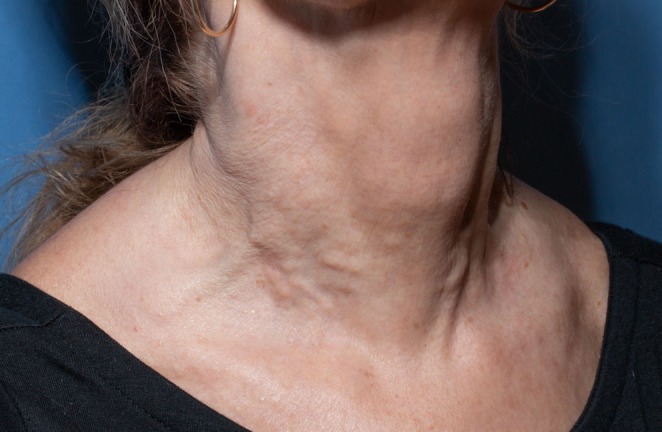 FIGURE 1
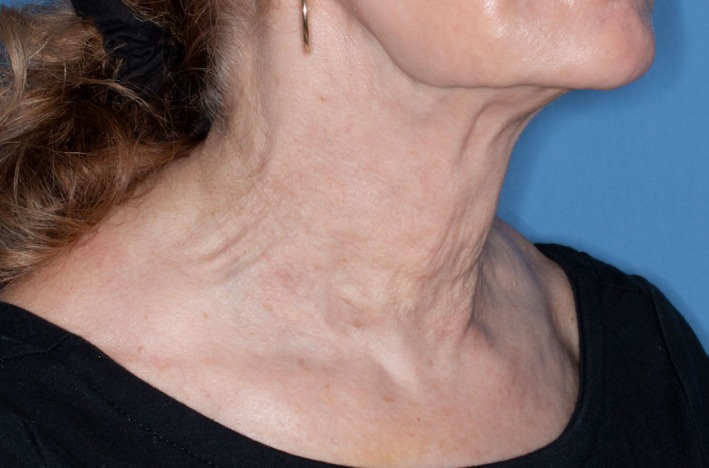 FIGURE 2
| Clinical pearls for calcium hydroxylapatite injections in the neck |
|---|
|
Administer botulinum toxin 2–4 weeks prior to CaHA injection to reduce platysmal movement and lower the risk of product aggregation. If onabotulinumtoxinA is used, the FDA‐approved dosing for the neck is 26–36 units. Avoid or use caution when injecting into the lower 20% of the neck, where the platysma lies more superficially and the skin is thinner, increasing the risk of superficial filler accumulation. Use higher dilutions of CaHA (e.g., 1:2–1:4) when treating thin or atrophic neck skin to minimize the risk of nodule formation. Limit CaHA volume to one syringe per session and adopt a slow, gradual approach to treatment. Injecting with a cannula or using a short linear threading technique with a needle may help to minimize trauma and improve control. If nodules develop and treatment is desired, initiate first‐line management with saline injection and massage. Cannula‐based saline infiltration may be more effective due to its ability to simultaneously deliver fluid and mechanically disrupt aggregates. Consider alternative diagnoses (e.g., infection, biofilm, and granulomatous reaction) and escalate to second‐ or third‐line therapies (e.g., intralesional corticosteroids or 5‐FU, fractional ablative laser, or surgical excision) only if nodules persist despite standard dispersion techniques. |
| Approach | Modality | Mechanism | Clinical considerations |
|---|---|---|---|
| No treatment | Observation | Natural degradation of CaHA over time | Suitable for asymptomatic, non‐visible nodules; based on patient preference |
| First line: minimal intervention | Aqueous dispersion (saline injections and massage) | Mechanical dispersion of CaHA particles | Common approach; effective for early or mild nodules; low‐risk; consider cannula rather than needle |
| Other forms of mechanical dispersion (e.g., radiofrequency, mechanized microneedling, thermomechanical ablation) | Mechanical dispersion of CaHA particles | Requires specialized equipment; emerging technique | |
| Second line: pharmacological and laser interventions | Intralesional corticosteroids (e.g., triamcinolone, dexamethasone) | Anti‐inflammatory; reduces collagen production | Risks include skin atrophy, pigmentation changes; most useful for inflammatory nodules |
| Intralesional 5‐fluorouracil (5‐FU) | Antimetabolite; inhibits fibroblast proliferation | May be combined with corticosteroids; consider for persistent nodules | |
| Fractional ablative laser therapy (CO2 or Er:YAG) | Thermal ablation; promotes remodeling | Best for superficial or fibrotic nodules; risk of pigmentation changes | |
| Ultrasound delivery of collagenase | Enhances enzymatic breakdown of CaHA aggregates | Investigational; safety not established | |
| Third line: invasive removal | Incision/lancing and drainage | Physical removal of the nodule | Invasive with potential for scarring |
| Surgical excision | Physical removal of the nodule | Invasive with potential for scarring | |
| Negative pressure microcannula aspiration | Physical removal of the nodule | Invasive with potential for scarring |
Peer Reviews
No public reviews on file for this paper yet. If you reviewed it on a platform where reviews are public (OpenReview, ICLR, NeurIPS, ICML), you can paste yours below so the community can read it here.
Videos
No videos yet. Explain this paper in a talk, walkthrough, or lecture? Add one.
Taxonomy
TopicsFacial Rejuvenation and Surgery Techniques · Botulinum Toxin and Related Neurological Disorders · Dermatologic Treatments and Research
Background
1
Radiesse (Merz Aesthetics, Raleigh, NC) is a biostimulatory filler containing calcium hydroxylapatite (CaHA) microspheres, which stimulate collagen and elastin production [1]. Hyperdilute CaHA (≥ 1:1 dilution) injection is an off‐label technique commonly used on the face and body to improve skin quality and firmness [1]. Although uncommon, nodules are the most frequent adverse event. We report a case of non‐tender nodules on the lower neck following CaHA injection, and we review contributing factors and strategies for prevention.
Case Report
2
A 72‐year‐old woman presented for treatment of neck aging. Examination showed crepiness and platysmal banding. Combined treatment with hyperdilute CaHA and Botox (onabotulinumtoxinA) was recommended.
The first two treatments, spaced 3 months apart, each involved one syringe of CaHA filler diluted 1:3 with bacteriostatic saline and injected using a 22G cannula in a retrograde threading pattern in the subdermal plane bilaterally. Local infiltration of lidocaine was used at cannula insertion sites, and treated areas were massaged postinjection. Both treatments were combined with onabotulinumtoxinA (Botox, Abbvie, Irvine, CA) injections to the platysma, either at the same visit or 2 weeks prior, and resulted in satisfactory outcomes without adverse events.
Nine months later, the patient underwent a third CaHA treatment using the same injection technique. However, her most recent botulinum toxin injection had been 2 months earlier. Approximately 3 months after this session, she noted multiple firm, non‐tender nodules on the lower neck (Figure 1).
Nodules following injection of calcium hydroxylapatite to the lower neck. Image taken approximately 3 months after most recent injection.
Due to the lack of standardized guidelines for this complication, we initiated intralesional saline injections and modified our approach based on response. Other treatments, including corticosteroids and 5‐fluorouracil, were considered but declined by the patient in favor of a low‐risk, minimally invasive approach. Injections were performed at 2‐week intervals. Saline was chosen based on prior studies suggesting in situ hyperdilution with saline and massage as a first‐line strategy [2, 3], which is believed to disperse CaHA particles and promote clearance of aggregated microspheres.
The initial treatment used a 30G needle followed by massage, resulting in minimal improvement. A 27G needle was used for the second injection, again followed by massage, still resulting in only mild improvement. Subsequent treatments were performed with a 22G cannula, which not only allowed for saline injection but also provided additional mechanical disruption of the nodules, simulating a subcision‐like effect. The clinical endpoint for each session was complete saline infiltration extending approximately 5 mm beyond each nodule. On average, 2.5 cc of saline was used per nodule. This approach led to incremental improvement and ultimately complete resolution after five total saline injections (three with a cannula) (Figure 2). The patient has continued regular follow‐up for over 2 years without recurrence of nodules.
Resolution of nodules after five saline injections over a 10‐week period.
Discussion
3
Although rare, nodule formation is the most frequently reported complication of CaHA filler injection, occurring after approximately 3% of injections [4]. Due to the absence of standardized treatment protocols, various strategies have been described in the literature. Understanding the pathogenesis and contributing factors is key to prevention and management.
CaHA nodules most often result from product aggregation, either due to muscle activity, injection technique (e.g., superficial injection, overfilling, and insufficient dilution), or, in rare cases, filler migration [2, 4, 5]. Among the known contributing factors, repeated muscular contraction leading to microsphere aggregation is believed to be the most common cause of CaHA nodules overall [4]. In a review of 5081 CaHA injections, 166 nodules were reported, most commonly at the lips (45%), perioral region (4%), and nasolabial folds (3%), highlighting a predilection for dynamic facial areas [4]. Less frequently, nodules may result from hypersensitivity reactions, infection, biofilm formation, or granulomatous reaction [2, 4]. Various classification systems have categorized CaHA nodules based on clinical features, including inflammatory versus noninflammatory and early versus delayed onset [2, 4]. These classifications can be useful in guiding differential diagnosis and treatment selection, particularly when symptoms such as erythema, tenderness, or rapid onset are present. In clinical practice, however, the majority of CaHA nodules are due to product aggregation, so it is reasonable to initially assume a mechanical etiology and pursue standard dispersion treatments. Alternative diagnoses should be considered if nodules are refractory or if there are signs or symptoms concerning for infection.
In the authors' experience, combined treatment with neuromodulator appears to reduce nodule risk by limiting muscular contraction. Botulinum toxin reaches peak effect at 4 weeks and wanes thereafter, potentially explaining reduced protection during the third injection in this case report [6]. Studies with hyaluronic acid (HA) filler show that combining with botulinum toxin can extend filler longevity by reducing muscle‐driven degradation [7, 8, 9, 10]. With biostimulatory fillers like CaHA, reduced muscle activity may instead prevent particle aggregation by minimizing repetitive mechanical shear forces in dynamic areas. Although direct evidence for this mechanism with CaHA is limited, the observed pattern of nodule development in high‐mobility areas supports this hypothesis and has informed expert recommendations for using neuromodulators as a preventive strategy.
Injection depth is also critical, especially because many patients who are good candidates for hyperdilute CaHA also have significant photoaging‐related dermal and epidermal atrophy. The platysma in the lower neck is more superficial (frequently 0.75–3 mm beneath the skin surface), due to thin skin and frequent adhesions between the skin and the underlying platysma. This varies depending on patient factors such as age, body mass index (BMI), and sex [11]. Because of this, more superficial injections (into the subdermal plane) may reduce the risk of CaHA accumulation within or below the platysma. In our current clinical practice, we also recommend avoiding injection into the lower 20% of the neck (Table 1).
Dilution is another important consideration. The current consensus for treatment of the neck with hyperdilute CaHA is to use higher dilutions (1:2–1:4, depending on skin thickness), as these are thought to carry a lower risk of nodule development [1]. Additional recommended techniques to prevent CaHA nodules are treating gradually, limiting each session to one syringe of product, and injecting with a cannula [1]. A short linear threading technique with a needle is an alternative technique. As demonstrated in this case, these techniques alone were insufficient in preventing nodule formation when platysmal activity was present.
When nodules do develop in any location, a stepwise approach to treatment is advised. Observation is an option, particularly for inconspicuous nodules. If treatment is desired, early intervention is key, as prolonged CaHA‐stimulated collagen and elastin production may increase the difficulty of treatment overtime [2, 4]. Generally, initial management involves dispersion techniques, such as saline or sterile water injections followed by massage [2, 4]. Our findings suggest that simple saline injections using small‐gauge needles provide only mild improvement, whereas cannula‐based injections offer superior efficacy by simultaneously delivering saline while mechanically disrupting the nodules. If nodules persist, second‐line options include intralesional injections of 5‐fluorouracil and/or corticosteroids, laser therapy, or surgical excision (Table 2).
Conclusion
4
Hyperdilute CaHA is an effective treatment for improving skin quality and firmness. While nodule formation is uncommon, it remains the primary adverse event, especially in dynamic areas with thin overlying skin. This case highlights preventive strategies, including injection technique, product dilution, and adjunctive use of neuromodulators. When nodules do occur, mechanical disruption with a cannula combined with saline injection is a safe and effective first‐line treatment. By continuing to refine injection strategies and improving our understanding of nodule formation, we can improve safety and efficacy in aesthetic treatments with CaHA.
Disclosure
Dr. Fabi is a consultant for AbbVie, Galderma, Merz, Revance, L'Oréal; investigator for AbbVie, Galderma, Merz, Revance, Croma, Symatese, L'Oréal; and stockholder in Revance and AbbVie. Dr. Kang and Dr. Hoss have no relevant disclosures.
Ethics Statement
This case report did not require institutional review board (IRB) approval as it presents a clinical case for educational purposes only, with all patient identifying information de‐identified in accordance with HIPAA regulations. Written, informed consent was obtained from the patient for all procedures performed.
Consent
Written, informed consent was obtained from the patient for publication of this case report and accompanying images.
Conflicts of Interest
The authors declare no conflicts of interest.
The reference list from the paper itself. Each links out to its DOI / PubMed record.
- 1K. Goldie , W. Peeters , M. Alghoul , et al., “Global Consensus Guidelines for the Injection of Diluted and Hyperdiluted Calcium Hydroxylapatite for Skin Tightening,” Dermatologic Surgery 44, no. Suppl 1 (2018): S 32–S 41.30358631 10.1097/DSS.0000000000001685 · doi ↗ · pubmed ↗
- 2A. D. Mc Carthy , J. van Loghem , K. A. Martinez , S. B. Aguilera , and D. Funt , “A Structured Approach for Treating Calcium Hydroxylapatite Focal Accumulations,” Aesthetic Surgery Journal 44, no. 8 (2024): 869–879.38366791 10.1093/asj/sjae 031PMC 11333958 · doi ↗ · pubmed ↗
- 3A. T. de Almeida , V. Figueredo , A. L. G. da Cunha , et al., “Consensus Recommendations for the Use of Hyperdiluted Calcium Hydroxyapatite (Radiesse) as a Face and Body Biostimulatory Agent,” Plastic and Reconstructive Surgery. Global Open 7, no. 3 (2019): e 2160.31044123 10.1097/GOX.0000000000002160 PMC 6467620 · doi ↗ · pubmed ↗
- 4J. A. Kadouch , “Calcium Hydroxylapatite: A Review on Safety and Complications,” Journal of Cosmetic Dermatology 16, no. 2 (2017): 152–161.28247924 10.1111/jocd.12326 · doi ↗ · pubmed ↗
- 5M. Vanaman , S. G. Fabi , and J. Carruthers , “Complications in the Cosmetic Dermatology Patient: A Review and Our Experience (Part 1),” Dermatologic Surgery 42, no. 1 (2016): 1–11.26716709 10.1097/DSS.0000000000000569 · doi ↗ · pubmed ↗
- 6T. C. Flynn , “Botulinum Toxin: Examining Duration of Effect in Facial Aesthetic Applications,” American Journal of Clinical Dermatology 11, no. 3 (2010): 183–199.20369902 10.2165/11530110-000000000-00000 · doi ↗ · pubmed ↗
- 7T. Custis , D. Beynet , D. Carranza , J. Greco , G. P. Lask , and J. Kim , “Comparison of Treatment of Melomental Fold Rhytides With Cross‐Linked Hyaluronic Acid Combined With Onabotulinumtoxin A and Cross‐Linked Hyaluronic Acid Alone,” Dermatologic Surgery 36, no. Suppl 3 (2010): 1852–1858.20969662 10.1111/j.1524-4725.2010.01741.x · doi ↗ · pubmed ↗
- 8J. Carruthers and A. Carruthers , “A Prospective, Randomized, Parallel Group Study Analyzing the Effect of BTX‐A (Botox) and Nonanimal Sourced Hyaluronic Acid (NASHA, Restylane) in Combination Compared With NASHA (Restylane) Alone in Severe Glabellar Rhytides in Adult Female Subjects: Treatment of Severe Glabellar Rhytides With a Hyaluronic Acid Derivative Compared With the Derivative and BTX‐A,” Dermatologic Surgery 29, no. 8 (2003): 802–809.12859378 10.1046/j.1524-4725.2003.29212.x · doi ↗ · pubmed ↗