Case Report: Heterozygous out-of-frame frameshift variant in ELANE without evidence of neutropenia
Yulin Li, Lang Yu, Yishi Zhang, Liwen Zhang, Lina Zhou, Xuemei Tang, Xiaodong Zhao

TL;DR
A patient with a specific ELANE gene mutation did not develop neutropenia, suggesting a potential new mechanism for treating related blood disorders.
Contribution
This case report provides clinical evidence that a specific ELANE frameshift variant may prevent mutant protein production and promote neutrophil maturation.
Findings
The patient had a heterozygous out-of-frame frameshift variant in ELANE but no neutropenia.
Bone marrow showed mild granulocytic hypoplasia without maturation arrest.
The variant may inhibit mRNA translation, supporting gene therapy development for ELANE-related diseases.
Abstract
Mutations in the ELANE gene, which encodes neutrophil elastase, are known to cause cyclic neutropenia (CyN) and severe congenital neutropenia (SCN). Currently, targeting ELANE for insertion-deletion to trigger nonsense-mediated mRNA decay (NMD) may be a simple and universal method to treat SCN caused by ELANE mutations. Here, we present a patient with a heterozygous out-of-frame frameshift variant (-2 frame indel) in exon 4 of the ELANE gene. The patient underwent whole exome sequencing during hospitalization for acute parotitis and bronchitis, and found a variant in ELANE, c.581_588del AGGCCGGC (p.Q194Rfs*93), inherited from the father. The father of the patient, without neutropenia, did not present any clinically significant symptoms and showed no evidence of somatic mosaicism. During the subsequent three-year follow-up period, the patient did not experience any other major…
Genes, proteins, chemicals, diseases, species, mutations and cell lines named across the full text — each resolved to its canonical identifier and authoritative record.
Click any figure to enlarge with its caption.
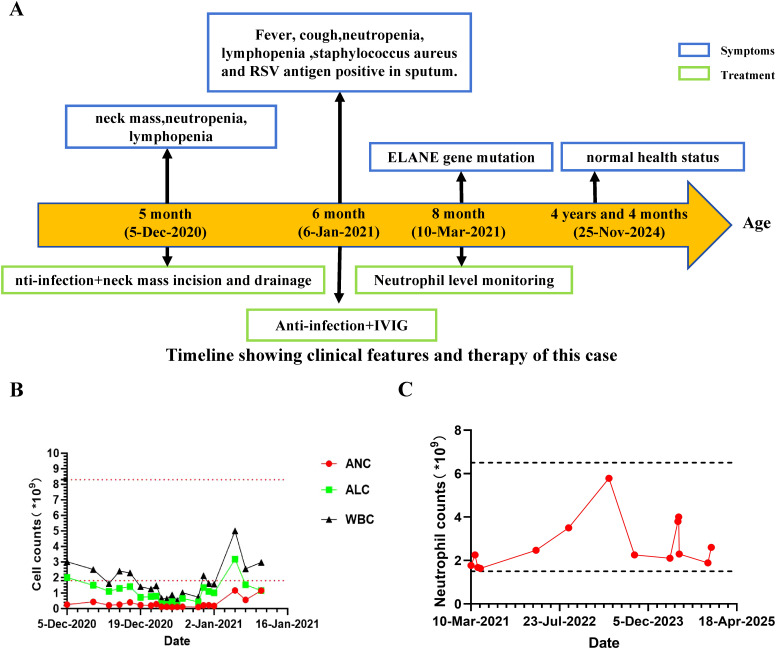 Figure 1
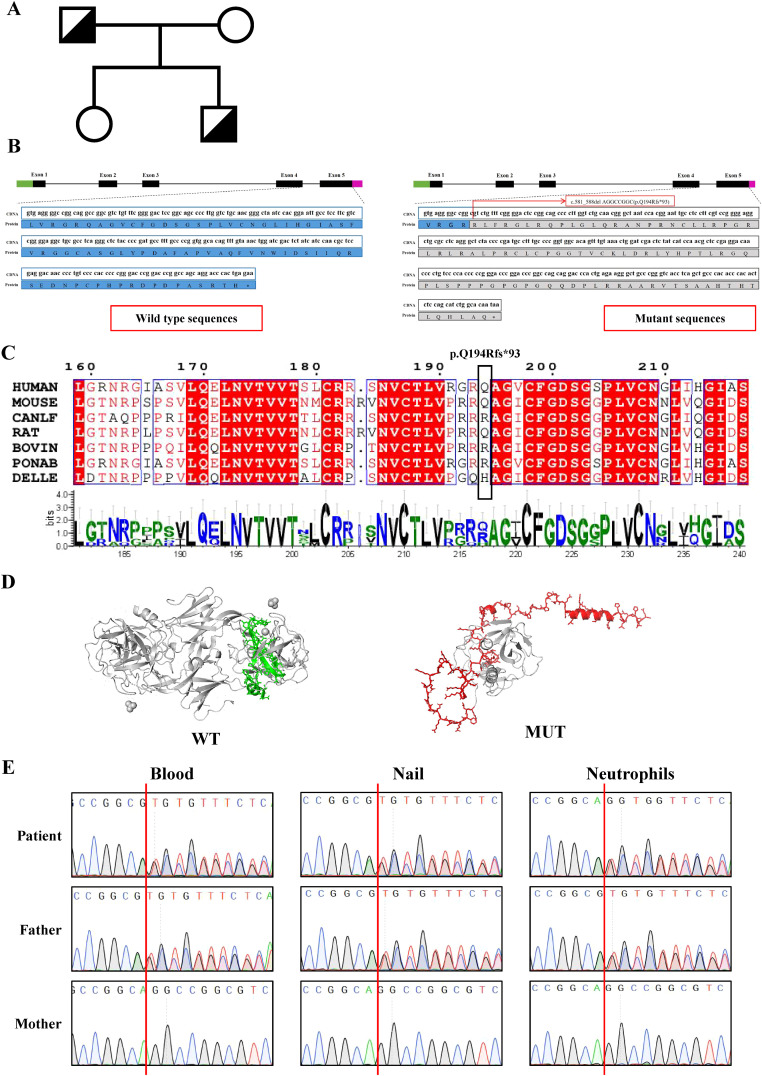 Figure 2
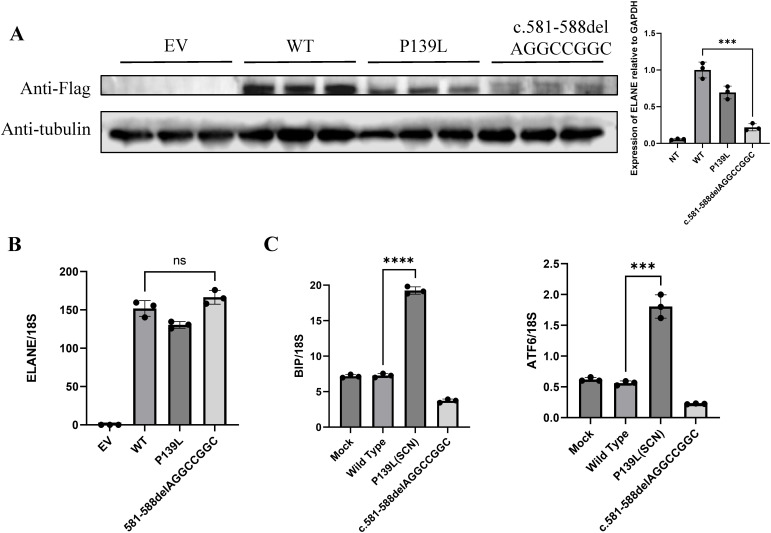 Figure 3
| Frameshifts | ||||||||
|---|---|---|---|---|---|---|---|---|
| No. | cDNA ( | Protein ( | AA length | Indel length | Frame (0, -1 or -2) | Exon | CN | CyN |
| 1 | c.269_277del | p.R91Afs∗175 | 264 | -9 | -2 | 3 | ✓ | |
| 2 | c.540_541dupCT | p.C181SfsX11 | 190 | +2 | -1 | 4 | ✓ | |
| 3 | c.585delC | p.G196AfsX16 | 210 | -1 | -1 | 5 | ✓ | |
| 4 | c.583_584dupGC | p.G196PfsX17 | 211 | +2 | -1 | 5 | ✓ | |
| 5 | c.588_589dupCG | p.V197AfsX16 | 211 | +2 | -1 | 5 | ✓ | |
| 6 | c.589_590insAGGCCGGC | Val197GlufsTer18 | 213 | +8 | -1 | 4 | ✓ | |
| 7 | c.590_591insTTTTT | p.C198FfsX16 | 212 | +5 | -1 | 5 | ✓ | |
| 8 | c.589_596dupGTCTGTTT | p.F199LfsX16 | 213 | +8 | -1 | 5 | ✓ | |
| 9 | c.601delG | p.D201TfsX11 | 210 | -1 | -1 | 5 | ✓ | |
| 10 | c.601del | p.D201Tfs∗11 | 210 | -1 | -1 | 5 | ✓ | |
| 11 | c.602_608delACTCCGG | p.D201AfsX9 | 208 | -7 | -1 | 5 | ✓ | |
| 12 | c.601_608dupGACTCCGG | p.S204TfsX11 | 213 | +8 | -1 | 5 | ✓ | |
| 13 | c.615delC | p.L206WfsX6 | 210 | -1 | -1 | 5 | ✓ | |
| 14 | c.641delG | p.G214EfsX26 | 238 | -1 | -1 | 5 | ✓ | |
| 15 | c.649delT | p.S217PfsX23 | 238 | -1 | -1 | 5 | ✓ | |
| 16 | c.658delC | p.R220GfsX20 | 238 | -1 | -1 | 5 | ✓ | |
| 17 | c.662delG | p.G221EfsX19 | 238 | -1 | -1 | 5 | ✓ | |
| 18 | c.667delT | p.C223AfsX17 | 238 | -1 | -1 | 5 | ✓ | |
| 19 | c.687delC | p.D230MfsX10 | 238 | -1 | -1 | 5 | ✓ | |
| 20 | c.688delG | p.D230MfsX10 | 238 | -1 | -1 | 5 | ✓ | |
| 21 | c.689_690insNN | p.D230fsX11 | 239 | +2 | -1 | 5 | ✓ | |
| 22 | c.697delG | p.A233PfsX7 | 238 | -1 | -1 | 5 | ✓ | |
| 23 | c.697_700delGCCC | p.A233PfsX6 | 237 | -4 | -1 | 5 | ✓ | |
| 24 | c.701delC | p.P234RfsX6 | 238 | -1 | -1 | 5 | ✓ | |
| 25 | c.703delG | p.V235WfsX5 | 238 | -1 | -1 | 5 | ✓ | |
| 26 | c.710delA | p.Q237RfsX3 | 238 | -1 | -1 | 5 | ✓ | |
Peer Reviews
No public reviews on file for this paper yet. If you reviewed it on a platform where reviews are public (OpenReview, ICLR, NeurIPS, ICML), you can paste yours below so the community can read it here.
Videos
No videos yet. Explain this paper in a talk, walkthrough, or lecture? Add one.
Taxonomy
TopicsBlood disorders and treatments · Immunodeficiency and Autoimmune Disorders · Erythrocyte Function and Pathophysiology
Introduction
The ELANE gene codes for neutrophil elastase (NE), a serine protease predominantly localized within neutrophil granules (1). Heterozygous mutations in ELANE cause both cyclic (CyN) and severe congenital neutropenia (SCN) (2). While the pathogenic mechanisms of the ELANE gene are still being investigated, previous hypotheses suggest that mutant polypeptides encoded by ELANE play a significant role. One hypothesis proposes that ELANE mutations induce protein misfolding, triggering stress responses and ultimately leading to apoptosis (3, 4). Another hypothesis suggests that mutated peptides are misrouted but still maintain their destructive proteolytic activity (5). Previous observations suggest that the pathogenicity of ELANE mutations may be due to gain-of-function alterations in mutant NE, rather than a loss of function in normal NE (5, 6).
Here, we present an intriguing case involving a patient with a heterozygous frameshift variant in exon 4 of the ELANE gene. Clinically, the patient does not exhibit symptoms consistent with severe congenital neutropenia or cyclic neutropenia.
Method
Genetic diagnosis
Whole-exome sequencing (WES) was performed on genomic DNA of the patient. Mutations in the ELANE gene were verified by Sanger sequencing for patient and his parents.
Construction of plasmids
7.1-pCMV-3×Flag wild-type human ELANE plasmids were purchased from Unibio (China) (7). As previously described, Point mutation plasmids and frameshift mutation plasmids were generated by overlap PCR method using WT as template. Mutations were confirmed by Sanger sequencing.
Western blotting
HEK 293T (ATCC, CRL-11268) were cultured in Dulbecco’s modified Eagle medium (DMEM;Gibco) supplemented with 10% fetal bovine serum (FBS; Excellbio) at 37°C with 5% CO2. Cells were transiently transfected with either wild-type human ELANE plasmids or mutant ELANE plasmids using PEI (APExBIO) according to the manufacturer’s protocol. The cells were lyzed in radioimmunoprecipitation assay buffer (RIPA) containing phenylmethanesulfonyl fluoride (PMSF) and a protease inhibitor cocktail (PIC). Protein expression was examined by western blotting with an anti-Flag (Sellleck) mouse antibody.
Detection of mutant ELANE-induced ER stress in U2OS cells
U2OS cells (ATCC^®^ HTB-96™) were cultured in DMEM (Gibco) supplemented with 10% fetal bovine serum (FBS; Excellbio) at 37°C with 5% CO_2_. Cells were transiently transfected with either wild-type human ELANE plasmids or mutant ELANE plasmids using PEI (APExBIO) according to the manufacturer’s protocol. Total RNA was extracted 24 hours post-transfection using TRIzol reagent (Invitrogen). cDNA was synthesized from 1 μg RNA using PrimeScript RT Master Mix (Takara Bio). Quantitative PCR was performed using SYBR Green Supermix (Bio-Rad) with primers specific for ER stress markers (BIP, ATF6) and 18S as an internal control (8).
Statistical analysis
Samples were compared using two-tailed, unpaired Student’s t test with GraphPad Prism 7.00. Error bars were represented by SD. *P < 0.05, **P < 0.01, ***P < 0.001.
Results
Case presentation
Here, we present an intriguing case involving a 4-year-and-4-month-old boy born to non-consanguineous parents, exhibiting a heterozygous frameshift variant in exon 4 of the ELANE gene, despite lacking evidence of congenital neutropenia (Figure 1A). At five months of age, he presented to a local hospital with an left neck mass. Physical examination revealed a left neck mass with mildly elevated local skin temperature, without erythema or ulceration. His hematologic profile revealed a consistent reduction in peripheral blood lymphocytes and neutrophils (Absolute neutrophil count range: 0.16-1.16×10^9^/L, absolute lymphocyte count range: 0.73-3.19×10^9^/L) (Figure 1B). Bone marrow cytology suggested mild granulocytic hypoplasia without maturation arrest. Further evaluations, including neck ultrasound and MRI, led to considerations of left acute suppurative parotitis, primary immunodeficiency, and congenital neutropenia. Based on these diagnoses, the local hospital initiated anti-infective treatment and performed incision and drainage of the neck mass. Postoperative purulent puncture culture results were positive for Staphylococcus aureus.
Clinical manifestation of this patient. (A) Clinical course of the patient. (B) Absolute number of peripheral blood white blood cells (WBC), lymphocytes, and neutrophils during follow-up. Horizontal dashed lines indicate upper and lower reference values of ANC. (C) Absolute number of peripheral blood neutrophils during the three-year follow-up.
The Patient was admitted to hospital at 6 months of age with a history of intermittent fever for over 1 month, left neck mass for 1 month, and cough for 4 days. Physical examination revealed a body temperature of 36.5°C, hyperpigmentation of the left cervical skin (approximately 6cm × 5cm), and slightly coarse breath sounds bilaterally. Chest CT plain scan demonstrated mild interstitial changes in both lungs. Combined with additional investigations (Supplementary Figure 1, Supplementary Table 1), the patient was diagnosed with primary immunodeficiency, suppurative parotitis (recovery phase), and acute bronchitis. He has exhibited good growth and development, and during the subsequent three-year follow-up, he has not experienced any major infections apart from occasional upper respiratory tract infections.
Genetic diagnosis
Suspected immune deficiency prompted WES, which identified a novel heterozygous frameshift variant in the ELANE gene, c.581_588del AGGCCGGC (p.Q194Rfs93), inherited from his father (Figure 2A, Supplementary Table 2). This variant, not previously reported, was predicted to be likely pathogenic (Figures 2B–D, Supplementary Figure 2). Consistent with ACMG guidelines, this variant is classified as a loss-of-function allele (frameshift mutation) that is expected to disrupt gene function. Its absence in population databases (gnomAD frequency = 0) supports its preliminary classification as Likely Pathogenic (9).This variant lead to an out-of-frame heterozygous frameshift variant in exon 4 of the ELANE gene, and the -2 frame indel in the late exon 4 has led to a C-terminal peptide extended by 18 amino acids (aa) (Figure 2B, Supplementary Figure 2). Given that we failed to obtain sufficient patient samples for analysis, we overexpressed ELANE and its mutant variants in vitro. The results revealed significantly reduced protein expression in the ELANE p.Q194Rfs93 with normal mRNA levels (Figures 3A, B). To validate whether ELANE variant-induced protein misfolding triggers endoplasmic reticulum (ER) stress response, we examined the mRNA expression levels of ER stress markers immunoglobulin heavy chain binding protein (BiP) and activating transcription factor 6 (ATF6). Compared with wild-type, human U2OS cells transiently expressing SCN-associated (P139L) ELANE mutant exhibited higher expression of both BiP and ATF6, whereas transient expression of this patient’s ELANE variant (c.581_588delAGGCCGGC) failed to induce ER stress in U2OS cells (Figure 3C).
Identification and characterization of ELANE mutations in the patient’s family. (A) Family pedigree. ELANE Q194Rfs93 mutation in patient and his father is indicated. (B) Schematic representation of the ELANE gene mutation (c.581_588delAGGCCGGC) and its predicted protein impact. (C) Multiple sequence alignment of ELANE across seven mammalian species shows complete conservation of the frameshift mutation region (red arrow indicates PQ194Rfs93 site). Conserved catalytic residues are marked with asterisks. (D) The wild-type ELANE structure (PDB: 7CBK) and AlphaFold3-predicted mutant are shown, with specifically altered residues colored (wild-type: green; mutant: red). (E) Sanger sequencing of the ELANE gene in patient and family members. Genomic DNA from blood, nails and neutrophils was used.*
The ELANE c.581_588delAGGCCGGC variant lacks pathogenic evidence. (A, B) Representative images of mutant ELANE protein and mRNA expression across EV, WT, P139L, and c.581-588del AGGCCGGC. from three independent experiments. (C) Endoplasmic reticulum stress induction by mutant ELANE, representative data from two to three independent experiments are shown. "**" means "p<0.001"; "***" means "p<0.0001", and "ns" means "not significant".
Notably, the patient’s parents and sister were healthy, with no history of recurrent infections or neutropenia. Particularly, his father had no childhood periodic neutropenia. Mosaic analysis revealed no mosaic phenomenon in the patient or his father (Figure 2E).
Treatment and outcomes
The patient received active anti-infective treatment and intravenous immunoglobulin (IVIG) (supportive treatment during the acute phase of infection), and showed improvement upon discharge. Throughout the course of the illness, a decline in the absolute number of WBC, lymphocytes, and neutrophils was observed in this patient (Figure 1B). Interestingly, following the treatment of the patient’s parotitis, the number of peripheral blood lymphocytes and neutrophils gradually increased, and long-term follow-up post-discharge revealed sustained normal absolute neutrophil counts (Absolute neutrophil count range: 1.64-5.78×10^9^/L) (Figure 1C). Importantly, he subsequently experienced no significant infection history or need for hematologic disorder treatment.
Discussions
A notable characteristic of ELANE gene mutations is their typically autosomal dominant nature, with the majority of SCN-associated ELANE mutations being missense mutations. Despite the presence of a normal ELANE allele, the aberrant NE protein still leads to neutropenia (10). Since NE appears non-essential, targeting ELANE for indel mutations to trigger NMD may be a straightforward and universal method to treat SCN caused by ELANE mutations (11). Previous studies have shown that introducing indels in ELANE exon 2 can restore neutrophil maturation in ELANE-mutant cells in vitro ( 12). SCN-associated frameshift mutations are limited to the penultimate exon (exon 4) and the last exon (exon 5) (10). According to the 50-nt rule, these frameshift mutations escape NMD (13). Rao et al. similarly found that efficient gene editing of early exons induced NMD, overcoming the neutrophil maturation arrest in HSPCs of ELANE-mutant SCN patients and producing normal hematopoietic engraftment (11). They observed that only -1 frame insertion or deletion (indel) of late exon (exon 4 and exon 5) can lead to the generation of premature termination codons (PTCs), escaping NMD and affecting normal protein function and causing neutrophil maturation arrest. In contrast, a -2 frame indel does not Express mutant protein, allowing normal neutrophil development. Their study demonstrates that a -2 frameshift indel generates additional amino acids, resulting in a shorter 3’ UTR. This alteration causes ELANE mRNA to shift from polysomes (actively translating) to monosomes (translationally inactive), leading to reduced translation efficiency. Both in vivo and in vitro experiments consistently showed significant enrichment of this variant in mature neutrophils.
A review of 26 frameshift mutations in the ELANE gene associated with congenital neutropenia revealed that nearly all insertion-deletion mutations lead to a single-frame shift. Moreover, among these 26 mutation types, all except one, which manifested as cyclic neutropenia, were categorized as severe congenital neutropenia (Table 1) (10, 14–16). In patient P1, a unique frameshift mutation is observed in the ELANE gene. The genotype of P1 is c.269_277del (p.R91Afs*175), occurring in exon 3, resulting in a -2 frame indel. Although P1’s clinical presentation is SCN, P1’s ELANE mutation is a compound heterozygous mutation, with the other mutation being a missense mutation in an early exon, c.278A>G (p.E93G) (14). Despite the existence of one patient with a -2 frame indel, owing to the compound heterozygous nature of the mutation and the absence of specific hematologic data, it is still presumed that in previous instances of congenital neutropenia caused by ELANE frameshift mutations, the mutations entail single-frame shifts in late exons. Analysis of ELANE frameshift variants in gnomAD (Supplementary Table 3) reveals distinct positional patterns: early exons harbor diverse frameshift types (0, -1, and -2 frame insertion or deletion), while late exons predominantly exhibit -2 frameshifts. These population frequency observations corroborate the mechanistic framework proposed by Rao et al.
Moreover, patients with ELANE gene deletions do not exhibit reduced neutrophil counts, providing additional support for the feasibility of inducing NMD through ELANE gene insertions or deletions as a treatment for SCN. Among the 11 documented cases of complete ELANE gene deletions, only one patient has been reported to have neutropenia, and this case lacks supporting evidence, suggesting that ELANE gene deletions do not lead to decreased neutrophil counts in patients (17). Additionally, a six-month-old Caucasian male patient with a de novo nonsense mutation in exon 2 of the ELANE gene, predicted to result in protein truncation or NMD, did not present clinically significant neutropenia (18). This absence of neutropenia may be attributed to early exon editing triggering NMD, thereby averting the maturation arrest of neutrophils, consistent with findings by Nasri et al. and Rao (11, 12).
The patient and his father in this case exhibits an out-of-frame heterozygous frameshift variant in exon 4 of the ELANE gene, and the -2 frame indel in the late exon 4 has led to a C-terminal peptide extended by 18 amino acids (aa). Our results demonstrated that although mRNA levels remain unchanged, the reduction in protein production reflects inefficient translation, and prevents the generation of mutant proteins, thus supporting neutrophil maturation (Figures 3A, B) (11, 13). From another perspective, our failure to observe endoplasmic reticulum stress alterations induced by this mutant variant further substantiates that it does not compromise neutrophil maturation (Figure 3C).
It is evident that our patient’s neutropenic episode is associated with severe acute suppurative mumps, as evidenced by the decrease in both white blood cells and lymphocytes. Importantly, these parameters all returned to normal following treatment, and over the three-year follow-up period, no history of periodic neutropenia or other signs of neutropenia were observed in the patient. While we acknowledge the possibility of other potential immune deficiencies in the patient, or that this variant ELANE c.581_588del; p.Q194Rfs*93 may reduce the efficiency of immune responses to severe infections (possibilities we cannot entirely exclude at present), we can confirm that both the patient and their father carry an out-of-frame shift variant in the ELANE gene (a -2 frame shift corresponding to the end exon), which is not expected to cause congenital neutropenia. These findings support the ongoing development of gene therapy strategies for addressing ELANE-associated diseases.
The reference list from the paper itself. Each links out to its DOI / PubMed record.
- 1Horwitz M Benson KF Person RE Aprikyan AG Dale DC. Mutations in ELA 2, encoding neutrophil elastase, define a 21-day biological clock in cyclic hematopoiesis. Nat Genet. (1999) 23:433–6. doi: 10.1038/70544, PMID: 10581030 · doi ↗ · pubmed ↗
- 2Dale DC Person RE Bolyard AA Aprikyan AG Bos C Bonilla MA. Mutations in the gene encoding neutrophil elastase in congenital and cyclic neutropenia. Blood. (2000) 96(7):2317–22. doi: 10.1182/blood.V 96.7.2317 11001877 · doi ↗ · pubmed ↗
- 3Xia J Link DC. Severe congenital neutropenia and the unfolded protein response. Curr Opin Hematol. (2008) 15:1–7. doi: 10.1097/MOH.0b 013e 3282 f 13cd 2, PMID: 18043239 · doi ↗ · pubmed ↗
- 4Köllner I Sodeik B Schreek S Heyn H Von Neuhoff N Germeshausen M. Mutations in neutrophil elastase causing congenital neutropenia lead to cytoplasmic protein accumulation and induction of the unfolded protein response. Blood. (2006) 108:493–500. doi: 10.1182/blood-2005-11-4689, PMID: 16551967 · doi ↗ · pubmed ↗
- 5Horwitz MS Corey SJ Grimes HL Tidwell T. ELANE mutations in cyclic and severe congenital neutropenia. Hematology/Oncology Clinics North America. (2013) 27:19–41. doi: 10.1016/j.hoc.2012.10.004, PMID: 23351986 PMC 3559001 · doi ↗ · pubmed ↗
- 6Horwitz MS. Neutrophil elastase: Nonsense lost in translation. Cell Stem Cell. (2021) 28:790–2. doi: 10.1016/j.stem.2021.04.007, PMID: 33961760 · doi ↗ · pubmed ↗
- 7Sun G Qiu L Yu L An Y Ding Y Zhou L. Loss of function mutation in ELF 4 causes autoinflammatory and immunodeficiency disease in human. J Clin Immunol. (2022) 42:798–810. doi: 10.1007/s 10875-022-01243-3, PMID: 35266071 · doi ↗ · pubmed ↗
- 8Hirata O Okada S Tsumura M Karakawa S Matsumura I Kimura Y. Mosaicism of an ELANE mutation in an asymptomatic mother in a familial case of cyclic neutropenia. J Clin Immunol. (2015) 35:512–6. doi: 10.1007/s 10875-015-0165-1, PMID: 25912133 · doi ↗ · pubmed ↗