Predictors of 30-Day Unplanned Readmission in Necrotizing Pancreatitis: A 12-Year Experience From a Tertiary Care Center
Gaurav Suryawanshi, Megan B. Ghai, Nauroze Faizi, Stuart K. Amateau, Nabeel Azeem, Shawn Mallery, Martin L. Freeman, Guru Trikudanathan

TL;DR
This study identifies factors that increase the risk of hospital readmission within 30 days for patients with necrotizing pancreatitis, aiming to improve patient outcomes.
Contribution
The study provides new insights into specific predictors of unplanned readmission in necrotizing pancreatitis patients over a 12-year period.
Findings
37.8% of necrotizing pancreatitis patients experienced unplanned readmission within 30 days.
Abdominal pain and sepsis were the most common reasons for readmission.
Larger necrosis collection size, prolonged pre-transfer hospital stay, and need for percutaneous feeding tube at discharge were independent predictors of readmission.
Abstract
Hospital readmission rate is a key hospital metric and represents a substantial burden to patients and the healthcare system. Necrotizing pancreatitis (NP) patients are at high risk of unplanned readmission. The aim of this study was to determine the incidence and predictors of 30-day unplanned readmission after index hospitalization for NP. Adult NP patients who were managed at a single tertiary referral center between 2009 and 2022 were identified from a prospective database and categorized into 2 groups based on 30-day unplanned readmission after index hospitalization. Patients with no follow-up who died during index admission or within 30 days of discharge were excluded. Baseline data on admission including demographic, clinical, interventional, imaging, and discharge characteristics were compared. Multivariable analysis was completed to identify independent predictors of 30-day…
Genes, proteins, chemicals, diseases, species, mutations and cell lines named across the full text — each resolved to its canonical identifier and authoritative record.
Click any figure to enlarge with its caption.
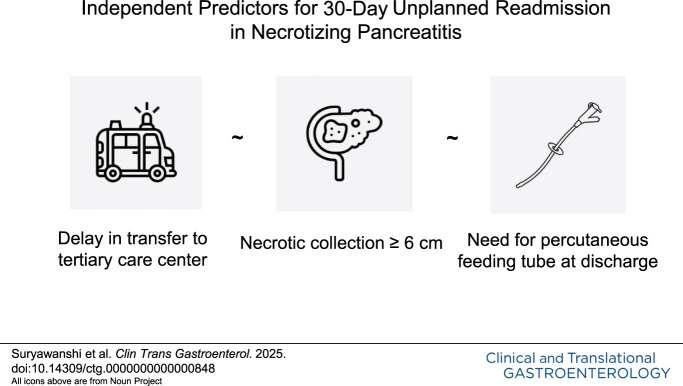 Figure 1
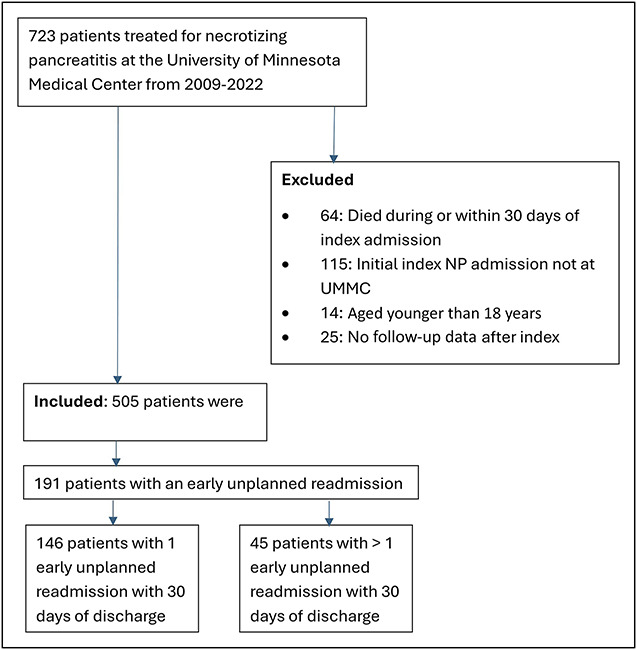 Figure 2
Peer Reviews
No public reviews on file for this paper yet. If you reviewed it on a platform where reviews are public (OpenReview, ICLR, NeurIPS, ICML), you can paste yours below so the community can read it here.
Videos
No videos yet. Explain this paper in a talk, walkthrough, or lecture? Add one.
Taxonomy
TopicsPancreatitis Pathology and Treatment · Pancreatic and Hepatic Oncology Research · Abdominal vascular conditions and treatments