Trivalent Metal Lewis Acids Activate CO2 in Transfer Hydrogenations
Alexandros Paparakis, Leandro D. Mena, Pritha Saha, Krishna Mohan Das, Daniel Shirwani, Jorge G. Uranga, Martin Hulla

TL;DR
Trivalent metal Lewis acids activate CO2 during transfer hydrogenation, enabling efficient synthesis of formamides and azoles from bio-derived hydrogen sources.
Contribution
This study introduces trivalent metal Lewis acids as catalysts for CO2 activation in transfer hydrogenation, bypassing traditional hydride abstraction mechanisms.
Findings
Trivalent metal MX3 Lewis acids catalyze CO2 hydrogenation to formate with γ-terpinene as a bio-derived H2 surrogate.
Formate produced via this method yields up to 91% N-formamides and 95% heterocycles like azoles through tandem reactions.
Density functional theory calculations confirm CO2 directly accepts a hydride from γ-terpinene during formate synthesis.
Abstract
Using γ‐terpinene as a bio‐derived H2 surrogate, trivalent metal MX3 (M = Al, Ga, In, Yb, X = Cl, OTf) Lewis acids (LAs) catalyze CO2 hydrogenation to formate, yielding p‐cymene as the by‐product. The resulting formate produces up to 91% N‐formamides in tandem hydrogenation‐coupling reactions and up to 95% heterocycles, including azoles, via further in situ transfer formylation to ortho‐substituted anilines and cyclization at 130 °C and 4 bar. But In(OTf)3 and a Lewis base fail to abstract a hydride from γ‐terpinene. Unlike other LAs and transfer hydrogenation catalysts that induce hydride abstraction from 1,4‐cyclohexadiene(s) over B(C6F5)3, alkali earth or noble metals, MX3 LAs activate CO2, so CO2 can directly accept a hydride from γ‐terpinene during formate synthesis, as shown by density functional theory calculations. This triple role of MX3 LAs in promoting (1) CO2 activation, (2)…
Genes, proteins, chemicals, diseases, species, mutations and cell lines named across the full text — each resolved to its canonical identifier and authoritative record.
Click any figure to enlarge with its caption.
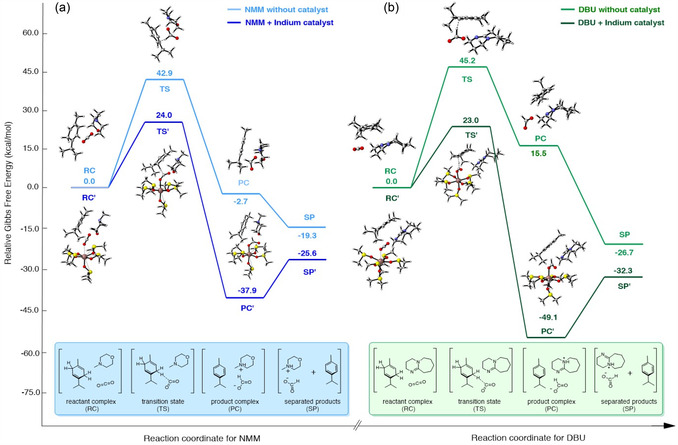 Figure 1
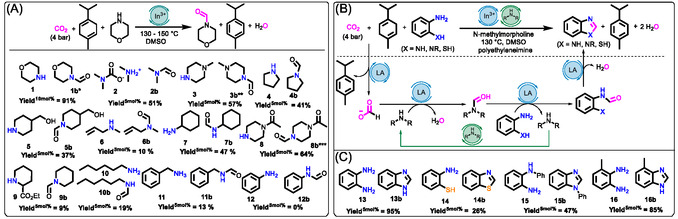 Figure 2
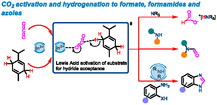 Figure 3
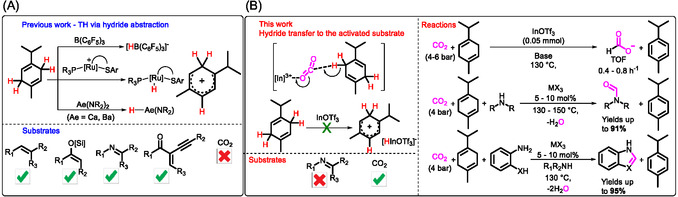 Figure 4
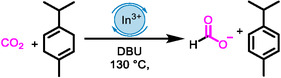 Figure 5
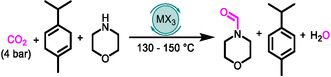 Figure 6
Peer Reviews
No public reviews on file for this paper yet. If you reviewed it on a platform where reviews are public (OpenReview, ICLR, NeurIPS, ICML), you can paste yours below so the community can read it here.
Videos
No videos yet. Explain this paper in a talk, walkthrough, or lecture? Add one.
Taxonomy
TopicsCarbon dioxide utilization in catalysis · Asymmetric Hydrogenation and Catalysis · CO2 Reduction Techniques and Catalysts