Evaluating body composition, the eating behavior scale, and the healthy lifestyle index in female Jordanian adults with metabolic syndrome: a cross-sectional study
Buthaina Alkhatib, Islam Al-Shami, Lana M. Agraib, Amjad Al Shdaifat

TL;DR
This study explores the link between metabolic syndrome and body composition in Jordanian women, finding that more severe metabolic syndrome is associated with higher body fat and lower healthy lifestyle scores.
Contribution
The study provides new insights into how body composition and lifestyle indicators correlate with metabolic syndrome severity in Jordanian women.
Findings
Participants with more MetS components had higher body fat and muscle mass percentages.
HLI scores decreased significantly with increasing MetS components.
No significant differences in eating behavior scores between MetS and non-MetS groups.
Abstract
Metabolic syndrome (MetS) is highly prevalent, and it is associated with unhealthy lifestyle risk factors that can be easily modified. To evaluate body composition, the adults’ eating behavior score (AEBQ), and the healthy lifestyle index (HLI) with metabolic syndrome (MetS) in female Jordanian adults. A cross-sectional study was conducted among 656 females in Jordan. Sociodemographic, anthropometric, blood pressure, and biochemical data were collected. The HLI and AEB questionnaire (AEBQ) was completed, and the waist-to-hip ratio (WHR) and body mass index (BMI) were calculated. MetS was determined based on NCEP-ATPII criteria. Participants with MetS had significantly higher percentages of body fat (44.15 ± 6.37%) and body muscle mass (25.7 ± 4.56%). The mean HLIBMI or HLIWHR for participants with MetS (10.7 ± 1.51 and 11.6 ± 2.03, respectively) was significantly lower than for…
Genes, proteins, chemicals, diseases, species, mutations and cell lines named across the full text — each resolved to its canonical identifier and authoritative record.
Click any figure to enlarge with its caption.
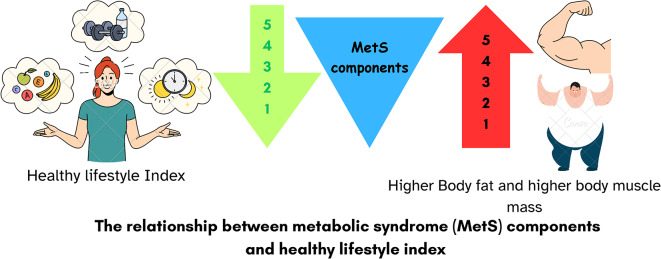 Figure 1
Peer Reviews
No public reviews on file for this paper yet. If you reviewed it on a platform where reviews are public (OpenReview, ICLR, NeurIPS, ICML), you can paste yours below so the community can read it here.
Videos
No videos yet. Explain this paper in a talk, walkthrough, or lecture? Add one.
Taxonomy
TopicsDiabetes, Cardiovascular Risks, and Lipoproteins · Obesity, Physical Activity, Diet · Health and Lifestyle Studies