Field evaluation of the P22 ELISA for diagnosis of caprine tuberculosis in an endemic area
Carlos Velasco, Javier Ortega, Julio Alvarez, Jose Antonio Infantes Lorenzo, José C. Moreno, Cristina Sanz, Beatriz Romero, Lucia de Juan, Lucas Dominguez, Mercedes Dominguez, Inmaculada Moreno, Alvaro Roy, Javier Bezos

TL;DR
This study evaluates the P22 ELISA as a diagnostic tool for goat tuberculosis, showing it can detect more infected herds than traditional tests when using serum or milk samples.
Contribution
The study demonstrates the P22 ELISA's enhanced sensitivity in detecting TB in goats, particularly when using individual milk samples.
Findings
The P22 ELISA detected more high-risk herds using serum and individual milk samples compared to SITT and CITT.
Individual milk samples showed higher reactivity in the P22 ELISA than serum samples.
The P22 ELISA could complement intradermal tests in TB eradication programs for goats.
Abstract
Animal tuberculosis (TB) affects a wide range of domestic species, including goats. TB eradication programs in goats are based on cell-based techniques such as the single and comparative intradermal tuberculin test (SITT and CITT, respectively). In recent years, an ELISA technique based on the P22 protein complex (P22 ELISA), has emerged as a valuable tool for TB diagnosis. The aim of the study was to evaluate the performance of the P22 ELISA in the context of a caprine TB eradication program using serum, individual milk and bulk tank milk (BTM) samples in order to define its usefulness in classifying herds compared to SITT and CITT. Samples from 53 herds categorized based on the detection of CITT reactors (16 high-risk herds, with one or more CITT reactors, and 37 low-risk herds, with only CITT-negative goats) were analyzed. Reactors in the P22 ELISA were detected in a higher number of…
Genes, proteins, chemicals, diseases, species, mutations and cell lines named across the full text — each resolved to its canonical identifier and authoritative record.
Click any figure to enlarge with its caption.
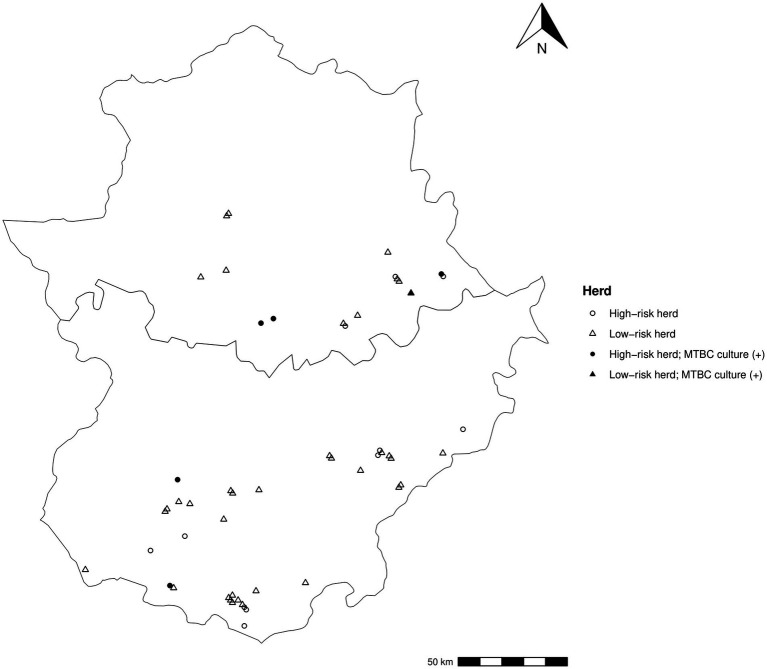 Figure 1
Peer Reviews
No public reviews on file for this paper yet. If you reviewed it on a platform where reviews are public (OpenReview, ICLR, NeurIPS, ICML), you can paste yours below so the community can read it here.
Videos
No videos yet. Explain this paper in a talk, walkthrough, or lecture? Add one.
Taxonomy
TopicsTuberculosis Research and Epidemiology · Mycobacterium research and diagnosis · Microbial infections and disease research