Predicting fitness coaches’ intentions to include persons with disabilities in gyms: an application of the theory of planned behavior
Milan Dransmann, Michael Braksiek, Christopher Meier, Bernd Gröben, Lara Lesch, Pamela Wicker

TL;DR
This study explores how fitness coaches in Germany can be encouraged to include people with disabilities in gyms, based on their attitudes and experiences.
Contribution
The study applies the theory of planned behavior to understand how intentions of fitness coaches to include people with disabilities are formed.
Findings
Descriptive norms and experiential attitudes significantly predict coaches' intentions to support individuals with disabilities.
Previous experiences and frequent contact with people with disabilities influence intention-forming factors.
Fitness coaches need targeted training and resources to translate their intentions into practice.
Abstract
Promoting equal access to fitness offers implies the inclusion of individuals with disabilities in gyms. However, many gyms do not meet the needs of people with disabilities due to physical, social, and human resource barriers. This study examines fitness coaches’ capacities and intentions of providing fitness offers for individuals with disabilities using the theory of planned behavior as a framework. A quantitative online survey was conducted with 182 fitness coaches in Germany. The data were analyzed using confirmatory factor analysis, structural equation modeling, and regression analysis to empirically test the theory of planned behavior constructs and identify factors influencing coaches’ intentions. The analysis confirmed that descriptive norms and experiential attitudes predict coaches’ intentions to support individuals with disabilities, highlighting the importance of social…
Genes, proteins, chemicals, diseases, species, mutations and cell lines named across the full text — each resolved to its canonical identifier and authoritative record.
Click any figure to enlarge with its caption.
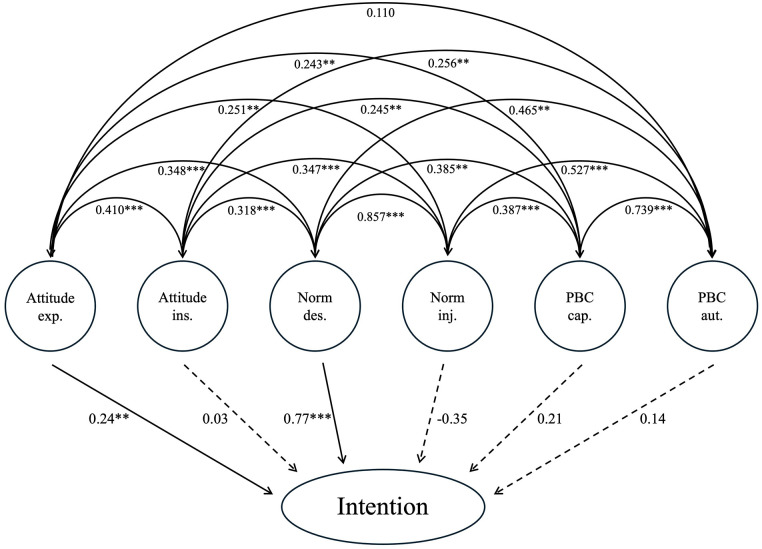 Figure 1
Peer Reviews
No public reviews on file for this paper yet. If you reviewed it on a platform where reviews are public (OpenReview, ICLR, NeurIPS, ICML), you can paste yours below so the community can read it here.
Videos
No videos yet. Explain this paper in a talk, walkthrough, or lecture? Add one.
Taxonomy
TopicsInclusion and Disability in Education and Sport · Physical Education and Pedagogy · Sports, Gender, and Society