Multiple Origins of Sex Chromosomes in Nothobranchius Killifishes
Monika Hospodářská, Pablo Mora, Anna Chung Voleníková, Ahmed Al‐Rikabi, Marie Altmanová, Sergey A. Simanovsky, Nikolas Tolar, Tomáš Pavlica, Karolína Janečková, Jana Štundlová, Kseniya Bobryshava, Marek Jankásek, Matyáš Hiřman, Thomas Liehr, Martin Reichard, Eugene Yu. Krysanov

TL;DR
This paper explores how sex chromosomes evolved multiple times in killifish species, revealing insights into the genetic mechanisms behind sex determination.
Contribution
The study identifies multiple independent origins of sex chromosomes in Nothobranchius killifishes and links these to recombination patterns and chromosomal rearrangements.
Findings
Sex chromosomes evolved independently at least four times in Nothobranchius killifishes.
Sex-determining regions are often located near centromeres or chromosome rearrangement breakpoints.
Two distinct evolutionary strata of sex chromosomes were found in N. guentheri, with a younger stratum containing a potential SD gene.
Abstract
Sex chromosomes have evolved repeatedly across eukaryotes. The emergence of a sex‐determining (SD) locus is expected to progressively restrict recombination, driving convergent molecular differentiation. However, evidence from taxa like teleost fishes, representing over half of vertebrate species with unmatched diversity in SD systems, challenges this model. Teleost sex chromosomes are often difficult to detect as they experience frequent turnovers, resetting the differentiation process. Nothobranchius killifishes, which include the XY system shared by N. furzeri and N. kadleci and X1X2Y systems in six other species, offer a valuable model to study sex chromosome turnovers. We characterised X1X2Y systems in five killifish species and found that sex chromosomes evolved at least four times independently. Sex‐determining regions resided near centromeres or predicted chromosome…
Genes, proteins, chemicals, diseases, species, mutations and cell lines named across the full text — each resolved to its canonical identifier and authoritative record.
Click any figure to enlarge with its caption.
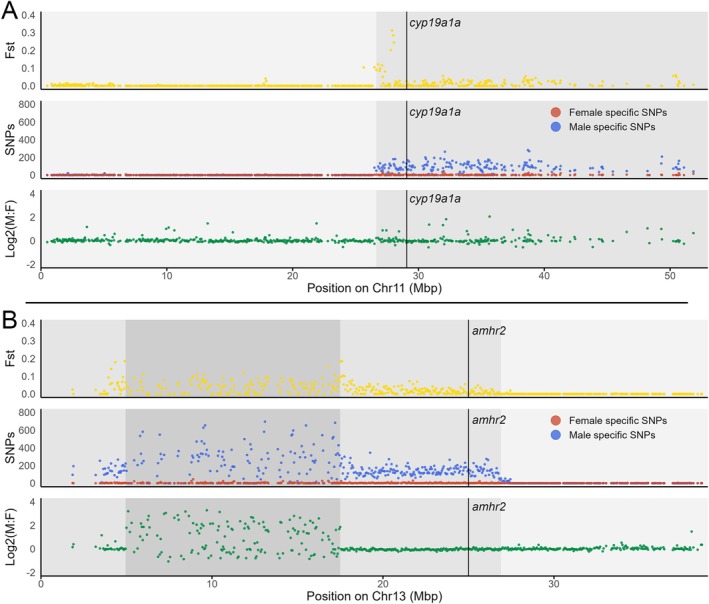 Figure 1
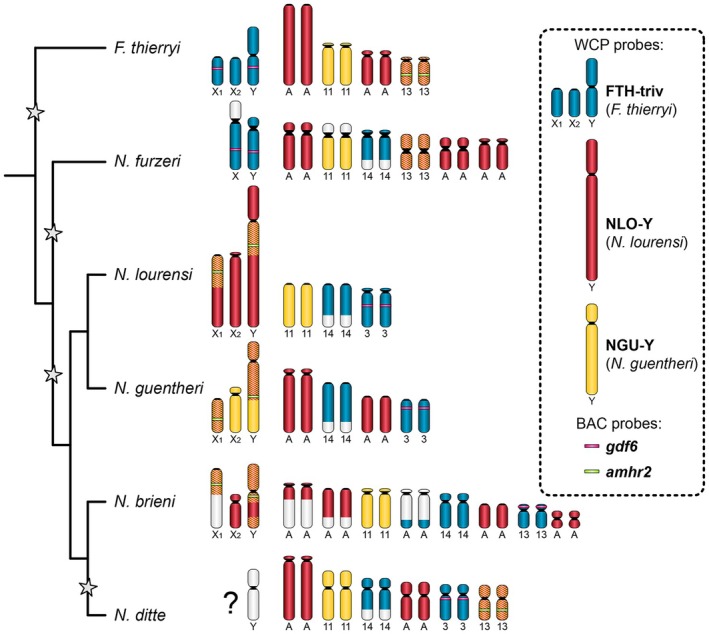 Figure 2
 Figure 3
 Figure 4
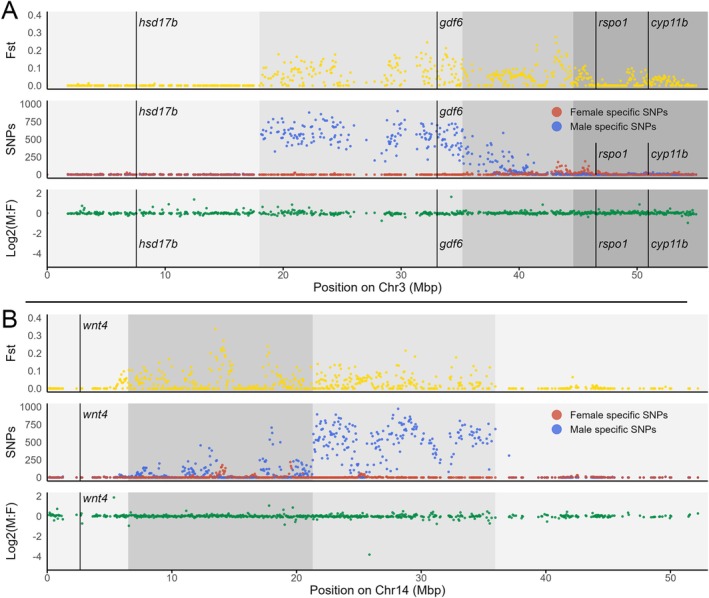 Figure 5
Peer Reviews
No public reviews on file for this paper yet. If you reviewed it on a platform where reviews are public (OpenReview, ICLR, NeurIPS, ICML), you can paste yours below so the community can read it here.
Videos
No videos yet. Explain this paper in a talk, walkthrough, or lecture? Add one.
Taxonomy
TopicsGenetic and Clinical Aspects of Sex Determination and Chromosomal Abnormalities · Fish biology, ecology, and behavior · Chromosomal and Genetic Variations