Engineered bacteriophytochrome heterodimers for research and applications
Iida Tuure, Cornelia Böhm, Jessica Rumfeldt, Elina Multamäki, Heikki Takala

TL;DR
Scientists engineered bacteriophytochrome proteins to form light-sensitive heterodimers, enabling new tools for controlling cellular processes with red light.
Contribution
The novel contribution is creating monomeric bacteriophytochrome modules that form stable heterodimers, enabling light-controlled kinase activity.
Findings
Modified bacteriophytochrome PSMs form stable heterodimers and control histidine kinase activity in response to red light.
Dimerization is essential for kinase activity of FixL but not for phosphatase activity of DrBphP.
Heterodimeric variants were applied to a red light-regulated gene expression system, demonstrating combined control of cellular events.
Abstract
Many proteins are dimeric, functioning as complexes of two identical or different subunits. Bacteriophytochromes are homodimeric photoreceptor proteins that sense red/far-red light with a photosensory module (PSM) and convert it to a biological response via an output module, usually a histidine kinase (HK). Here, we generate monomeric bacteriophytochrome PSMs that form stable heterodimers once mixed by modifying two salt bridges at the dimerization interface of the Deinococcus radiodurans phytochrome (DrBphP). We confirm that these heterodimeric PSMs can control output HK module activity in response to red light and reveal that dimerization is required for kinase activity of the model HK FixL, but not necessarily for phosphatase activity of DrBphP. By applying the heterodimeric variants to a red light-regulated gene expression tool, we exemplify the combined control of cellular events…
Genes, proteins, chemicals, diseases, species, mutations and cell lines named across the full text — each resolved to its canonical identifier and authoritative record.
Click any figure to enlarge with its caption.
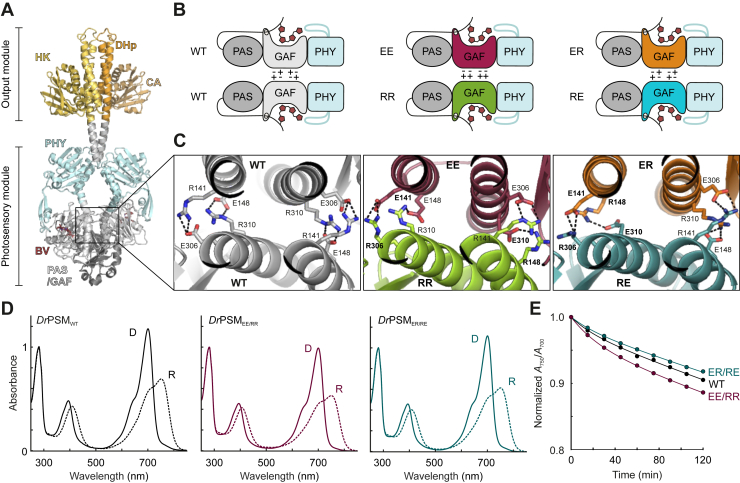 Figure 1
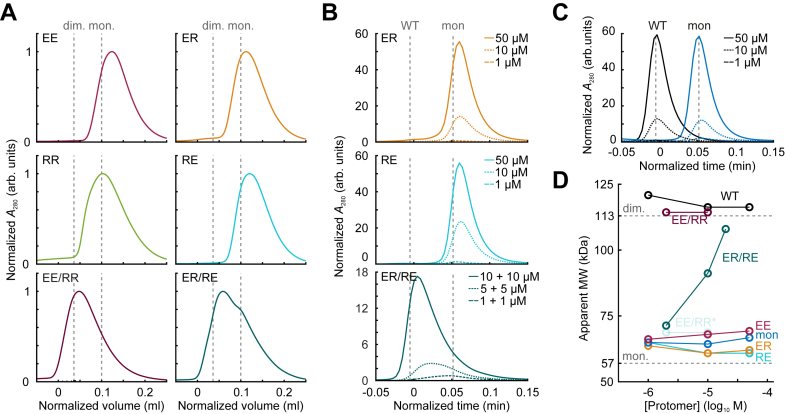 Figure 2
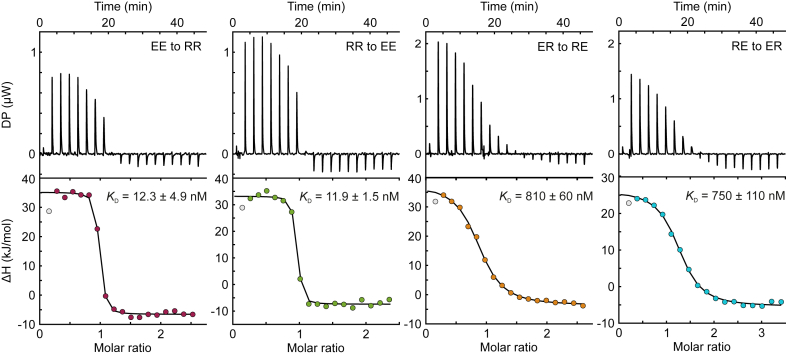 Figure 3
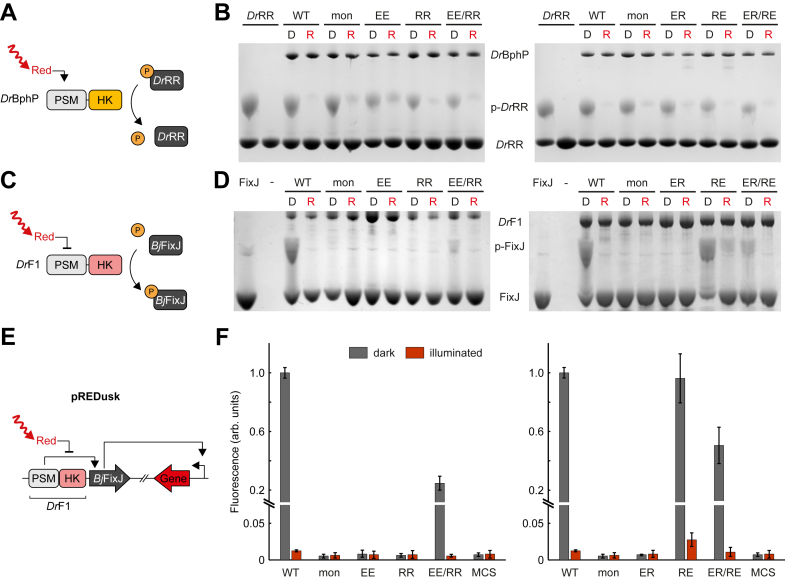 Figure 4
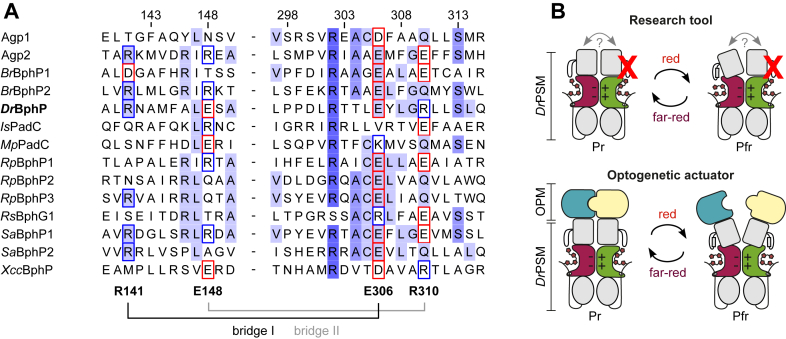 Figure 5
Peer Reviews
No public reviews on file for this paper yet. If you reviewed it on a platform where reviews are public (OpenReview, ICLR, NeurIPS, ICML), you can paste yours below so the community can read it here.
Videos
No videos yet. Explain this paper in a talk, walkthrough, or lecture? Add one.
Taxonomy
TopicsLight effects on plants · Photoreceptor and optogenetics research · Plant and Biological Electrophysiology Studies