Comparison of 2 different fluoroscopy activation intervals in shock wave lithotripsy: a prospective randomized study
Cengiz Çanakcı, Ahmet Şahan, Orkunt Özkaptan, Erdinç Dinçer, Utku Can, Alper Coşkun

TL;DR
A study compared two fluoroscopy intervals during kidney stone treatment and found that longer intervals reduce radiation exposure without affecting treatment success.
Contribution
The study identifies that extending fluoroscopy activation intervals during shock wave lithotripsy reduces radiation exposure without compromising outcomes.
Findings
Fluoroscopy time was significantly longer in the group with more frequent checks.
No significant difference in stone-free status was observed between the two groups.
Extending fluoroscopy intervals reduces radiation exposure without affecting treatment success.
Abstract
Intermittent fluoroscopic controls are required during shock wave lithotripsy (SWL) to readjust the probe due to patients’ movements, respiratory movement, and stone displacement within the kidney. However, there is still no consensus in the literature on the optimal frequency of fluoroscopic monitoring. Our aim was to determine the optimal fluoroscopy activation interval in fluoroscopy‑guided SWL and examine its effect on fluoroscopy time and stone‑free status. This prospective randomized study included patients with opaque renal pelvic stones smaller than 2 cm, subjected to fluoroscopy‑guided SWL between July 2020 and January 2024. The patients were divided into 2 groups. Fluoroscopic control was performed every 250 shocks in group 1, and every 500 shocks in group 2. Demographic data, calculus volume and density, skin‑to‑stone distance, number of shots and sessions, fluoroscopy…
Genes, proteins, chemicals, diseases, species, mutations and cell lines named across the full text — each resolved to its canonical identifier and authoritative record.
Click any figure to enlarge with its caption.
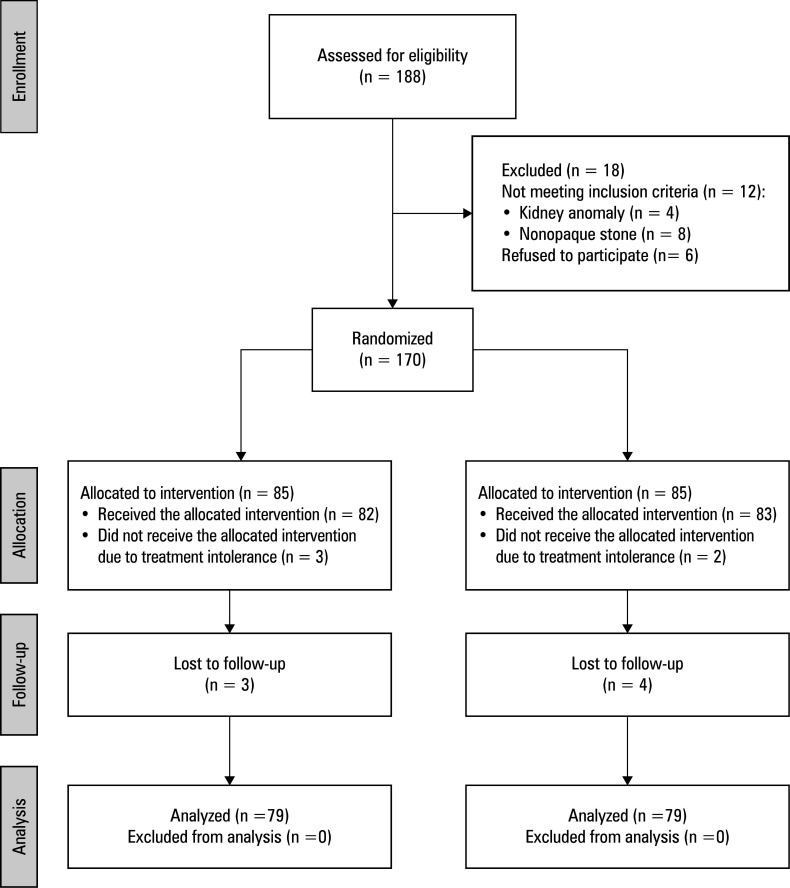 Figure 1
Peer Reviews
No public reviews on file for this paper yet. If you reviewed it on a platform where reviews are public (OpenReview, ICLR, NeurIPS, ICML), you can paste yours below so the community can read it here.
Videos
No videos yet. Explain this paper in a talk, walkthrough, or lecture? Add one.
Taxonomy
TopicsKidney Stones and Urolithiasis Treatments · Traumatic Ocular and Foreign Body Injuries · Radiation Dose and Imaging