Detergent Screening With Hybrid Detergents Increases Observable Number of Protein Identities in Bottom‐Up Proteomics
Jan‐Simon Behnke, Andreas Hentschel, Maximilian Wolf, Virginia Wycisk, Albert Sickmann, Robert S. Heyer, Leonhard H. Urner

TL;DR
Using hybrid detergents in proteomics increases the number of detectable proteins, improving overall proteome coverage.
Contribution
Introducing hybrid detergents that combine ionic and nonionic properties to enhance observable proteomes.
Findings
Combining hybrid detergents with traditional ones increased unique protein identities from 1604 to 2169 in E. coli.
Hybrid detergents do not behave as an average of their individual components in solubilizing proteins.
Cationic detergents and their hybrids are particularly effective for expanding proteome observability.
Abstract
Detergents are key reagents in bottom‐up proteomics that create an apparent, yet underappreciated bias on observable proteomes. Maximizing the chemical diversity of detergents in parallelized screens is supposed to maximize observable proteomes if proteomics data sets of different detergents are combined. The aim of our work is to investigate the potential of fusing ionic and nonionic detergent headgroups into hybrid detergents for increasing the observable number of unique protein identities. Our data indicate that the solubilizing properties of hybrid detergents do not reflect an average of canonical detergents. The number of unique protein identities obtainable from an Escherichia coli screen increases from 1604 to 2169 when proteomics data sets from sodium dodecyl sulfate, dodecyltrimethylammonium bromide, dendritic triglycerol detergent, and related hybrid detergents are combined.…
Genes, proteins, chemicals, diseases, species, mutations and cell lines named across the full text — each resolved to its canonical identifier and authoritative record.
Click any figure to enlarge with its caption.
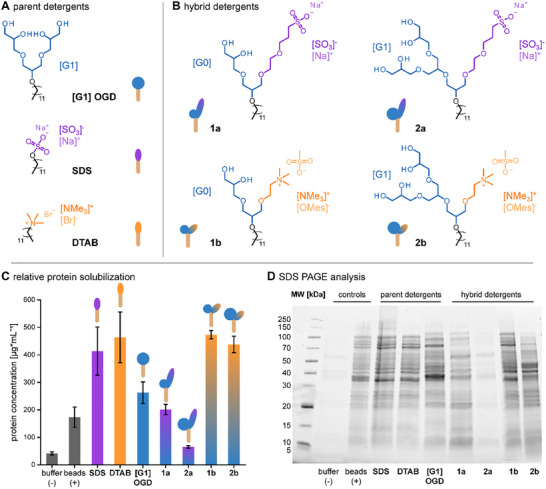 Figure 1
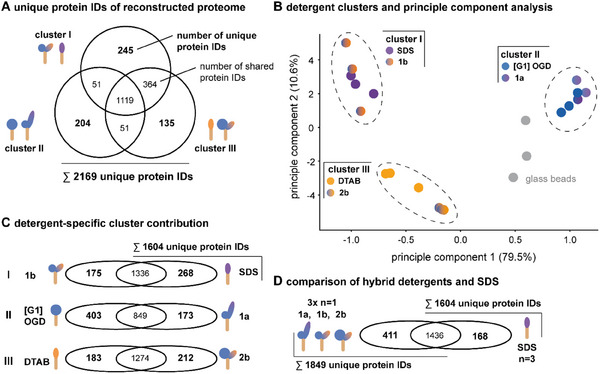 Figure 2
Peer Reviews
No public reviews on file for this paper yet. If you reviewed it on a platform where reviews are public (OpenReview, ICLR, NeurIPS, ICML), you can paste yours below so the community can read it here.
Videos
No videos yet. Explain this paper in a talk, walkthrough, or lecture? Add one.
Taxonomy
TopicsAdvanced Proteomics Techniques and Applications · Mass Spectrometry Techniques and Applications · Metabolomics and Mass Spectrometry Studies