Telecentric stereo 3D imaging with isotropic micrometer resolution bridges macro- and microscale in small Lepidopterans
Andreas Walter Stark, Adeoluwa Osadare, Matthew Guo, Gregor Joerg Gentsch, Dennis Boettger, Gunnar Brehm, Christian Franke

TL;DR
A new 3D imaging system with micrometer resolution is developed for detailed biological studies of small moths, bridging macro and micro scales.
Contribution
The novel integration of telecentric stereo vision and structured illumination into a user-friendly system for non-invasive biological imaging.
Findings
The system achieves 8.0 μm lateral and 4.46 μm axial resolution in a 11×11×6 mm measurement volume.
It enables isotropic micrometer accuracy in 3D reconstructions of scattering biological objects like small moths.
The method bridges macroscopic and microscopic resolution in biological imaging without requiring expert users.
Abstract
We present a straightforward, application-driven telecentric stereo 3D-measurement system for high-precision measurements, designed for applications ranging from industrial quality control to biological research including scanning of Lepidoptera moths. Utilizing a dual-camera setup with telecentric lenses and structured illumination, our system achieves lateral resolution of 8.0 \documentclass[12pt]{minimal} \usepackage{amsmath} \usepackage{wasysym} \usepackage{amsfonts} \usepackage{amssymb} \usepackage{amsbsy} \usepackage{mathrsfs} \usepackage{upgreek} \setlength{\oddsidemargin}{-69pt} \begin{document}\end{document}m and axial resolution of 4.46 \documentclass[12pt]{minimal} \usepackage{amsmath} \usepackage{wasysym} \usepackage{amsfonts} \usepackage{amssymb} \usepackage{amsbsy} \usepackage{mathrsfs}…
Genes, proteins, chemicals, diseases, species, mutations and cell lines named across the full text — each resolved to its canonical identifier and authoritative record.
Click any figure to enlarge with its caption.
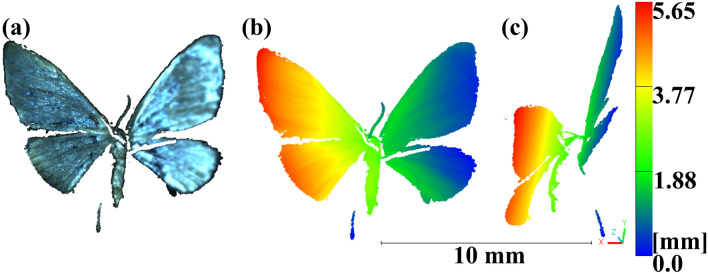 Figure 1
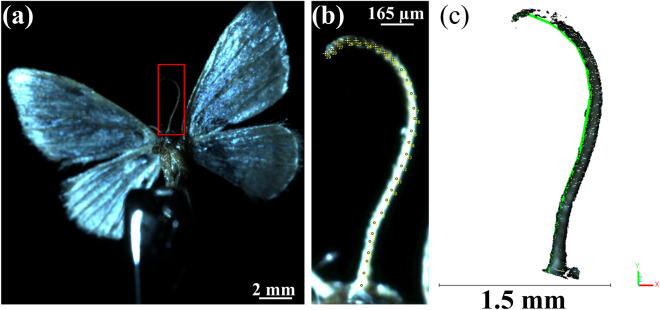 Figure 2
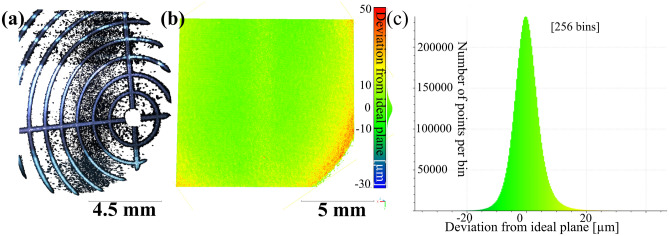 Figure 3
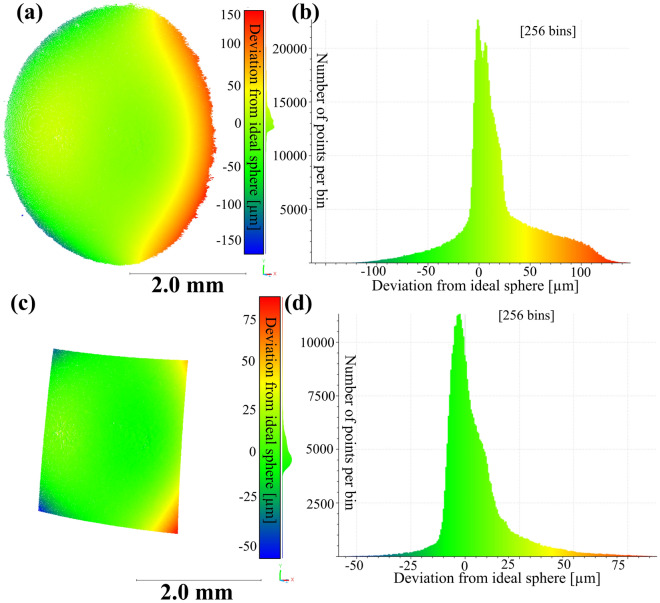 Figure 4
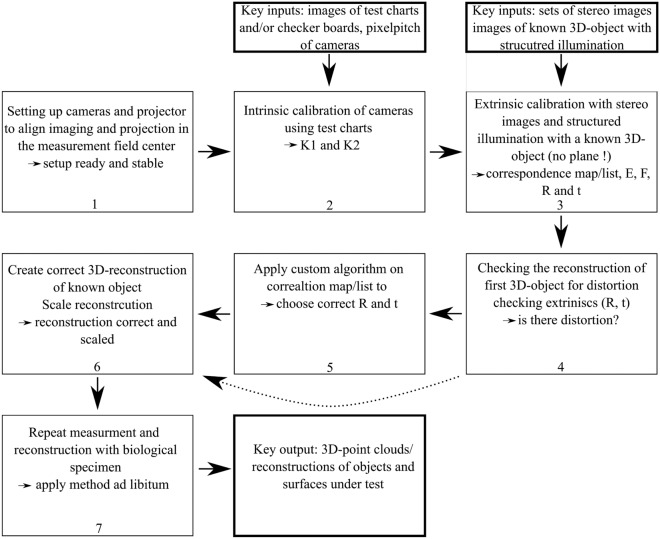 Figure 5
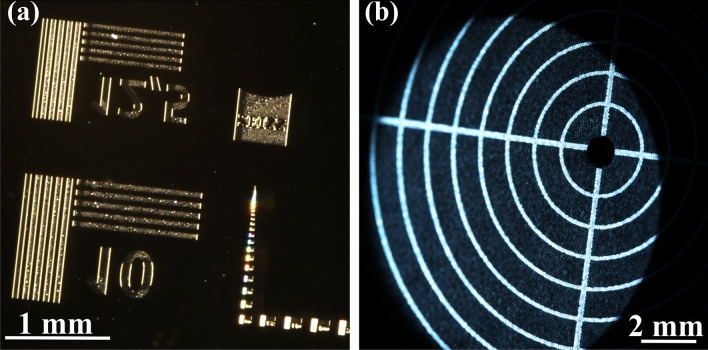 Figure 6
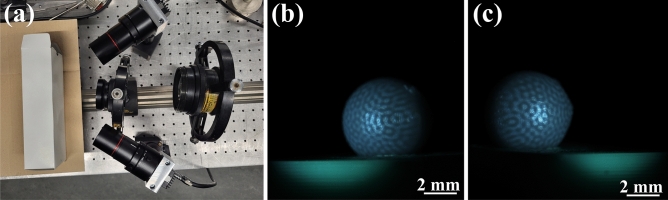 Figure 7
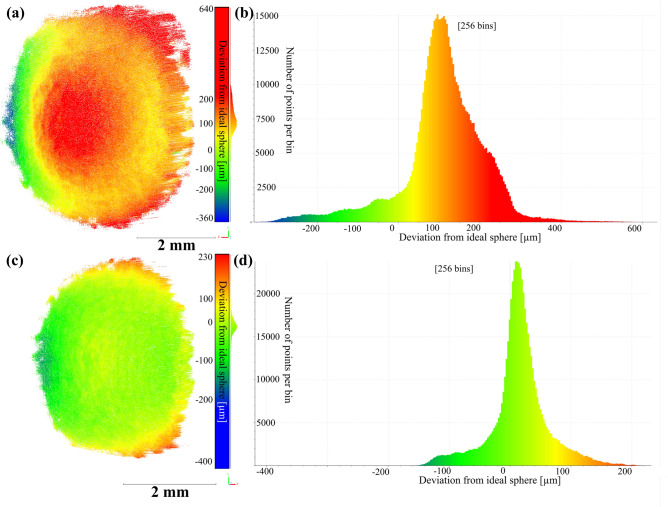 Figure 8
Peer Reviews
No public reviews on file for this paper yet. If you reviewed it on a platform where reviews are public (OpenReview, ICLR, NeurIPS, ICML), you can paste yours below so the community can read it here.
Videos
No videos yet. Explain this paper in a talk, walkthrough, or lecture? Add one.
Taxonomy
TopicsSpecies Distribution and Climate Change · Optical measurement and interference techniques · Amphibian and Reptile Biology