Real-world comparison of lymphopenia profiles in S1P receptor modulators for multiple sclerosis: a multicenter retrospective study
Giorgia Teresa Maniscalco, Maddalena Sparaco, Maria Di Gregorio, Giuseppina Cafasso, Elisabetta Signoriello, Felice Romano, Rosa Iodice, Roberta Fantozzi, Paolo Bellantonio, Aurora Zanghi, Leonardo Sinisi, Alessandro D’Ambrosio, Vincenzo Busillo, Valentina Scarano, Rocco Capuano

TL;DR
This study compares how different S1P receptor modulators used for multiple sclerosis affect lymphopenia in real-world patients.
Contribution
The first real-world, head-to-head observational study comparing lymphopenia profiles among different S1P modulators.
Findings
Ozanimod and Ponesimod showed higher lymphocyte counts than Siponimod and Fingolimod at various time points.
Severe lymphopenia was more common with Siponimod compared to Ponesimod and Ozanimod.
Grade 4 lymphopenia was observed in Ozanimod and Siponimod at three months.
Abstract
Sphingosine-1-phosphate (S1P) receptor modulators, regulating the S1P/S1PR pathway, lead to lymphocyte sequestration in lymphoid organs, which results in peripheral lymphopenia. This study evaluates the degree of lymphopenia induced by S1P modulators in people with Multiple Sclerosis (MS): Ozanimod, Siponimod, Ponesimod, and Fingolimod. We conducted a retrospective multicenter study across thirteen MS centers in Italy, including 191 MS patients (mean age 46.4 years; 61.3% women). Of these, 28.8% received Siponimod, 26.2% Ozanimod, 24.1% Fingolimod, and 20.9% Ponesimod. Lymphocyte counts were measured at baseline (T0), one month (T1), three months (T3), and six months (T6) post-treatment. Lymphopenia grades range from 0 (≥ 1.0 × 10^9 cells/L) to 4 (< 0.2 × 10^9 cells/L), according to Common Terminology Criteria for Adverse Events. At T1, Ozanimod showed a significantly higher mean…
Genes, proteins, chemicals, diseases, species, mutations and cell lines named across the full text — each resolved to its canonical identifier and authoritative record.
Click any figure to enlarge with its caption.
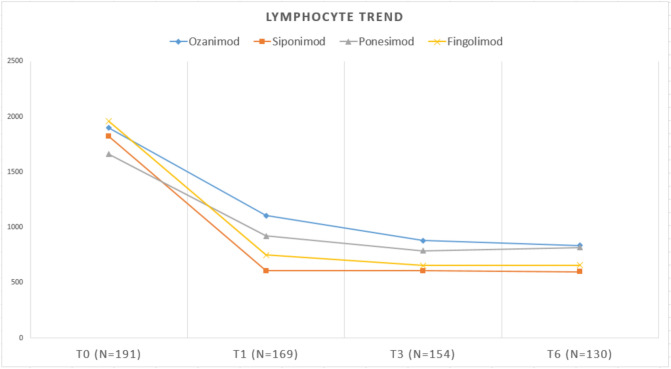 Figure 1
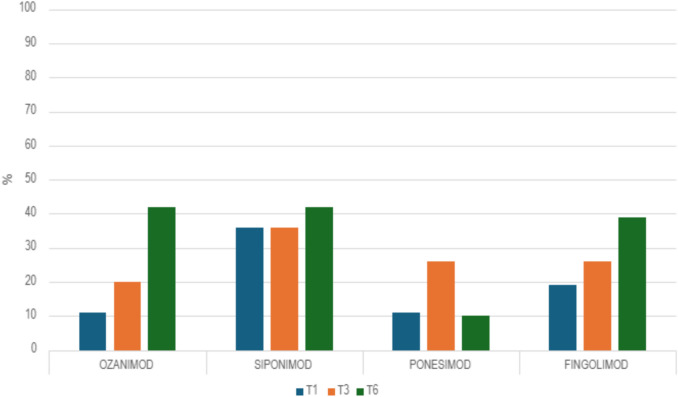 Figure 2
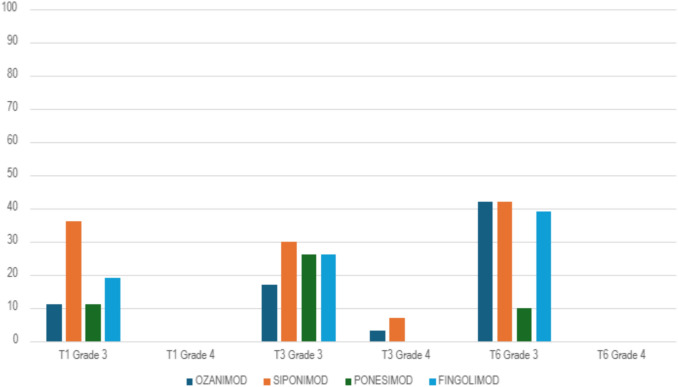 Figure 3
Peer Reviews
No public reviews on file for this paper yet. If you reviewed it on a platform where reviews are public (OpenReview, ICLR, NeurIPS, ICML), you can paste yours below so the community can read it here.
Videos
No videos yet. Explain this paper in a talk, walkthrough, or lecture? Add one.
Taxonomy
TopicsMultiple Sclerosis Research Studies · Sphingolipid Metabolism and Signaling · Systemic Lupus Erythematosus Research