Dynamic circulating tumor DNA indicates pathological benefits of additional neoadjuvant chemoimmunotherapy courses for locally advanced non-small-cell lung cancer patients
Dong Lin, Liang Wu, Pei Wang, Xiaolong Li, Xiaolan Wang, Yiran Cai, Kangli Xiong, Xi Chen, Fu Yang, Wei Huang, Xing Wang, Jiang Fan

TL;DR
This study shows that tracking circulating tumor DNA can help determine if more chemotherapy and immunotherapy cycles benefit lung cancer patients.
Contribution
The study introduces ctDNA-based MRD as a novel biomarker to guide optimal neoadjuvant chemoimmunotherapy cycles in locally advanced NSCLC.
Findings
Patients who eliminated ctDNA-MRD after two cycles had higher pCR rates with additional therapy.
ctDNA-MRD correlated strongly with radiological assessment in the four-cycle NCI group.
Subgroups with persistent ctDNA-MRD had the lowest pCR rates.
Abstract
Few studies have focused on the optimal cycles of neoadjuvant chemoimmunotherapy (NCI). This study introduced minimal residual disease (MRD) based on circulating tumor DNA (ctDNA), and investigated the association between ctDNA-MRD and NCI cycles and pathological response. This study was based on a phase III trial (NCT05157776). The patients with IIIA NSCLC without driver genes were given two cycles of NCI (initial two-cycle NCI), after which they were 1:1 randomly assigned to the two-cycle NCI groups (no additional NCI) or four-cycle NCI group (with another two cycles of NCI). This study involved 13 patients with 28 blood samples. At the start of the study, ctDNA-MRD was detected in 10 out of the 13 patients (77%). The pathologically complete response (pCR) rate was higher in the four-cycle NCI group (3/6, 50%) than in the two-cycle NCI group (1/7, 14.2%). Remarkably, the subgroup…
Genes, proteins, chemicals, diseases, species, mutations and cell lines named across the full text — each resolved to its canonical identifier and authoritative record.
Click any figure to enlarge with its caption.
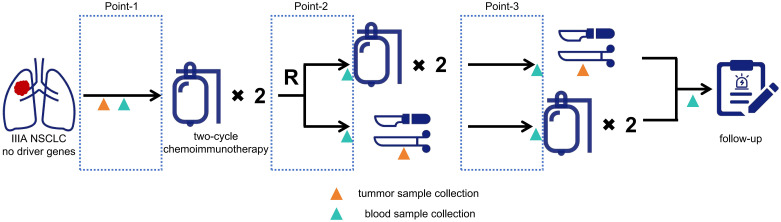 Figure 1
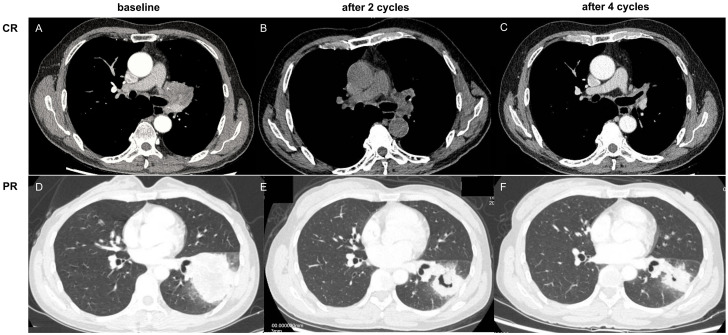 Figure 2
 Figure 3
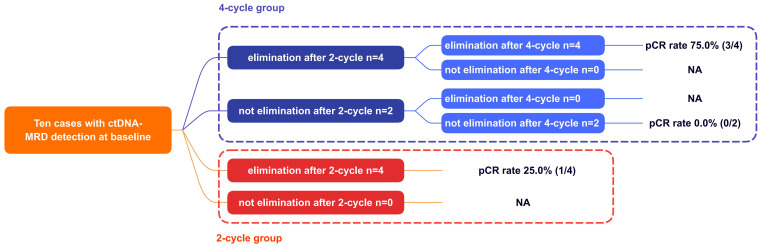 Figure 4
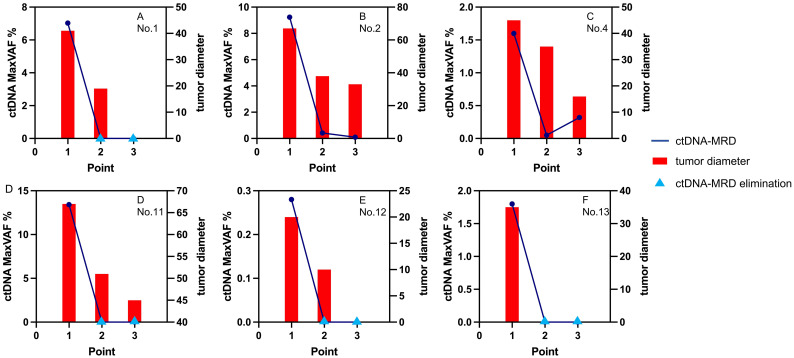 Figure 5
Peer Reviews
No public reviews on file for this paper yet. If you reviewed it on a platform where reviews are public (OpenReview, ICLR, NeurIPS, ICML), you can paste yours below so the community can read it here.
Videos
No videos yet. Explain this paper in a talk, walkthrough, or lecture? Add one.
Taxonomy
TopicsCancer Genomics and Diagnostics · Lung Cancer Treatments and Mutations · Lung Cancer Diagnosis and Treatment