Effectiveness of the sleep apnea-specific hypoxic burden and sleep breathing impairment index in assessing cognitive impairment in children with obstructive sleep apnea
Simin Zhu, Yanuo Zhou, Chendi Lu, Zitong Wang, Lina Ma, Xiaoxin Niu, Yushan Xie, Zihan Xia, Yonglong Su, Yuqi Yuan, Jiayi Yang, Rui Lu, Xinru Lv, Wei Hou, Yani Feng, Xiaoyong Ren, Yewen Shi

TL;DR
This study shows that specific sleep apnea metrics better predict cognitive issues in children with obstructive sleep apnea compared to traditional measures.
Contribution
The study introduces SASHB and SBII as more effective metrics than OAHI for assessing cognitive impairment in children with OSA.
Findings
OSA children showed cognitive decline and ERP abnormalities compared to non-OSA children.
SASHB and SBII correlated more strongly with cognitive impairment than OAHI, especially in younger children.
Cognitive scores like FIQ, VIQ, and PIQ were inversely related to SASHB and SBII after adjusting for age, sex, and BMI.
Abstract
This study investigated cognitive impairment in children with obstructive sleep apnea (OSA) by evaluating the utility of sleep apnea-specific hypoxic burden (SASHB) and sleep breathing impairment index (SBII) compared to the obstructive apnea-hypopnea index (OAHI). A retrospective analysis included 141 children with suspected OSA from Xi'an Jiaotong University Second Affiliated Hospital (October 2021–October 2024), categorized into OSA (n = 104) and non-OSA (n = 37) groups based on OAHI. Demographic, polysomnography (PSG), and event-related potential (ERP) data were collected. Cognitive function (full, verbal, and performance IQ: FIQ, VIQ, PIQ) was assessed using the China-Wechsler Intelligence Scale (C-WISC). Correlations between cognitive scores, ERP parameters, OAHI, SASHB, and SBII were analyzed. OSA children exhibited higher rates of snoring/sleep suffocation, prolonged…
Genes, proteins, chemicals, diseases, species, mutations and cell lines named across the full text — each resolved to its canonical identifier and authoritative record.
Click any figure to enlarge with its caption.
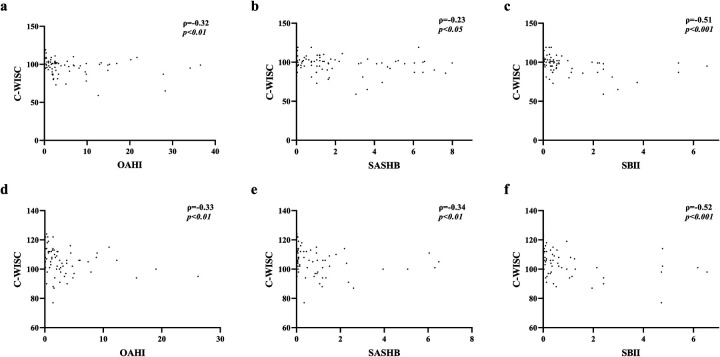 Figure 1
Peer Reviews
No public reviews on file for this paper yet. If you reviewed it on a platform where reviews are public (OpenReview, ICLR, NeurIPS, ICML), you can paste yours below so the community can read it here.
Videos
No videos yet. Explain this paper in a talk, walkthrough, or lecture? Add one.
Taxonomy
TopicsObstructive Sleep Apnea Research · Neuroscience of respiration and sleep · Cardiovascular and Diving-Related Complications