Overdose-Related Trends in Online Search Behavior in Japan: Analysis Using Infodemiological Methods
Miyu Eguchi, Soichiro Ushio, Satoru Esumi, Yukiomi Eguchi, Toshinobu Hayashi, Taisuke Kitamura, Kenichi Mishima, Takashi Egawa

Abstract
Genes, proteins, chemicals, diseases, species, mutations and cell lines named across the full text — each resolved to its canonical identifier and authoritative record.
Click any figure to enlarge with its caption.
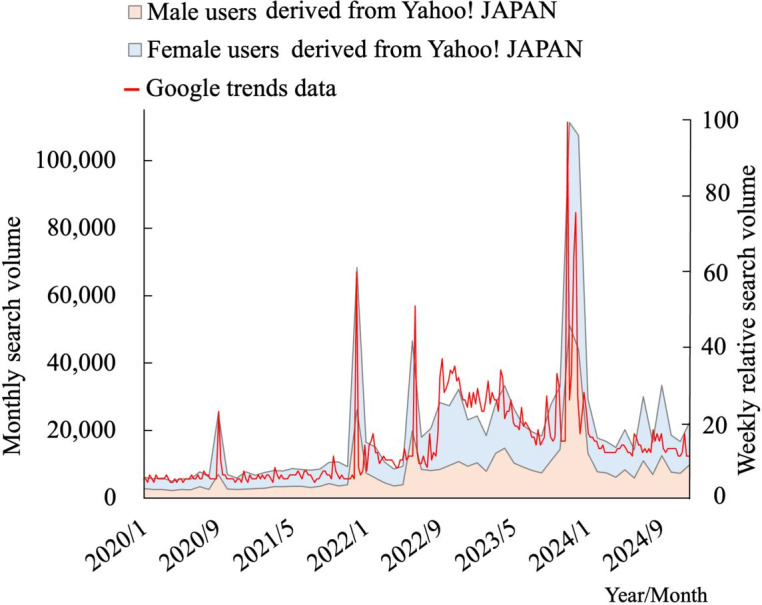 Figure 1
| Drug class | Duplicate search volume (N=25,490), n (%) |
|---|---|
| Benzodiazepines and non-benzodiazepines | 9320 (36.6) |
| Antipsychotics | 9010 (35.3) |
| Antidepressants | 2800 (11.0) |
| Respiratory drugs | 2220 (8.7) |
| Mood stabilizers (eg, lithium and valproic acid) | 1000 (3.9) |
| Other sedative-hypnotics (eg, bromvalerylurea and allylisopropylacetylurea) | 580 (2.3) |
| Illegal drugs | 560 (2.2) |
| Others (eg, potassium cyanide and herbal medicines) | 810 (3.2) |
Peer Reviews
No public reviews on file for this paper yet. If you reviewed it on a platform where reviews are public (OpenReview, ICLR, NeurIPS, ICML), you can paste yours below so the community can read it here.
Videos
No videos yet. Explain this paper in a talk, walkthrough, or lecture? Add one.
Taxonomy
TopicsMisinformation and Its Impacts · Mental Health via Writing · Spam and Phishing Detection
Introduction
Overdose incidents involving over-the-counter (OTC) and prescription drugs have increased worldwide with the COVID-19 pandemic [1]. In Japan, overmedication of OTC drugs has become a major issue. With digital platforms' essential role in health information access, increase in drug overdose information has raised concerns [23]. Although infodemiological research has examined drug-related search behaviors [3], it does not capture the postpandemic increase in overdoses. This study aimed to investigate overdose-related online search trends in Japan using infodemiological methods.
Methods
Data Sources
Online search data on Yahoo! JAPAN, one of the most frequently used search engines in Japan [4], were obtained from DS.INSIGHT (last accessed: January 6, 2025). This platform provides data on search behaviors over time among different demographic groups, including search volume by sex. The search volume obtained from DS.INSIGHT is based on the number of users searching Yahoo! JAPAN and is extrapolated using the Ministry of Internal Affairs and Communications’ Telecommunications Usage Trends Survey. Online search data for “O-ba-do-zu” (overdose) from 2020 to 2024 were extracted. To identify drugs of interest, related queries were extracted; only terms with volumes exceeding 100 were included. Searches within one week before and after the overdose-related queries were analyzed. The identified drugs were categorized accordingly. Additionally, Japan’s weekly search data for the same timeframe were extracted using Python (version 3.11.3) with the Google Trends (GT) application programming interface (last accessed: May 30, 2025). “O-ba-do-zu” was queried as a search term, not a topic; the category was set to “all categories.” GT provides the relative search volume (RSV) on a 0‐100 scale, reflecting public interest in specific terms.
Results
The monthly search volume for “O-ba-do-zu” from DS.INSIGHT and weekly RSV for “O-ba-do-zu” from GT for 2020‐2024 are shown in Figure 1. DS.INSIGHT data showed that “O-ba-do-zu” queries in 2024 (240,000) were approximately five times greater than in 2020 (89,800). GT data showed that RSV for “O-ba-do-zu” increased during 2020‐2024. Searches by female users accounted for 52.67% (14,800/28,200)‐72.11% (18,100/25,000) of the search volume. Notable peaks in search frequency occurred in September 2020, December 2021, June 2022, and November-December 2023. Table 1 shows the frequency of drugs searched together with “O-ba-do-zu” in 2024, according to Yahoo! JAPAN. Among duplicate overdose-related searches, 11.8% (3100/26,300) were for OTC drug compounds, which included components of respiratory medications, sedative-hypnotics, and other categories.
Search trends for “O-ba-do-zu (overdose)” in Japan, 2020‐2024.
Discussion
In this study, we investigated overdose–related online search trends in Japan by using data from two search engines using infodemiological methods, and found increased online interest in drug overdoses in Japan over the past 5 years. We also elucidated the patterns of overdose–related search behavior and the specific interests of individuals conducting such searches. Our findings, including the higher proportion of female searchers [56] and ranking of searched drugs [7], are consistent with previous ones.
Seasonality in intentional drug overdose has been reported [8]. However, differing seasonal patterns were reported in another study [9], and a consensus remains to be established. Although we observed two sharp peaks in December over the 5-year period, no consistent periodic pattern was identified. In Japan, search spikes often coincided with socially and culturally impactful events, such as the release of a song titled “Overdose” in September 2022 and reports of overdose cases involving elementary school students.
In drug intoxication cases, multiple drugs are often consumed. While our results were consistent with previous ones, comparison of actual usage rates by using search volume data is difficult. Some compounds are used in both OTC and prescription drugs. Nevertheless, distinguishing OTC drugs from prescription ones by using search terms was difficult; therefore, we analyzed the retrieved compounds as OTC drugs. We found that OTC drug–associated compounds accounted for 11.8% of all retrieved drug-related searches, a proportion lower than 22.5% of OTC drug use, reported among transported patients. OTC drug overdoses are more common in younger individuals. As younger individuals tend to gather information from social media rather than Internet searches, these results may reflect a demographic bias toward older age groups [10]. This study analyzed search behavior, not actual overdose cases. Thus, the findings reflect public interest, rather than incident frequency. The main limitation of this study is the inability to demonstrate a direct link between search volume and real-world overdose events. Therefore, our findings should be interpreted cautiously.
In conclusion, rising interest in overdosing in Japan reflects growing public concerns. Monitoring trends and offering timely information may support early public health interventions and overdose prevention.
The reference list from the paper itself. Each links out to its DOI / PubMed record.
- 1Cartus AR Li Y Macmadu A et al Forecasted and observed drug overdose deaths in the US during the COVID-19 pandemic in 2020 JAMA Netw Open Mar 1202253 e 223418 doi 10.1001/jamanetworkopen.2022.3418 Medline 35311967 PMC 8938716 · doi ↗ · pubmed ↗
- 2Alasmari A Zhou L Share to seek: the effects of disease complexity on health information-seeking behavior J Med Internet Res Mar 242021233 e 21642 doi 10.2196/21642 Medline 33759803 PMC 8074994 · doi ↗ · pubmed ↗
- 3Martínez-Aguilar L Sanz-Lorente M Martínez-Martínez F Faus MJ Sanz-Valero J Public interest in drug-related problems reflected in information search trends: an infodemiological study Daru Dec 2024322537547 doi 10.1007/s 40199-024-00519-w Medline 38888730 PMC 11555055 · doi ↗ · pubmed ↗
- 4Hakariya H Yokoyama N Lee J Hakariya A Ikejiri T Illicit trade of prescription medications through X (formerly Twitter) in Japan: cross-sectional study JMIR Form Res 052820248 e 54023 doi 10.2196/54023 Medline 38805262 PMC 11167319 · doi ↗ · pubmed ↗
- 5Speed KA Mc Neil R Hayashi K Maher L Boyd J “It just doesn’t stop”: Perspectives of women who use drugs on increased overdoses during the COVID-19 pandemic Drug Alcohol Rev Feb 2025442602612 doi 10.1111/dar.13996 Medline 39703005 PMC 11813672 · doi ↗ · pubmed ↗
- 6Tanibuchi Y Omiya S Usami T Matsumoto T Clinical characteristics of over-the-counter (OTC) drug abusers in psychiatric practice in Japan: comparison of single and multiple OTC product abusers Neuropsychopharmacol Rep Mar 2024441176186 doi 10.1002/npr 2.12415 Medline 38299253 PMC 10932778 · doi ↗ · pubmed ↗
- 7Tanaka C Tagami T Nagano M Nakayama F Kaneko J Kuno M Risk factors for the need for advanced care among prescription and over-the-counter drug overdose patients Acute Med Surg 2024111 e 942doi 10.1002/ams 2.942Medline 38500638 PMC 10946162 · doi ↗ · pubmed ↗
- 8Lo CH Liao CH Tan ST Su YJ Differences of chronological seasonality in drug overdose J Int Med Res Aug 20235183000605231192779 doi 10.1177/03000605231192779 Medline 37632450 PMC 10926412 · doi ↗ · pubmed ↗