Correction: Arylazobenzimidazoles: versatile visible-light photoswitches with tuneable Z-isomer stability
Sophie A. M. Steinmüller, Magdalena Odaybat, Giulia Galli, Davia Prischich, Matthew J. Fuchter, Michael Decker

TL;DR
This paper corrects a previously published study on arylazobenzimidazoles as photoswitches with adjustable stability.
Contribution
The correction addresses errors or updates in the original publication on photoswitch properties.
Findings
The correction clarifies details about the photoswitches' Z-isomer stability.
It ensures the accuracy of the reported data and conclusions.
Abstract
Correction for ‘Arylazobenzimidazoles: versatile visible-light photoswitches with tuneable Z-isomer stability’ by Sophie A. M. Steinmüller et al., Chem. Sci., 2024, 15, 5360–5367, https://doi.org/10.1039/D3SC05246J.
Genes, proteins, chemicals, diseases, species, mutations and cell lines named across the full text — each resolved to its canonical identifier and authoritative record.
Click any figure to enlarge with its caption.
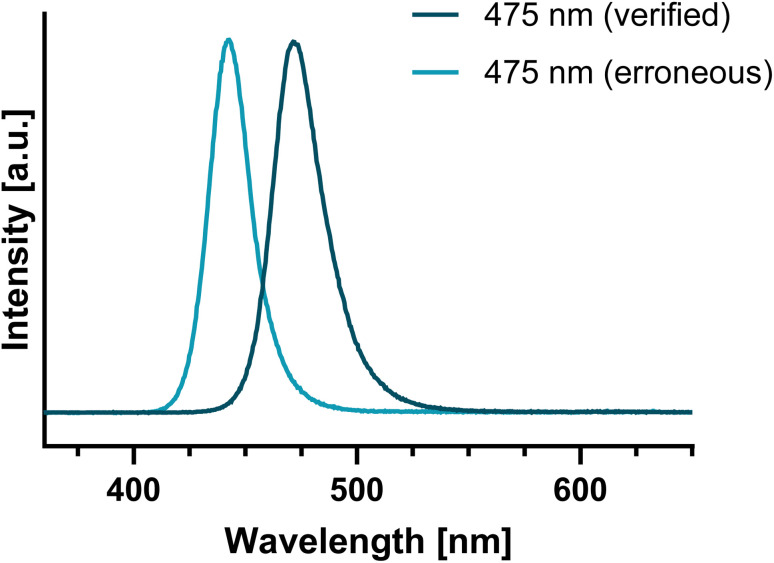 Figure 1
- —Deutsche Forschungsgemeinschaft10.13039/501100001659
- —Elitenetzwerk Bayern10.13039/501100008848
- —Engineering and Physical Sciences Research Council10.13039/501100000266
Peer Reviews
No public reviews on file for this paper yet. If you reviewed it on a platform where reviews are public (OpenReview, ICLR, NeurIPS, ICML), you can paste yours below so the community can read it here.
Videos
No videos yet. Explain this paper in a talk, walkthrough, or lecture? Add one.
Taxonomy
TopicsPhotochromic and Fluorescence Chemistry · Advanced biosensing and bioanalysis techniques · Luminescence and Fluorescent Materials
We recently became aware of inconsistent results obtained with two 475 nm lamps, that were used for excitation of the synthesized photoswitches in this study. This led us to directly measure the emission spectra of the lamps for validation. The measurements revealed that one of the lamps, although supplied to give maximal emission at 475 nm, in fact emitted at 440 nm due to incorrect supplier information (Fig. 1).
Following this, we recorded emission spectra of all other lamps employed within this publication and verified that no other wavelengths were affected. After reviewing all our experimental data, we repeated the measurements of the directly affected arylazobenzimidazoles, i.e., those previously addressed using the ‘475 nm’ LED to achieve Z-isomer photoswitching (compounds 13d,e,f and 18a,b,d). For compounds where 475 nm light (using a verified lamp) still produced the highest Z-isomer conversion, we retained the original values and figures. For those that had shown highest conversion using the erroneous 475 nm LED, we have retained the reported Z/E ratio listed in Table 2 of the original publication (as it remains the best performance observed) but corrected the corresponding wavelength to 440 nm (according to the verified LED used) in the tables and figures, including those in the ESI. For the affected compounds (13d and 18a,b,d), the emission of the 440 nm LED overlaps more effectively with the respective E-isomer's absorption band, leading to greater excitation and isomerization efficiency. Additionally, for these compounds, irradiation with 440 nm light minimizes excitation of the respective Z-isomer, thereby favouring a higher Z-population at the photostationary state. The overall findings and conclusions of our paper are not affected. To ensure all information provided in this publication is correct, we revise it as follows:
“For most compounds, violet light (λ = 400 nm) was used to obtain the largest Z-isomer PSD, while the highest Z-conversion for compounds 13d, 18a, 18b and 18d was achieved with blue light (λ = 440 nm). For compounds 13e and 13f the highest Z-conversion was achieved with cyan light (λ = 475 nm).”
Conclusion
The adapted conclusion therefore reads: “Through introduction of 5- and 6-methoxy-substituents at the benzimidazole-core, reversible photoswitching with blue or cyan and red-light was enabled for compounds 13d–f, 18a,b and 18d.”
This erratum also provides an updated ESI for the original paper, where the wavelengths in the spectra have been corrected according to the actual lamp used. Generally, the reported changes further refine the tuneability of the class of arylazobenzimidazole photoswitches in this work, which does by no means change the overall conclusions.
The Royal Society of Chemistry apologises for these errors and any consequent inconvenience to authors and readers.