Author Correction: Bmi-1 promotes the proliferation, migration and invasion, and inhibits cell apoptosis of human retinoblastoma cells via RKIP
Qian Li, Te Fu, Ning Wei, Qiaoling Wang, Xin Zhang

Abstract
Genes, proteins, chemicals, diseases, species, mutations and cell lines named across the full text — each resolved to its canonical identifier and authoritative record.
Click any figure to enlarge with its caption.
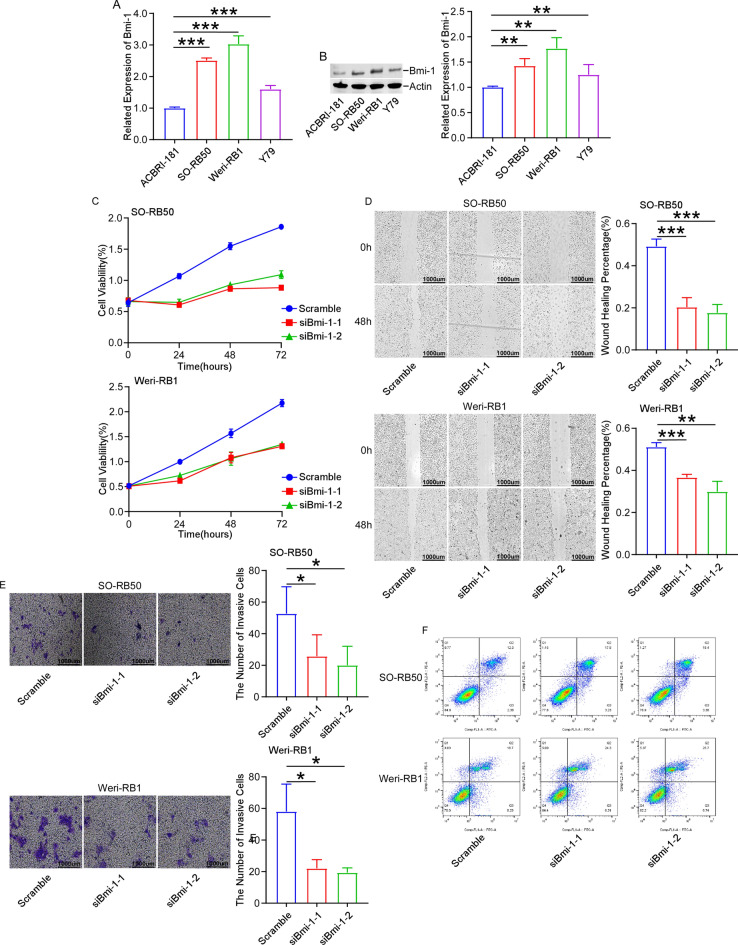 Figure 1
Peer Reviews
No public reviews on file for this paper yet. If you reviewed it on a platform where reviews are public (OpenReview, ICLR, NeurIPS, ICML), you can paste yours below so the community can read it here.
Videos
No videos yet. Explain this paper in a talk, walkthrough, or lecture? Add one.
Taxonomy
TopicsCancer Mechanisms and Therapy · Melanoma and MAPK Pathways · Signaling Pathways in Disease
Correction to: Scientific Reports 10.1038/s41598-024-65011-6, published online 24 June 2024
The original version of the Article contained an error in Figure 1. As a result of an error during figure assembly, the image for the Scramble condition for SO-RB50 in Figure 1E was mistakenly a duplication of the image for the siBmi-1 + siRKIP for SO-RB50 in Figure 4C.
The original Figure 1 and accompanying legend appear below.
Fig. 1. Knockdown of Bmi-1 inhibits cell proliferation, migration and invasion, and increases cell apoptosis. RT-qPCR (A) and Western blot (B) showed that the expression of Bmi-1 was higher in Y79, SO-RB50 and Weri-RB1 cells than that of normal retinal vascular endothelial cell line ACBRI-181. (C) MTT assay revealed that knockdown of Bmi-1 suppressed cell proliferation compared with control group at 24 h, 48 h and 72 h. (D) Wound healing displayed that Bmi-1 silencing reduced the migration of SO-RB50 cells (Scale bar: 500 μm) and Weri-RB1 cells (Scale bar: 500 μm). (E) Transwell assay displayed that Bmi-1 silencing reduced the invasion of SO-RB50 cells and Weri-RB1 cells (Scale bar: 200 μm). (F) FCM demonstrated that knockdown of Bmi-1 increased cell apoptosis. *P < 0.05, **P < 0.01, ***P < 0.001, compared to the ACBRI-181 cells or the Scramble group.
The original Article has been corrected.