Taking time: Auditory statistical learning benefits from distributed exposure
Jasper de Waard, Jan Theeuwes, Louisa Bogaerts

TL;DR
This study shows that spreading out exposure to speech patterns over several days improves long-term learning compared to cramming it all in one day.
Contribution
The study demonstrates that spaced exposure enhances long-term auditory statistical learning compared to massed exposure.
Findings
Spaced and massed exposure groups showed equal learning during exposure.
After a 2-week delay, the spaced group had higher accuracy in a forced-choice test.
Spaced exposure improves long-term retention of statistical patterns in speech.
Abstract
In an auditory statistical learning paradigm, listeners learn to partition a continuous stream of syllables by discovering the repeating syllable patterns that constitute the speech stream. Here, we ask whether auditory statistical learning benefits from spaced exposure compared with massed exposure. In a longitudinal online study on Prolific, we exposed 100 participants to the regularities in a spaced way (i.e., with exposure blocks spread out over 3 days) and another 100 in a massed way (i.e., with all exposure blocks lumped together on a single day). In the exposure phase, participants listened to streams composed of pairs while responding to a target syllable. The spaced and massed groups exhibited equal learning during exposure, as indicated by a comparable response-time advantage for predictable target syllables. However, in terms of resulting long-term knowledge, we observed a…
Genes, proteins, chemicals, diseases, species, mutations and cell lines named across the full text — each resolved to its canonical identifier and authoritative record.
Click any figure to enlarge with its caption.
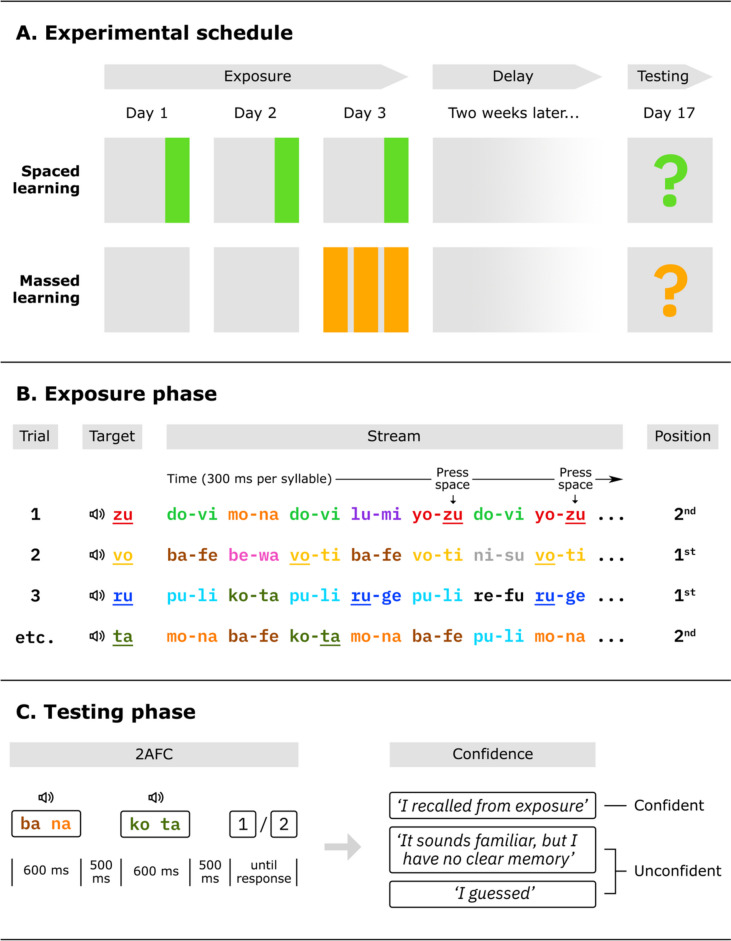 Figure 1
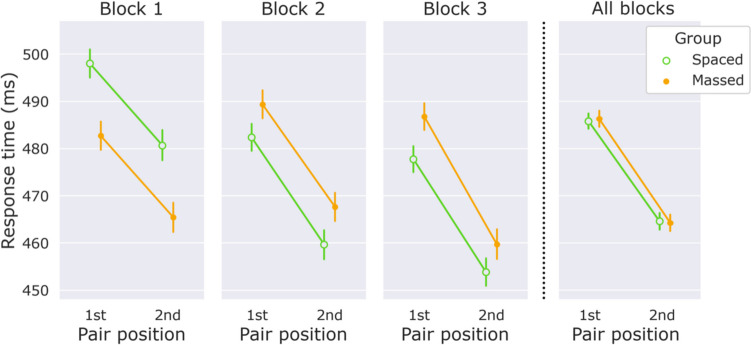 Figure 2
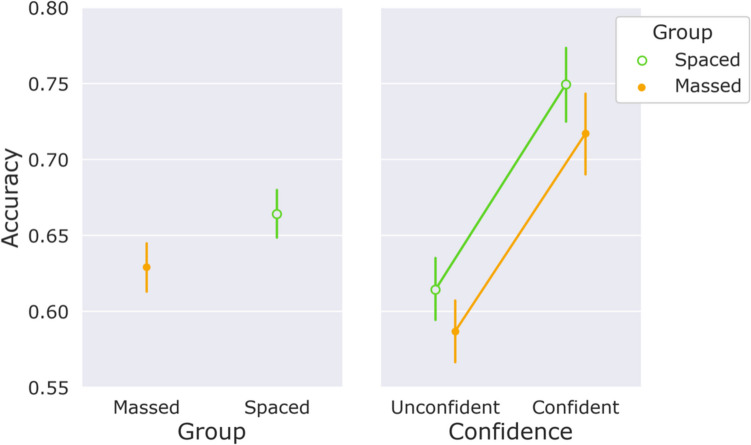 Figure 3
Peer Reviews
No public reviews on file for this paper yet. If you reviewed it on a platform where reviews are public (OpenReview, ICLR, NeurIPS, ICML), you can paste yours below so the community can read it here.
Videos
No videos yet. Explain this paper in a talk, walkthrough, or lecture? Add one.
Taxonomy
TopicsNeuroscience and Music Perception · Hearing Loss and Rehabilitation · Speech and Audio Processing
Introduction
Since the seminal work by Ebbinghaus (1885), on human learning and forgetting, evidence for superior learning outcomes achieved through several spaced practice sessions compared with intensive massed learning has continued to grow (review: Gerbier & Toppino, 2015). Conventionally, the spacing effect is studied using learning paradigms in which participants study materials such as word lists (e.g., Melton, 1967), texts (e.g., Rawson & Kintsch, 2005), or faces (e.g.,Russo et al., 1998) and are tested on these materials after a delay period (Wiseheart et al., 2019). The testing phase assesses the ability to recall or recognize items that were learned either in one massed session or across several spaced sessions that total the same length. However, learning in daily life often takes place incidentally, especially concerning the extraction of statistical regularities (e.g., Aslin, 2017; Saffran et al., 1996). For this so-called statistical learning, where learners extract stimuli from a continuous input stream rather than being presented with clearly separated individual stimuli, the spacing effect could also exert its influence.
Statistical learning is the ability to extract statistical patterns from the environment and use them to segment sensory input, ultimately allowing the anticipation of upcoming events (Theeuwes et al., 2022). A seminal study by Saffran et al. (1996) exposed 8-month-old infants to a continuous stream of spoken syllables. They demonstrated that infants could learn the underlying structure of the speech stream from passive listening, and could use this information to parse the stream into its constituents (syllables consistently occurring together making up novel words). Since then, research in statistical learning has expanded to include learning in adults (Saffran et al., 1997), primates (Conway & Christiansen, 2001; Hauser et al., 2001), and rats (Toro & Trobalón, 2005), as well as over different auditory and visual input materials (Frost et al., 2019). Statistical learning paradigms range from passive perception to active engagement (Arciuli & Simpson, 2012; Batterink 2017), with the latter usually involving some kind of cover task, such as detecting a direct repetition of a stimulus (e.g., Arciuli & Simpson, 2012; Emberson et al., 2011; Turk-Browne et al., 2005). The current consensus is that statistical learning does not require conscious effort and that learning can occur without awareness (Frost et al., 2019), although the absence of awareness is often hard to establish (Vadillo et al., 2016, 2020) and the role of attention remains a contended issue (Batterink & Paller, 2019; Duncan & Theeuwes, 2020; Toro et al., 2005; Turk-Browne et al., 2005). However, evidence suggests that the explicitness of the task and awareness of the participants have little consequences for the eventual learning (Batterink et al., 2015; Gao & Theeuwes, 2022; see also Ordin & Polyanskaya, 2021).
Considering the domain of language, statistical learning plays a key role in the rapid language acquisition of infants and children (e.g., Abreu et al., 2023; Erickson & Thiessen, 2015; Romberg & Saffran, 2010), and individuals’ statistical ability is predictive of individual differences in oral language and literacy skills (Ren et al., 2023; Siegelman et al., 2017). The spacing effect has been observed in many language-learning experiments (Bahrick et al., 1993; Bird, 2011; Rogers 2015, 2017), yet results have been equivocal. For example, Pagán and Nation (2019) did not find a spacing effect for adults learning new words from sentence context, and a recent study demonstrated improved recognition of written word forms but comparable recall after spaced learning (Wegener et al., 2022). Considering the importance of statistical learning for language acquisition, it is remarkable that it has never been studied in relation to statistical learning. Indeed, nearly all studies within the field of statistical learning have employed a single-session exposure phase, and most work tested immediate recognition of the embedded patterns (Frost et al., 2019). Yet recent findings suggest that even single-session exposure leads to stable memory representations of the learned patterns, at least up to 1 week later (Arciuli & Simpson, 2012). This raises the question of the optimal exposure regimen for this incidental and more automatic type of learning. Specifically, we asked whether auditory statistical learning would benefit from a spaced exposure phase.
Predictions
Based on theoretical views stressing the competition between different memory systems, such as the complementary learning systems theory (McClelland et al., 1995) and the proposal of competing declarative and procedural learning systems (Foerde et al., 2006), one might predict that statistical learning performance does not necessarily mimic the advantage of distributed learning found for intentional learning tasks. While episodic memory encodes individual events, statistical learning relies on the recurring relations between events to extract regularities, which has led to the idea of a neurocognitive trade-off between episodic memory and statistical learning (Schapiro et al., 2017; Sherman & Turk-Browne, 2020; Sherman et al. 2022). Similarly, recent findings suggest that cognitive depletion may improve the capacity for statistical learning (Smalle et al., 2022) and language learning (Smalle et al., 2021), allowing it to occur uninhibited by higher cognitive mechanisms. This suggests that explicit learning strategies and statistical learning may rely on competing neural mechanisms. The absence of a spacing benefit for auditory statistical learning would thus speak to the dissociation between statistical learning and more conventional learning paradigms.
Other authors, however, have argued that statistical learning is not as unique as it purports to be, and relies on the same neural mechanisms that govern any memory process (Perruchet & Vinter, 1998; Thiessen, 2017). Furthermore, the spacing effect could reflect a fundamental characteristic of human memory independent of the specific type of learning. Indeed, suggestive of the generality of the spacing effect is that it has been observed in infants (Cornell, 1980) and first-graders (Toppino & DiGeorge, 1984). Using conditioning and habituation paradigms, distributed learning has also been found to benefit even organisms with minimal cognitive abilities, such as fruit flies (Tully et al., 1994), sea slugs (Carew et al., 1972), and bees (Deisig et al., 2007). Given the widespread advantages of spaced learning, we preregistered the prediction that auditory statistical learning in adults would likewise benefit from a spaced exposure phase.
Current study
We used a longitudinal design with two groups (Fig. 1A). The spaced group was exposed to the auditory regularities in three single block sessions spread out over 3 consecutive days, while in the massed group all exposure occurred in a single session of three blocks on the third day. In the exposure phase (Fig. 1B), participants listened to rapid streams of syllables while responding as quickly as possible to a target syllable that was defined at the start of each stream. Streams were made up of syllable pairs that remained fixed throughout the entire experiment. Once learned, the first syllable of a pair can serve as a cue for the second syllable (e.g., Batterink, 2017), such that we expected faster response times (RTs) when the target syllable was second compared with first in the pair. The inclusion of the target-detection task required participants to actively listen, but since none of the instructions or feedback referred to the regularities in the streams, the learning can still be considered incidental. Since the spacing effect is most pronounced after a delay period (Cepeda et al., 2008), we incorporated a 2-week delay after the exposure phase. In the subsequent testing phase (Fig. 1C), participants performed a two-alternative forced-choice (2AFC) test, in which pairs from the exposure stream were pitted against foils, and they were required to indicate the more familiar pair followed by a confidence rating. We expected above-chance performance for confident as well as unconfident responses, with elevated performance in the spaced group. The study was preregistered online (https://aspredicted.org/e4mm3.pdf).Fig. 1. Overview of the experimental design (we recommend viewing in color). A. The spaced group’s exposure phase was spread out over 3 days, while the massed group’s took place in 1 day. After a 2-week delay, both groups performed the testing phase. B. In the exposure phase, participants responded (timed) to a prespecified target (e.g., “zu”) in a rapid auditory stream of syllables. The stream was composed of fixed syllable pairs (e.g., “yo zu”) that remained constant throughout the experiment. C. In the testing phase, participants chose one of two auditory pairs (one from the learning phase, one a newly created “foil”) as most familiar, and subsequently indicated their confidence for their choice. (Color figure online)
Methods
Participants
In the absence of a reliable effect size from previous literature, we followed Brysbaert (2019), who suggests d = 0.4 as the smallest theoretically meaningful effect size in psychological research. To achieve d = 0.4 with β = 0.80, we used a sample size of 200 for a between-groups comparison. We ran two iterations of the study to replace participants who dropped out, after which each group contained 99 participants. All participants took part in the study through Prolific (Palan & Schitter, 2018) and were between 18 and 40 years old (spaced group mean age = 31.1 years, massed group mean age = 31.5 years). They reported living in the UK or Ireland, and having at minimum an undergraduate degree. Participation took approximately 35 min, earning £5.25 plus a £2 bonus after completion of all sessions. The experiment was approved by the Ethical Committee of the Faculty of Behavioral and Movement Sciences of the Vrije Universiteit Amsterdam. All participants gave informed consent and all methods were performed in accordance with the Declaration of Helsinki.
Experimental design
The experiment was created in OpenSesame (Mathôt et al., 2012) using OSweb 1.4.11, and run using JATOS 3.7.4 (Lange et al., 2015). We used the 24 male-voice auditory syllable stimuli from Batterink (2017). Each syllable had a duration of 300 ms. Audio was played at a comfortable volume determined by the participant at the start of each session. The display background was grey (RGB: 128/128/128).
Depending on their (randomly determined) group assignment, of which participants were not informed, they were asked to return to the experiment on Prolific at set dates, following the schedule in Fig. 1A. The exposure phase consisted of three blocks of 24 trials, and the testing phase was a single block of 36 trials. To investigate a possible link between statistical learning and cognitive depletion, participants indicated their wakefulness on a Likert scale (1–5) at the beginning and end of every block. For each participant, the 24 syllables were randomly arranged into 12 syllable pairs, which remained constant throughout the experiment.
In the exposure phase (Fig. 1B), every trial started with a target syllable, which could be repeated by pressing the “a” key. The stream started after a 500-ms delay once the participant pressed the “s” key. Each syllable had a duration of 300 ms with 0 ms between syllables, and each stream contained the target four times. Audio from an example trial is available online (https://osf.io/5smzf/). Participants were instructed to press the space bar as soon as they heard the target. A response was considered correct if it fell within a 100–1,200-ms time window after target onset (see the Supplementary Materialsfor a wider time window comparison). Feedback was provided after every stream, indicating the number of correct responses (out of four) and average RT. If a participant responded incorrectly more than twice during a stream (indicating that they could be blindly pressing the space bar), a warning message was shown.
Each stream contained four unique syllable pairs, repeated four times for a total of 32 syllables. The pairs were shuffled pseudorandomly so that (i) a pair is never directly repeated (AA), (ii) the same combination of pairs is never directly repeated (ABAB), and (iii) the target is not in the first or last pair of the stream. Within a block of 24 streams, each syllable served as the target once, and each set of four consecutive streams contained two targets that were first within their pair (e.g., ko ta), and two targets that were second within their pair (e.g., ko ta). Furthermore, each set of three consecutive streams contained all 24 syllables. These constraints were implemented to ensure gradual learning of all pairs, and to minimize measurement error as a consequence of being early or late in a block. After the last block of the exposure phase, participants were asked two questions to assess their awareness of the regularities: (Q1) “This experiment was made up of a collection of audio streams. Did you notice anything about the streams?” and (Q2) “The order of the sounds in the streams was not random. Each stream consisted of several repeating subgroups of sounds. Please estimate: how many sounds were in a subgroup?”
For the testing phase (Figure 1C), 12 foil pairs were created by recombining the syllables from the learned pairs, respecting each syllable’s position (i.e. if a syllable had the second position within the learned pair, it would also have the second position within the foil). Each test trial pitted a learned pair and a foil against each other. Each learned pair was pitted against three different foils, making 36 trials. The trial order was pseudorandom, such that in every 12 consecutive trials, all learned pairs and all foils were used once, half of the trials started with the foil, and the syllables from the learned pair in a given trial were never also in the foil.
When a participant pressed “s” to start the trial, a 1,000-ms delay was followed by the first pair/foil (300 ms per syllable), a 500-ms delay, the second pair/foil, another 500-ms delay, and a response display. Participants indicated the most familiar pair by pressing 1 or 2. After a response was provided, participants rated their confidence by selecting one of three options: (i) “I recalled from exposure”; (ii) “It sounds familiar, but I have no clear memory”; or (iii) “I guessed.” In our main analyses, the first option was considered “confident,” while the latter two were grouped together as “unconfident,” following a procedure from Smalle et al. (2022).
Analyses
Only participants who completed the entire experiment were included in the analysis. Ten participants (spaced: 6, massed: 4) dropped out between the last exposure phase and the test phase. We filtered out exposure trials with less than two correct responses (spaced: 1.4%, massed: 1.7% of trials) or more than two responses (spaced: 1.7%, massed: 1.5% of trials) given at a point in the stream when no target was presented. If more than 20 trials (out of 72) were filtered out, the data of the participant was discarded entirely (three participants, all in the spaced group). Next, we removed targets that were not detected (spaced: 4.6%, massed 4.7% of targets). Lastly, we filtered out RTs that were more than 2.5 standard deviations away from the mean, separately for each participant (spaced: 3.1%, massed 3.3% of RTs). Test trials were removed when the response took longer than 5 seconds after onset of the response display (spaced: 3.7%, massed: 3.9% of trials).
Analyses of variance (ANOVAs), t tests, Pearson correlations, and Bayesian equivalents were performed using Jamovi 1.6.23 (Sahin & Aybek, 2019). Bayesian analyses were used to determine if nonsignificant results provide evidence for the null hypothesis. We report BF_01_ and BF_excl_, both expressing the strength of evidence in favor of the null hypothesis. We used the default Cauchy distribution (scale = 0.707) as the prior (Keysers et al., 2020; Morey & Rouder, 2011) for all analyses, such that the BF provides a good indication of the strength of evidence against (BF > 1) or for (BF < 1) the null hypothesis. The verbal labels used to describe the strength of the evidence are based on an established classification (Jeffreys, 1998). We used an appropriate alternative test when a violation of the assumption of normality (Mann–Whitney U) or homogeneity of variances (Welch’s) was detected. Data files and analysis scripts are available online (https://osf.io/wkj5c).
Results
Exposure phase: Preregistered analyses
Figure 2 shows RTs in the exposure phase as a function of the syllable’s position within the pair (first/second), for the spaced versus the massed groups. We performed a repeated-measures ANOVA, with RT as the dependent variable, pair position (first/second) and block (1–3) as factors, and group (spaced/massed) as a between-subjects factor. Crucially, we found a reliable main effect of pair position, F(1,196) = 174.47, p < .001, η_p_^2^ = 0.47, indicating that participants used the learned syllable pairings to anticipate second-position targets. We also observed small but reliable effects of block, F(2,392) = 9.48, p < .001, η_p_^2^ = 0.05, Block × Group, F(2,392) = 11.14, p < .001, η_p_^2^ = 0.05, and Block × Pair Position, F(2,392) = 7.25, p < .001, η_p_^2^ = 0.04. All remaining effects were nonsignificant—namely, group, F(1,196) = 0.31, p = .579, BF_excl_ = 3.12, η_p_^2^ = 0, Group × Pair Position, F(1,196) = 0.18, p = .672, BF_excl_ = 9.63, η_p_^2^ = 0.00, and Group × Pair Position × Block, F(2,392) = 0.51, p = .599, BF_excl_ = 13.35, η_p_^2^ = 0.00. The BFs for the Group × Pair Position and Group × Pair Position × Block interactions can be taken as strong evidence that the spaced and massed groups showed equal RT benefits on the second pair position. Block-by-block comparisons between the groups (reported in the Supplementary Materials) confirm this.Fig. 2. Response times in the exposure phase as a function of pair position (first/second) for the spaced and massed group separately. Error bars show 95% confidence intervals corrected for within-subject comparisons (Cousineau, 2005)
Planned block-by-block comparisons revealed that the benefit of the second pair position was significant in every block for the spaced group, with all p values < .001 and d values > 0.68, as well as for the massed group, with all p values < .001 and d values > 0.58. We conclude that the RT benefit of the second over the first pair position was robust and occurred already in the first block. The results regarding the effect of stream position, referring to the position of the target among the four targets per stream, are reported in the Supplementary Materials.
Exposure phase: Explorative analyses
To investigate the development of learning between blocks (irrespective of group), we performed a repeated-measures ANOVA, with the SL index as the dependent variable and block as the factor. We found a significant effect of block, F(2,197) = 7.27, p < .001, η_p_^2^ = 0.04. Post-hoc Bonferroni comparisons revealed an increase in the SL index between Blocks 1 and 3, t(197) = 3.54, p = .002, d = 0.25, but no significant difference between Blocks 1 and 2, t(197) = 2.26, p = .074, BF_01_ = 1.04, d = 0.16, or Blocks 2 and 3, t(197) = 1.66, p = .295, BF_01_ = 3.26, d = 0.12.
Testing phase: Preregistered analyses
Figure 3 shows response accuracy in the testing phase for the spaced and the massed group. In the spaced group, accuracy was above chance level (0.5), t(98) = 54.3, p < .001, d = 5.45. This held true for confident responses (34.5% of the responses), t(94) = 35.7, p < .001, d = 3.66, as well as unconfident responses (65.5% of the responses), t(97) = 44.6, p < .001, d = 4.50. In the massed group accuracy was also above chance, t(98) = 66.7, p < .001, d = 6.7, for confident responses, t(90) = 32, p < .001, d = 3.35, as well as unconfident responses, t(97) = 49.2, p < .001, d = 4.97. This indicates that participants in both groups had explicit as well as implicit knowledge. We performed a repeated-measures ANOVA, with confidence as factor and group as a between-subjects factor, resulting in a main effect of confidence, F(1,182) = 69.18, p < .001, η_p_^2^ = 0.28, and nonsignificant effects of group, F(1,182) = 2.6, p = .108, η_p_^2^ = 0.01, BF_excl_ = 2.78, and Group × Confidence, F(1,182) = 0.03, p = .859, η_p_^2^ = 0.0, BF_excl_ = 4.76. The BF for Group × Confidence can be taken as evidence that the spacing benefit was equal for confident and unconfident responses. Notably, the main effect of group in the ANOVA was nonsignificant, but we lost power due to missing values for confident (16 participants) and unconfident (two participants) accuracies. Crucially, when we compared overall testing phase accuracy, we observed significantly higher accuracy in the spaced group compared with the massed group, Welch’s t(184) = 2.19, p = .030, d = 0.31. We have replicated these results in a mixed-effects logistic regression model (reported in the supplementary materials). While not preregistered, it could be argued that such a model is better suited for this type of data (Jaeger, 2008).Fig. 3. Accuracy in the testing phase as a function of group (left panel) and as a function of confidence (right panel) separated by group. Error bars show 95% confidence intervals
Testing phase: Explorative analyses
To investigate whether participants had any awareness of the regularities, we first manually coded the answers to the open-ended Q1 (see Methods). We found that 59% (spaced: 61%, massed: 57%) of participants made mention of the word “pattern(s)” or gave a description thereof. However, when asked how many sounds were in the repeating subgroups (Q2), the median answer was 6 (SD = 4.4), and only 2.5% of participants (spaced: 0.5%, massed: 2%) gave the correct answer of 2. Some correlations regarding the self-reported wakefulness scores are reported in the Supplementary Materials.
Discussion
In an auditory statistical learning paradigm, we observed a significant benefit of spaced over massed learning of novel embedded syllable patterns after a delay period. In the testing phase (2 weeks after the last exposure delay), the spaced group showed higher accuracy in identifying the learned pairs from the foils. Participants who had been exposed to the syllable pairings across 3 days outperformed those who received all exposure at once on a single day, even though both groups had the same total time of pattern exposure and learning during exposure (as measured by the RT benefit for targets that came second within a pair) was highly comparable for the spaced and massed groups. We interpret this as evidence for a spacing effect for auditory statistical learning. This suggests that the spacing effect, which is already well-established for many other forms of learning, also applies to auditory statistical learning.
While our findings were derived from a controlled experimental design, they highlight the importance of the timing of language learning both outside and inside the laboratory. Given the key role of auditory statistical learning for speech segmentation and natural language learning (Alexander et al., 2023; Pelucchi et al., 2009), our results further strengthen the call for incorporating spaced learning practices in language learning and education more broadly (Cull, 2000). On the other hand, they also have important implications for the research efforts on statistical learning. Whereas the majority of statistical learning in everyday life likely takes place over periods that span at least multiple days (akin to the spaced group in our design), exposure in statistical learning experiments typically takes no more than a few minutes (Frost et al., 2019), in a single session on a single day (for rare exceptions of multiday training, see Alexander et al., 2023; Chetail 2017). The finding that spaced learning benefits auditory statistical learning implies that such investigations are likely to underestimate participants’ statistical learning abilities.
Multiple mechanisms have been proposed to drive the spacing benefit, and it seems likely that a combination of forces simultaneously determine the effect (Gerbier & Toppino, 2015). According to the deficient processing hypothesis, a quickly repeated (i.e., massed) occurrence of a stimulus is processed less deeply (Johnston & Uhl, 1976; Magliero, 1983), resulting in decreased encoding quality. This more superficial encoding could reflect a conscious decrease in effort but has also been observed in incidental learning and implicit memory tasks (Greene, 1989, 1990). The decreased encoding quality for quickly repeated items has been linked to priming effects (Russo et al., 1998) and repetition suppression effects (Henson, 2003; Van Strien et al., 2007; Van Turennout et al., 2003) in behavioral and neuroimaging studies, respectively. Aside from encoding, in multiday spacing studies such as the present one, the spacing benefit likely also relies at least in part on the benefits of sleep for memory consolidation (Rasch & Born, 2013), which have also been observed for statistical learning (Durrant et al., 2011, 2016). How these different factors contribute to the overall spacing effect requires further investigation.
Learning during exposure: Rapid yet steady
The online index of learning during exposure revealed that the RT benefit for the second-position targets was already robust in the first block, consistent with earlier work demonstrating that adult listeners gain sensitivity to the statistical structure in speech rapidly (Batterink, 2017). However, this benefit increased from the first block (comprising repetitions 1–32 for each pair) to the third block (comprising repetitions 65–96). This suggests that despite rapid initial learning, the learning or its consequence in terms of anticipating upcoming stimuli might not asymptote as quickly as has previously been suggested (Siegelman et al., 2018), and instead indicators of statistical learning could become particularly pronounced after numerous repetitions (Bogaerts et al., 2020).
The role of awareness in the spacing effect
There was some indication of awareness of the regularities among a majority of participants (59%), although very few (3%) participants could indicate the length of the repeated patterns correctly. The absent Group × Confidence interaction (BF_excl_ = 4.76) suggests that the spacing benefit was equal for confident and unconfident responses, which could be taken as evidence for the irrelevance of awareness for the spacing effect. There is no clear consensus in the literature regarding the spacing benefit for implicit memory (Greene, 1990; Nakata & Elgort, 2021; Parkin et al., 1990; Whyte et al., 2022). More research is required to investigate the role of awareness in the spacing effect. This could for example be investigated using a statistical learning paradigm with or without explicit instructions (e.g., Batterink et al., 2015).
Avenues for future research
We have shown evidence for the benefit of spaced exposure in statistical learning, but more research is needed to investigate the impact of spaced exposure under different circumstances. For example, in the present study, each pair of syllables was repeated 32 times within a block. It is possible that there is a trade-off between “taking time” and still having sufficient repetitions within a learning session to create a memory trace that will survive the delay until the next pattern occurrence, so that in case there are fewer repetitions within a block it may be more beneficial to lump together several blocks. Similarly, a different spacing, delay between exposure and test, and number of blocks could impact the spacing effect. Furthermore, our study involved adult participants, and it is well-documented that statistical learning abilities vary in complex ways across development (Krogh et al., 2013; Shufaniya & Arnon, 2018), as do the processes of memory retention (Gómez, 2017). Given that statistical learning tasks can be used as a simulation of language learning, they may be useful in investigating spacing at various stages of language development.
Supplementary Information
Below is the link to the electronic supplementary material.Supplementary file1 (DOCX 297 KB)
The reference list from the paper itself. Each links out to its DOI / PubMed record.
- 1Abreu, R., Postarnak, S., Vulchanov, V., Baggio, G., & Vulchanova, M. (2023). The association between statistical learning and language development during childhood: A scoping review. Heliyon, 9(8), Article e 18693.10.1016/j.heliyon.2023.e 18693 PMC 1040500837554804 · doi ↗ · pubmed ↗
- 2Aslin, R. N. (2017). Statistical learning: A powerful mechanism that operates by mere exposure. Wiley Interdisciplinary Reviews: Cognitive Science, 8(1/2), Article e 1373.10.1002/wcs.1373 PMC 518217327906526 · doi ↗ · pubmed ↗
- 3Brysbaert, M. (2019). How many participants do we have to include in properly powered experiments? A tutorial of power analysis with reference tables. Journal of Cognition, 2(1), Article 16.10.5334/joc.72PMC 664031631517234 · doi ↗ · pubmed ↗
- 4Duncan, D., & Theeuwes, J. (2020). Statistical learning in the absence of explicit top-down attention.” Cortex: A Journal Devoted to the Study of the Nervous System and Behavior, 131, 54–65. 10.1016/j.cortex.2020.07.00610.1016/j.cortex.2020.07.00632801075 · doi ↗ · pubmed ↗
- 5Frost, R., Armstrong, B. C., & Christiansen, M. H. (2019). Statistical learning research: A critical review and possible new directions. Psychological Bulletin, 145(12), Article 1128.10.1037/bul 000021031580089 · doi ↗ · pubmed ↗
- 6Gómez, R. L. (2017). Do infants retain the statistics of a statistical learning experience? Insights from a developmental cognitive neuroscience perspective. Philosophical Transactions of the Royal Society B: Biological Sciences, 372(1711). 10.1098/rstb.2016.005410.1098/rstb.2016.0054 PMC 512407927872372 · doi ↗ · pubmed ↗
- 7Krogh, L., Vlach, H. A., & Johnson, S. P. (2013). Statistical learning across development: Flexible yet constrained. Frontiers in Psychology, 3, Article 598.10.3389/fpsyg.2012.00598 PMC 357681023430452 · doi ↗ · pubmed ↗
- 8Lange, K., Kühn, S., & Filevich, E. (2015). “Just Another Tool for Online Studies” (JATOS): An easy solution for setup and management of web servers supporting online studies.” PLOS ONE, 10(6), Article e 0130834. 10.1371/journal.pone.013083410.1371/journal.pone.0130834 PMC 448271626114751 · doi ↗ · pubmed ↗