Cerebrospinal fluid haptoglobin levels and outcome after aneurysmal subarachnoid haemorrhage: Evidence from Mendelian randomization
Gbenga A. Kayode, Loukas Zagkos, Godspower Oboli, Sonya Abraham, Gregory Kato, Quazi Ataher, Evangelia Farmakioti, Lothar Tremmel, Stephen Burgess

TL;DR
Higher cerebrospinal fluid haptoglobin levels may improve outcomes after aneurysmal subarachnoid haemorrhage by reducing neurotoxic effects of free haemoglobin.
Contribution
This study provides causal evidence using Mendelian randomization that higher CSF haptoglobin is linked to better outcomes after aSAH.
Findings
Genetically predicted higher CSF haptoglobin is associated with lower risk of catastrophic aSAH.
The effect is specific to outcomes after aSAH and not related to aSAH risk or other cerebrovascular events.
A proof-of-concept analysis validated the proposed mechanism linking haptoglobin to haemoglobin levels.
Abstract
Subarachnoid haemorrhage (SAH) poses a life-threatening risk, contributing to half of all haemorrhagic strokes, with aneurysmal SAH (aSAH) affecting approximately 6 individuals per 100,000 annually. Following aSAH, the influx of plasma haptoglobin into the cerebrospinal fluid (CSF) is insufficient to sequester the released free haemoglobin in the subarachnoid space and avoid its neurotoxic effects. Exogenous administration of haptoglobin could be a therapeutic strategy for improving outcomes after aSAH. Using individual level data in the UK Biobank and genetic summary statistics from the largest relevant cohorts, Mendelian randomization analysis was conducted to explore the associations of genetically predicted CSF haptoglobin with the risk of catastrophic aSAH (i.e., fatal aSAH or non-fatal aSAH with at least one of: hemiparesis, aphasia, apraxia, or visual field defects within 7…
Genes, proteins, chemicals, diseases, species, mutations and cell lines named across the full text — each resolved to its canonical identifier and authoritative record.
Click any figure to enlarge with its caption.
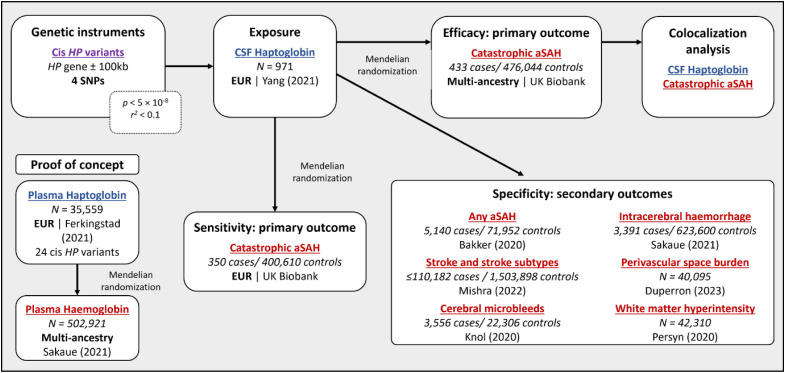 Figure 1
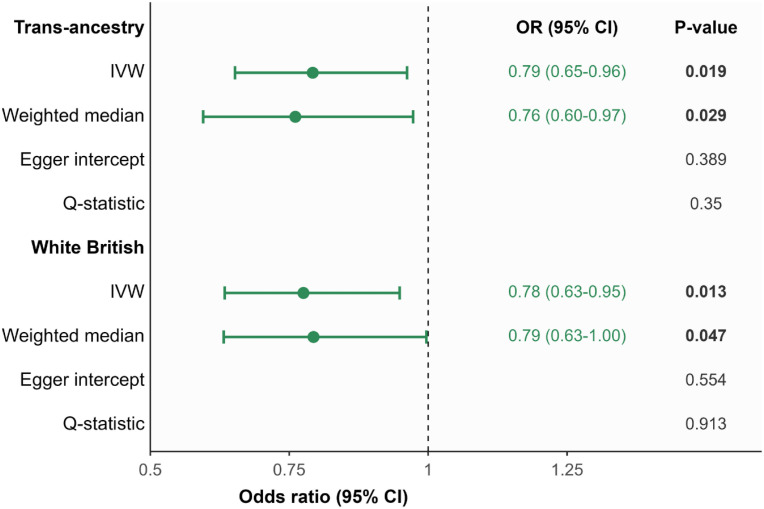 Figure 2
 Figure 3
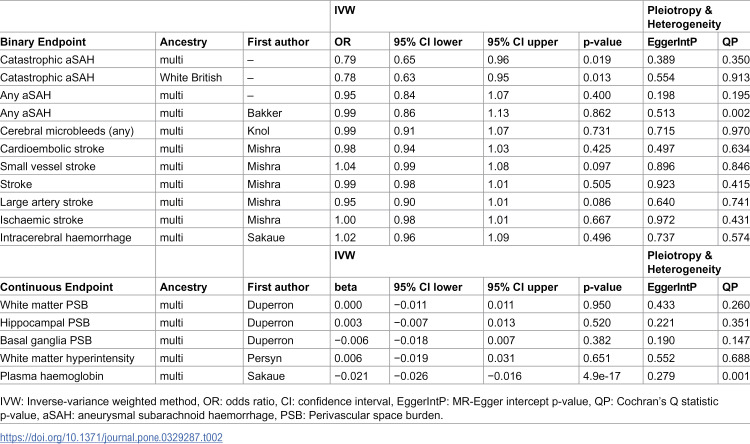 Figure 4
Peer Reviews
No public reviews on file for this paper yet. If you reviewed it on a platform where reviews are public (OpenReview, ICLR, NeurIPS, ICML), you can paste yours below so the community can read it here.
Videos
No videos yet. Explain this paper in a talk, walkthrough, or lecture? Add one.
Taxonomy
TopicsIntracranial Aneurysms: Treatment and Complications · Intracerebral and Subarachnoid Hemorrhage Research · Traumatic Brain Injury and Neurovascular Disturbances