Frenemy: adaptive temperate phage_SAP_1432 supports Staphylococcus aureus survival in changing temperatures
Ting-ting Liu, Peng-cheng Gao, Jie-wen Cui, Wu-bin Wang, Fu-ying Zheng, Xue-rui Li, Yue-feng Chu

TL;DR
A heat-resistant phage helps Staphylococcus aureus survive better at high temperatures, showing how phages can benefit bacteria during climate change.
Contribution
This study reveals that a temperate phage can enhance bacterial survival and thermal performance in changing temperature conditions.
Findings
Phage_SAP_1432 increased the maximal growth rate of Staphylococcus aureus Q1432 by 41.2% at specific temperatures.
The presence of phage_SAP_1432 shifted the optimal growth temperature of the host from 41.0°C to 44.1°C.
Bacteria co-cultured with phage_SAP_1432 survived at temperatures up to 80°C, compared to 51°C without the phage.
Abstract
It is important to understand how the presence of pathogens could benefit the survival of their hosts during climate change. In this study, we investigated the influence of the heat-resistant temperate phage phage_SAP_1432 on its bacterial host Staphylococcus aureus Q1432 at different temperatures. Thermal host performance curves at a multiplicity of infection of 0.001 showed that the phage killed the bacterium efficiently from 20 to 39°C and from 47 to 50°C. However, the phage resulted in a 41.2% increase in the maximal growth rate for the host bacterium from 1.53 (95% confidence interval [CI]: 1.42–1.63) in the absence of phage_SAP_1432 to 2.16 (95% CI: 2.02–2.37) in its presence, along with a shift in the optimum temperature from 41.0°C to 44.1°C. In the absence of phage, the maximum survival temperature of S. aureus Q1432 was 51°C, but after co-culture with phage_SAP_1432, a few…
Genes, proteins, chemicals, diseases, species, mutations and cell lines named across the full text — each resolved to its canonical identifier and authoritative record.
Click any figure to enlarge with its caption.
 Figure 1
 Figure 2
 Figure 3
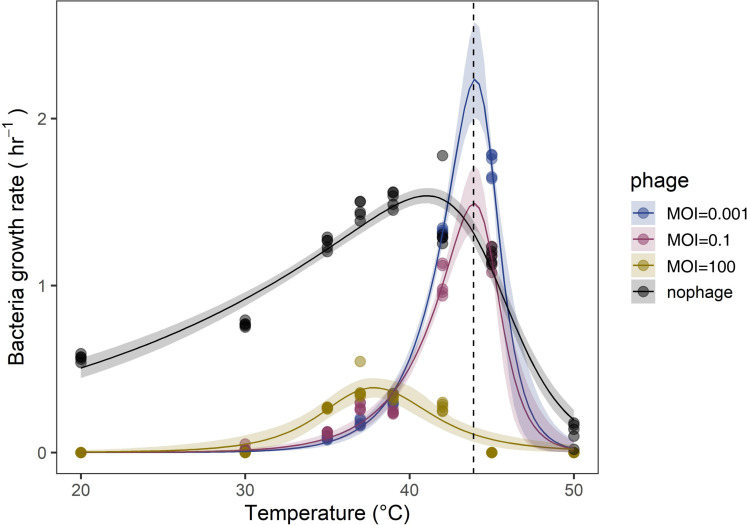 Figure 4
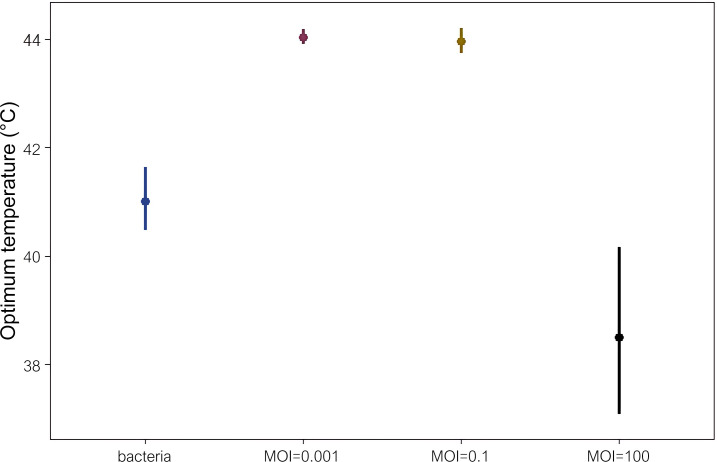 Figure 5
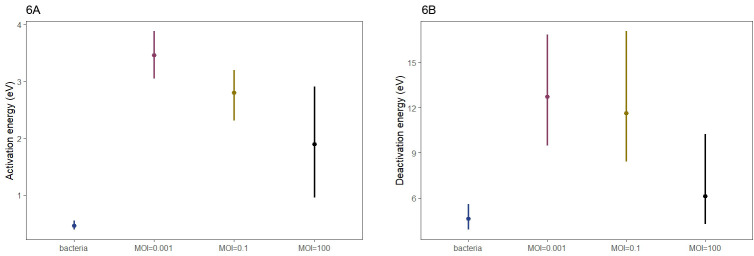 Figure 6
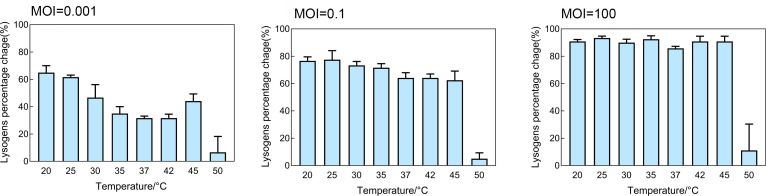 Figure 7
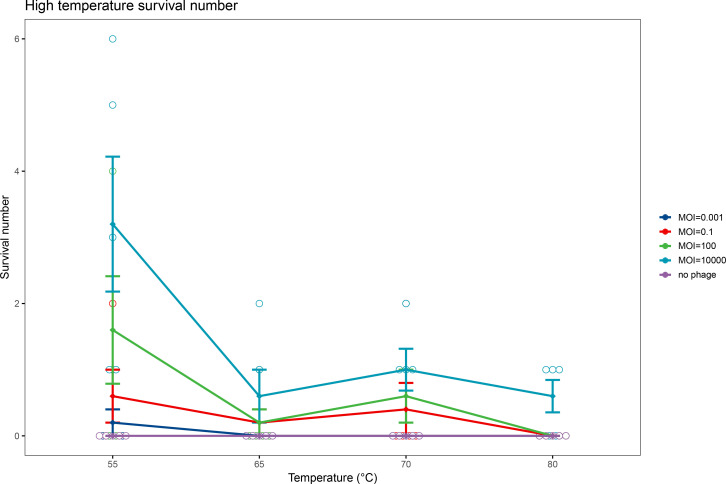 Figure 8
Peer Reviews
No public reviews on file for this paper yet. If you reviewed it on a platform where reviews are public (OpenReview, ICLR, NeurIPS, ICML), you can paste yours below so the community can read it here.
Videos
No videos yet. Explain this paper in a talk, walkthrough, or lecture? Add one.
Taxonomy
TopicsBacteriophages and microbial interactions · Genomics and Phylogenetic Studies · Microbial infections and disease research