Immunological and inflammatory responses in the kidneys in experimental acanthamoebiasis
Karolina Kot, Patrycja Tomasiak, Maciej Tarnowski, Danuta Kosik-Bogacka, Natalia Łanocha-Arendarczyk

TL;DR
This study explores how the immune system responds in the kidneys during Acanthamoeba infection in mice, revealing changes in inflammation-related proteins and cytokines.
Contribution
The study identifies specific immune response patterns in the kidneys of infected mice, offering new insights into acanthamoebiasis pathophysiology.
Findings
Early infection in immunocompetent mice showed elevated IFNγ, TNFα, PTGS2/COX-2, and IL-17A mRNA levels.
Late-stage infection in immunocompetent mice showed decreased levels of NLRP3, IL-1β, IL-10, and several cytokines.
Immunosuppressed mice showed higher NLRP3, PTGS2/COX-2, and cytokine expressions but lower IL-18 in infected kidneys.
Abstract
The pathomechanisms of Acanthamoeba spp. infection are still poorly understood. The aim of the study was to determine the expression of the NLR family pyrin domain-containing protein 3 (NLRP3), prostaglandin-endoperoxide synthase 2 (PTGS2, commonly known as cyclooxygenase-2, COX-2), and various cytokines in the kidneys of immunocompetent and immunosuppressed mice infected with Acanthamoeba sp. (T16 genotype). The proteins were analyzed by quantitative reverse transcription PCR. In immunocompetent mice, we observed increased mRNA levels of interferon gamma (IFNγ), tumor necrosis factor alpha (TNFα), PTGS2/COX-2, and interleukin (IL)-17A at the beginning of infection. While in the late stages, we found decreased levels of NLRP3, IL-1β, IL-10, IL-17A, IL-21, IL-23, IFNγ, TNFα, and macrophage inflammatory protein-2 (MIP-2) in the kidneys of infected hosts compared to uninfected ones. In…
Genes, proteins, chemicals, diseases, species, mutations and cell lines named across the full text — each resolved to its canonical identifier and authoritative record.
Click any figure to enlarge with its caption.
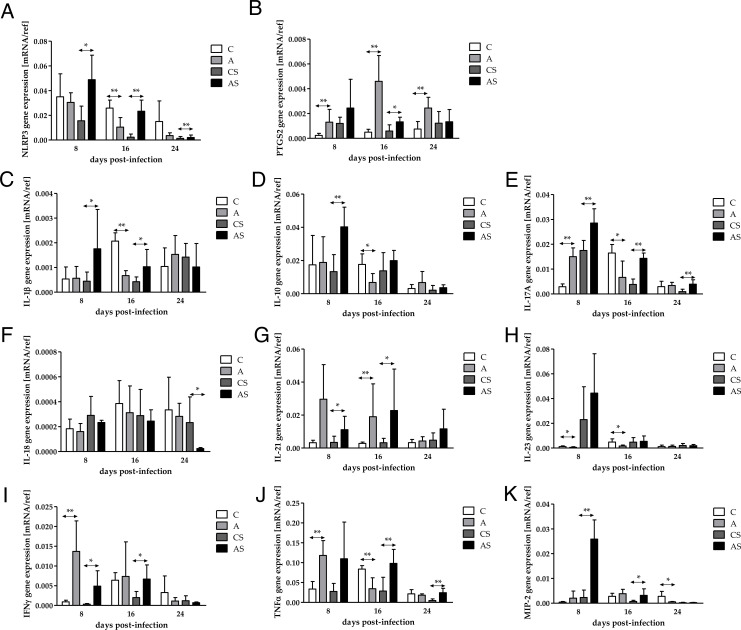 Figure 1
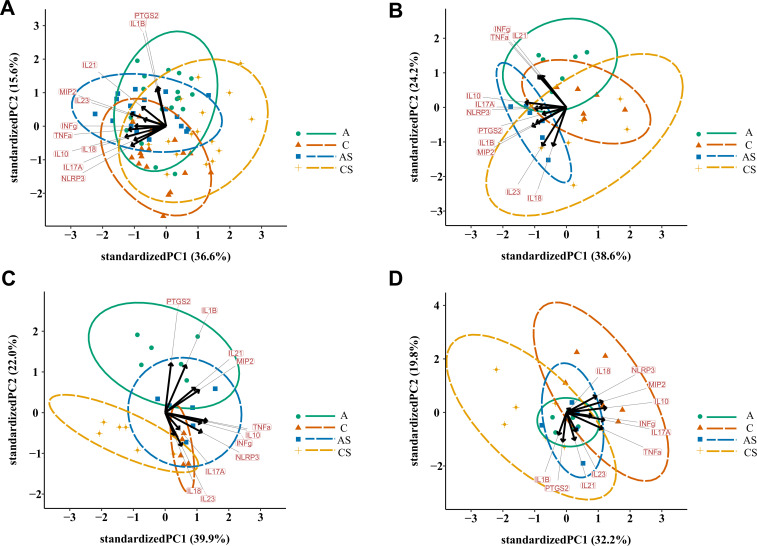 Figure 2
Peer Reviews
No public reviews on file for this paper yet. If you reviewed it on a platform where reviews are public (OpenReview, ICLR, NeurIPS, ICML), you can paste yours below so the community can read it here.
Videos
No videos yet. Explain this paper in a talk, walkthrough, or lecture? Add one.
Taxonomy
TopicsLegionella and Acanthamoeba research · Heme Oxygenase-1 and Carbon Monoxide · Vibrio bacteria research studies